

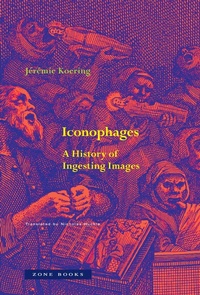
Iconophages
Description

An unprecedented art-historical account of practices of image ingestion from ancient Egypt to the twentieth century Eating and drinking images may seem like an anomalous notion but, since antiquity, in the European and Mediterranean worlds, people have swallowed down frescoes, icons, engravings, eucharistic hosts stamped with images, heraldic wafers, marzipan figures, and other sculpted dishes. Either specifically made for human consumption or diverted from their original purpose so as to be ingested, these figured artifacts have been not only gazed upon but also incorporated-taken into the body-as solids or liquids. How can we explain such behavior? Why take an image into one's own body, devouring it at the risk of destroying it, consuming rather than contemplating it wisely from a distance? What structures of the imagination underlie and justify these desires for incorporation? What are the visual configurations offered up to the mouth, and what are their effects? What therapeutic, religious, symbolic, and social functions can we attribute to these forms of relations with icons? These are a few of the questions raised in this investigation into iconophagy. Iconophages aims to retrace, for the first time, the history of iconophagy. Jérémie Koering examines this unexplored facet of the history of images through an interdisciplinary approach that ranges across art history, cultural and material history, anthropology, philosophy, and the history of the body and the senses. He analyzes the human investment, in terms of culture and imagination, at stake in this seemingly paradoxical way of experiencing images. Beyond the hidden knowledge unearthed here, these pages bring to light a new way of understanding images, just as they illuminate the occasionally outlandish relations we maintain with them.
More details
Other editions
Additional editions
Persons
Content
- Cover
- Contents
- Introduction: Amuse-Bouche
- I. Ingesting Images
- Eating and Drinking the Gods
- Ingesting Images in the Christian World
- A Taste of Miracle
- II. Imagining Ingestion
- The Body Connected
- Mystical Incorporations
- Ruminatio
- Devouring
- III. Sharing Images
- The Sacrificed Image
- Sweet Holy Days
- Eating the Family
- Political In(di)gestion
- A Consummate Art for Consumption
- Conclusion: A Short Sweet
- Acknowledgments
- Notes
- Bibliography
- Index
