

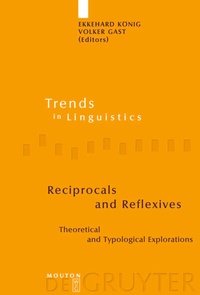
Reciprocals and Reflexives
Description

This collection of original papers is a representative survey of recent theoretical and cross-linguistic work on reciprocity and reflexivity. Its most remarkable feature is its combination of formal approaches, case studies on individual languages and broad typological surveys in one volume, showing that the interaction of formal approaches to grammar and typology may lead to new insights and results for both fields.
Among the major issues addressed in this volume are the following: How can our current knowledge about the space and limits of variation in the relevant domain be captured in a structural typology of reciprocity? What light can such a typology shed on the facts of particular languages or groups of languages (e.g. Austronesian)? How can recent descriptive and typological insights be incorporated into a revised and more adequate version of the Binding Theory? How do verbal semantics, argument structure and reciprocal markers interact? How can we explain the pervasive patterns of ambiguity observable in these two domains, especially the use of the same forms both as reflexive and reciprocal markers? What are the major sources in the historical development of reciprocal markers?
This combination of large-scale typological surveys with in-depth studies of particular languages provides new answers to old questions and raises important new questions for future research.
More details
Other editions
Additional editions
Persons
Content
- Frontmatter
- Contents
- Abbreviations and glosses
- Reciprocity and reflexivity - description, typology and theory
- Reciprocal constructions: Towards a structural typology
- Constructions expressing middle, reflexive and reciprocal situations in some Oceanic languages
- The intersection between reflexives and reciprocals: A grammaticalization perspective
- Reflexive encoding of reciprocity: Cross-linguistic and language-internal variation
- Distinguishing reciprocals from reflexives in Kuuk Thaayorre
- Valency-changing operations in Wolof and the notion of "co-participation"
- On reciprocal and reflexive uses of anaphors in German and other European languages
- Thoughts on the origin, progress, and pronominal status of reciprocal forms in Germanic, occasioned by those of Bavarian
- Irreducible symmetry in reciprocal constructions
- The inherently reflexive and the inherently reciprocal predicate in Hungarian: Each to their own argument structure
- The Syntax of Reciprocal Verbs: An Overview
- Anaphoric dependencies: How are they encoded? Towards a derivation-based typology
- Domain restrictions on reciprocal interpretation
- A binding theory exempt anaphor
- From intensive to reflexive: The prosodic factor
- Backmatter
