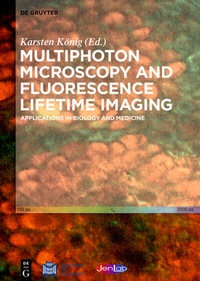
Multiphoton Microscopy and Fluorescence Lifetime Imaging
Description

This monograph focuses on modern femtosecond laser microscopes for two photon imaging and nanoprocessing, on laser tweezers for cell micromanipulation as well as on fluorescence lifetime imaging (FLIM) in Life Sciences. The book starts with an introduction by Dr. Wolfgang Kaiser, pioneer of nonlinear optics and ends with the chapter on clinical multiphoton tomography, the novel high resolution imaging technique. It includes a foreword by the nonlinear microscopy expert Dr. Colin Sheppard.
Contents
Part I: Basics
Brief history of fluorescence lifetime imaging
The long journey to the laser and its use for nonlinear optics
Advanced TCSPC-FLIM techniques
Ultrafast lasers in biophotonics
Part II: Modern nonlinear microscopy of live cells
STED microscopy: exploring fluorescence lifetime gradients for super-resolution at reduced illumination intensities
Principles and applications of temporal-focusing wide-field two-photon microscopy
FLIM-FRET microscopy
TCSPC FLIM and PLIM for metabolic imaging and oxygen sensing
Laser tweezers are sources of two-photon effects
Metabolic shifts in cell proliferation and differentiation
Femtosecond laser nanoprocessing
Cryomultiphoton imaging
Part III: Nonlinear tissue imaging
Multiphoton Tomography (MPT)
Clinical multimodal CARS imaging
In vivo multiphoton microscopy of human skin
Two-photon microscopy and fluorescence lifetime imaging of the cornea
Multiscale correlative imaging of the brain
Revealing interaction of dyes and nanomaterials by multiphoton imaging
Multiphoton FLIM in cosmetic clinical research
Multiphoton microscopy and fluorescence lifetime imaging for resection guidance in malignant glioma surgery
Non-invasive single-photon and multi-photon imaging of stem cells and cancer cells in mouse models
Bedside assessment of multiphoton tomography
More details
Other editions
Additional editions