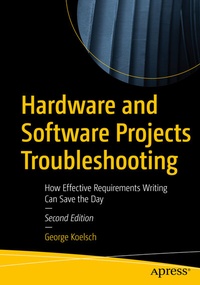
Hardware and Software Projects Troubleshooting
Description

Learn how to create good requirements when designing hardware and software systems. While this book emphasizes writing traditional "shall" statements, it also provides guidance on use case design and creating user stories in support of agile methodologies. The book surveys modelling techniques and various tools that support requirements collection and analysis. You'll learn to manage requirements, including discussions of document types and digital approaches using spreadsheets, generic databases, and dedicated requirements tools. Good, clear examples are presented, many related to real-world work the author has performed during his career. More importantly, you will learn how these techniques can prevent the problems that occur during requirements development. Most of all, you will learn how good requirements governance will greatly increase the success of development projects by getting all people involved to eliminate the adverse impacts to requirements throughout the developmentlifecycle.
Hardware and Software Projects Troubleshooting covers techniques for defining user needs, so you can determine which combination of approaches to use for your projects. You'll also learn how to analyze the different development methodologies so that you can determine the advantages and disadvantages of different requirements approaches and implement them correctly as your needs evolve. Unlike most requirements books, this one teaches writing both hardware and software requirements because many projects include both areas. To exemplify this approach, two example projects are developed throughout the book, one focusing on hardware, and the other on software.
What You Will Learn
- Focus on how to eliminate or mitigate requirements problems
- Understand the 14 techniques for capturing all requirements
- Address software and hardware needs; because most projects involve both
- Ensure all statements meetthe 16 attributes of a good requirement
- Differentiate the 19 different functional types of requirements, and the 31 non-functional types
- Write requirements properly based on extensive examples of good 'shall' statements, user stories, and use cases
- Employ modelling techniques to mitigate the imprecision of words
- Install requirements governance to significantly improve project success
Who This Book Is For
Requirements engineers who want to improve and master their craft, as well as students and those employed in government or other organizations at all levels.More details
Other editions
Additional editions