

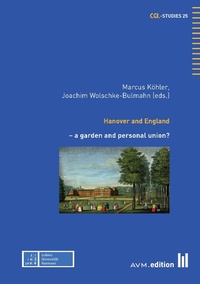
Hanover and England
- a garden and personal union?
1st Edition
Published on 31. July 2018
230 pages
978-3-96091-498-3 (ISBN)
Description

When George I, Elector of Hanover, was crowned King of England in 1714, he established a dynastic union between the two countries that endured until 1837, leaving many cultural and political accomplishments to posterity. The 300th anniversary of this union led the Institute of Landscape Architecture, Technische Universität Dresden, and the Centre of Garden and Landscape Architecture (CGL), Leibniz Universität Hannover, to take a critical look at the gardens that resulted. The symposium "Hanover and England: a union of state and garden / German and British garden culture between 1714 and today" was sponsored by the Lower Saxonian Ministry of Science and Culture. The resulting papers dealt with far more than garden history, addressing as well the background and channels by which ideas on art, agriculture, commerce, technology, literature and politics were exchanged. Given the encyclopedic interests of late 18th century thinkers, it was necessary to invite several academic disciplines to participate, in order to describe and discuss the cultural transfer between Great Britain and Hanover. The transfer of horticultural and artistic ideas very often flourished in the 19th century at different places. For this reason, the conference focused on two key aspects: the Hanoverian-British exchange between 1714 and 1837 (the period of the actual royal union) and the Anglo-German relations that endure to the present day.
Als Georg I., Kurfürst von Hannover, 1714 zum König von England gekrönt wurde, begründete dies eine Personalunion zwischen den beiden Ländern, die bis 1837 bestand und der Nachwelt eine Vielzahl kultureller und politischer Errungenschaften hinterließ. Das 300-jährige Jubiläum dieses Zusammenschlusses nahmen das Institut für Landschaftsarchitektur der Technischen Universität Dresden und das Zentrum für Gartenkunst und Landschaftsarchitektur (CGL) der Leibniz Universität Hannover zum Anlass, sich kritisch mit den in dieser Zeit entstandenen Gärten auseinanderzusetzen. Das Symposium "Hanover and England: a union of state and garden / German and British garden culture between 1714 and today" wurde vom Niedersächsischen Ministerium für Wissenschaft und Kultur gefördert. Die Beiträge beschäftigten sich nicht nur mit Gartengeschichte, sondern widmeten sich auch dem Austausch von Ideen zu Kunst, Landwirtschaft, Handel, Technologie, Literatur und Politik. So schien es sinnvoll, unterschiedliche akademische Disziplinen zur Teilnahme einzuladen, um den kulturellen Transfer zwischen Großbritannien und Hannover zu untersuchen und zu diskutieren. Die Konferenz konzentrierte sich auf zwei Schlüsselaspekte: den hannoverisch-britischen Austausch zwischen 1714 und 1837 (die Zeit der Personalunion) und die deutsch-englischen Beziehungen, die bis heute andauern.
Als Georg I., Kurfürst von Hannover, 1714 zum König von England gekrönt wurde, begründete dies eine Personalunion zwischen den beiden Ländern, die bis 1837 bestand und der Nachwelt eine Vielzahl kultureller und politischer Errungenschaften hinterließ. Das 300-jährige Jubiläum dieses Zusammenschlusses nahmen das Institut für Landschaftsarchitektur der Technischen Universität Dresden und das Zentrum für Gartenkunst und Landschaftsarchitektur (CGL) der Leibniz Universität Hannover zum Anlass, sich kritisch mit den in dieser Zeit entstandenen Gärten auseinanderzusetzen. Das Symposium "Hanover and England: a union of state and garden / German and British garden culture between 1714 and today" wurde vom Niedersächsischen Ministerium für Wissenschaft und Kultur gefördert. Die Beiträge beschäftigten sich nicht nur mit Gartengeschichte, sondern widmeten sich auch dem Austausch von Ideen zu Kunst, Landwirtschaft, Handel, Technologie, Literatur und Politik. So schien es sinnvoll, unterschiedliche akademische Disziplinen zur Teilnahme einzuladen, um den kulturellen Transfer zwischen Großbritannien und Hannover zu untersuchen und zu diskutieren. Die Konferenz konzentrierte sich auf zwei Schlüsselaspekte: den hannoverisch-britischen Austausch zwischen 1714 und 1837 (die Zeit der Personalunion) und die deutsch-englischen Beziehungen, die bis heute andauern.
More details
Other editions
Additional editions

Book
07/2018
1st Edition
Akademische Verlagsgemeinschaft München
€54.90
Shipment within 10-20 days
Content
- Cover
- Impressum
- Content
- Welcome addresses
- Klaus Hulek: Welcome Address by the Vice President for Research, Leibniz University of Hannover
- Simon McDonald: Welcome address by the British Ambassador to Germany
- Stefan Schostok: Welcome address by the Lord Mayor of the City of Hannover
- Annette Schwandner: Welcome address by the Ministry of Science and Culture, Lower Saxony
- Introduction
- Marcus Köhler and Joachim Wolschke-Bulmahn: Introductory Remarks
- Part I: Hanover and England. The period of the personal union (1714 to 1837)
- David Jacques: Between traditions: The Hanoverians' taste in gardens
- Hansjörg Küster: Land reform during the period of the Personal Union
- Marcus Köhler: "The whole of this country is not unlike a well-kept garden" - eighteenth-century Hanoverian travellers to England and their role in propagating the landscape garden
- Sophie von Schwerin: Science gardens - pleasure gardens. On the connection between the Royal Botanic Gardens, Kew, and Berggarten in Herrenhausen
- Clarissa Campbell Orr: The Botanising Court: Queen Charlotte and Mary Delany
- John Edmondson: "Foreign herbs surpriz'd in English ground": the life and work of Georg D. Ehret (1708-1770)
- Bernd Adam: The Great Fountain at Herrenhausen - innovations from England enabled the creation of the highest water jet in Europe
- Carsten Neumann: The house Bothmer in Klütz - An English-Dutch manor in Mecklenburg
- Part II: Germany and England. Reflexion and reception from 1837 until today
- Todd Longstaffe-Gowan: The unaffected Englishness of Queen Caroline's gardens at Kensington Palace
- Gert Groening: Bio-aesthetic planning - a conjecture about an imperialistic garden cultural relation between the German Empire and independent India via the British Empire
- Sigrid Thielking: On the construct 'English garden' - perception and myth in garden literature
