

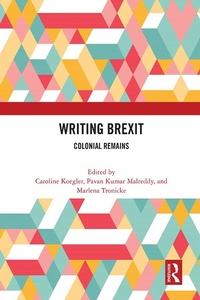
Writing Brexit
Colonial Remains
1st Edition
Published on 29. June 2021
148 pages
978-1-000-39923-3 (ISBN)
Description

Drawing from a rich corpus of British cultural production and postcolonial theory, this book positions Brexit in the historical nexus of colonialism, colonial nostalgia, and the rise of narcissistic nationalism in contemporary Europe.
This collection moves away from existing literary discourses framing Brexit as a 'novel' event that ushered in a new genre of British fiction. It challenges the hackneyed public discourses that depict the results of the 2016 Referendum as the catalyst of regional instability as well as sociopolitical emergency in Europe. This book traces and critiques populist myth-making in the current United Kingdom through engagement with a wide range of literary and cultural productions, and reminds readers of the proleptic potential of postcolonial theorists and authors - Paul Gilroy, Austin Clarke, Mohsin Hamid, Ali Smith, to name a few - in identifying the residual ideologies of imperialism in the lead up to and after the Brexit campaign. The articles featured here extend Brexit's figurative geography towards India, Britain, Pakistan, Ireland, Palestine, Barbados, and Eastern Europe, amongst others. They engage with films, media representations, and public discourses alongside more traditional genres such as the novel and stage productions. With a diversified approach to scholarly fields such as postcolonial literary and cultural studies, the book offers new insights into Brexit's diverse histories not only in academic discourses, but also in the socio-political public sphere at large.
The chapters in this book were originally published as a special issue of the Journal of Postcolonial Writing.
This collection moves away from existing literary discourses framing Brexit as a 'novel' event that ushered in a new genre of British fiction. It challenges the hackneyed public discourses that depict the results of the 2016 Referendum as the catalyst of regional instability as well as sociopolitical emergency in Europe. This book traces and critiques populist myth-making in the current United Kingdom through engagement with a wide range of literary and cultural productions, and reminds readers of the proleptic potential of postcolonial theorists and authors - Paul Gilroy, Austin Clarke, Mohsin Hamid, Ali Smith, to name a few - in identifying the residual ideologies of imperialism in the lead up to and after the Brexit campaign. The articles featured here extend Brexit's figurative geography towards India, Britain, Pakistan, Ireland, Palestine, Barbados, and Eastern Europe, amongst others. They engage with films, media representations, and public discourses alongside more traditional genres such as the novel and stage productions. With a diversified approach to scholarly fields such as postcolonial literary and cultural studies, the book offers new insights into Brexit's diverse histories not only in academic discourses, but also in the socio-political public sphere at large.
The chapters in this book were originally published as a special issue of the Journal of Postcolonial Writing.
Reviews / Votes
These excellent essays are an important intervention in understanding the cultural politics of the Brexit phenomenon. Multifarious in their starting points and focus, they hone in on the cultural nostalgias, the politics of race and nation, and the long-term historical forces which have shaped the UK's departure from the European project.Colin Graham, Professor and Dean of the Faculty of Arts, Celtic Studies & Philosophy, Maynooth University, Ireland
Drawing on fiction, film, theatre and other cultural texts, these twelve postcolonial scholars give unique insights into the resurgent colonialism and nostalgia for Britain's imperial past that underpinned the decision to leave Europe in the 2016 Brexit referendum, and its aftermath.
Janet Wilson and Chris Ringrose, editors, Journal of Postcolonial Writing
An impressive lineup of young and veteran postcolonial scholars turn the outward colonial gaze inwards, resulting in an original set of perspectives on the (textual) forms and (historical) formations of Britain's exit from the EU.
Lars Eckstein, Professor of Anglophone Literatures Cultures, University of Potsdam, Germany
More details
Edition
1. Auflage
Language
English
Place of publication
London
United Kingdom
Publishing group
Taylor & Francis Ltd
Target group
College/higher education
ISBN-13
978-1-000-39923-3 (9781000399233)
Copyright in bibliographic data and cover images is held by Nielsen Book Services Limited or by the publishers or by their respective licensors: all rights reserved.
Schweitzer Classification
Other editions
Additional editions
Book
09/2023
1st Edition
Routledge
€62.40
Shipment within 15-20 days
Book
06/2021
1st Edition
Routledge
€179.81
Shipment within 15-20 days
Persons
Caroline Koegler is Assistant Professor of British Literary and Cultural Studies, University of Muenster, Germany.
Pavan Kumar Malreddy teaches English Literature at Goethe University Frankfurt, Germany.
Marlena Tronicke is Assistant Professor of British Literary and Cultural Studies, University of Muenster, Germany.
Pavan Kumar Malreddy teaches English Literature at Goethe University Frankfurt, Germany.
Marlena Tronicke is Assistant Professor of British Literary and Cultural Studies, University of Muenster, Germany.
Content
Introduction: The colonial remains of Brexit: Empire nostalgia and narcissistic nationalism
Caroline Koegler, Pavan Kumar Malreddy and Marlena Tronicke
1. Ain't No Black in the (Brexit) Union Jack
Ronald Cummings
2. Warning Signs: Postcolonial Writing and the Apprehension of Brexit
John McLeod
3. Brexit literature's present absentees: Triangulating Brexit, anti-Semitism, and the Palestinian crisis
Lindsey Moore
4. 'We are all migrants through time': History and Geography in Mohsin Hamid's Exit West
Shazia Sadaf
5. 'Eastern Europeans' and BrexLit
Vedrana Velickovic
6. Imperial Pasts, Dystopian Futures, and the Theatre of Brexit
Marlena Tronicke
7. The Brexit within: Mapping the Rural and the Urban in Contemporary British Fiction
Birte Heidemann
8. Writing Back to Brexit: Transcultural Intertextuality, Refugees, and the Colonial Archive from Chaucer to Kipling
Jan Rupp
9. (Post)colonial friendships and Empire 2.0: A Brexit reading of Victoria & Abdul
Clelia Clini
Caroline Koegler, Pavan Kumar Malreddy and Marlena Tronicke
1. Ain't No Black in the (Brexit) Union Jack
Ronald Cummings
2. Warning Signs: Postcolonial Writing and the Apprehension of Brexit
John McLeod
3. Brexit literature's present absentees: Triangulating Brexit, anti-Semitism, and the Palestinian crisis
Lindsey Moore
4. 'We are all migrants through time': History and Geography in Mohsin Hamid's Exit West
Shazia Sadaf
5. 'Eastern Europeans' and BrexLit
Vedrana Velickovic
6. Imperial Pasts, Dystopian Futures, and the Theatre of Brexit
Marlena Tronicke
7. The Brexit within: Mapping the Rural and the Urban in Contemporary British Fiction
Birte Heidemann
8. Writing Back to Brexit: Transcultural Intertextuality, Refugees, and the Colonial Archive from Chaucer to Kipling
Jan Rupp
9. (Post)colonial friendships and Empire 2.0: A Brexit reading of Victoria & Abdul
Clelia Clini
