

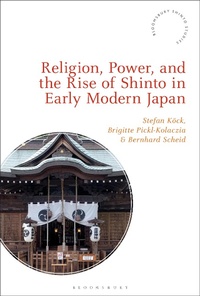
Religion, Power, and the Rise of Shinto in Early Modern Japan
1st Edition
Published on 8. April 2021
304 pages
978-1-350-18107-6 (ISBN)
Description

This book sheds new light on the relationship between religion and state in early modern Japan, and demonstrates the growing awareness of Shinto in both the political and the intellectual elite of Tokugawa Japan, even though Buddhism remained the privileged means of stately religious control.
The first part analyses how the Tokugawa government aimed to control the populace via Buddhism and at the same time submitted Buddhism to the sacralization of the Tokugawa dynasty. The second part focuses on the religious protests throughout the entire period, with chapters on the suppression of Christians, heterodox Buddhist sects, and unwanted folk practitioners. The third part tackles the question of why early Tokugawa Confucianism was particularly interested in "Shinto" as an alternative to Buddhism and what "Shinto" actually meant from a Confucian stance.
The final part of the book explores attempts to curtail the institutional power of Buddhism by reforming Shinto shrines, an important step in the so called "Shintoization of shrines" including the development of a self-contained Shinto clergy.
The first part analyses how the Tokugawa government aimed to control the populace via Buddhism and at the same time submitted Buddhism to the sacralization of the Tokugawa dynasty. The second part focuses on the religious protests throughout the entire period, with chapters on the suppression of Christians, heterodox Buddhist sects, and unwanted folk practitioners. The third part tackles the question of why early Tokugawa Confucianism was particularly interested in "Shinto" as an alternative to Buddhism and what "Shinto" actually meant from a Confucian stance.
The final part of the book explores attempts to curtail the institutional power of Buddhism by reforming Shinto shrines, an important step in the so called "Shintoization of shrines" including the development of a self-contained Shinto clergy.
More details
Series
Edition
1. Auflage
Language
English
Place of publication
London
United Kingdom
Publishing group
Bloomsbury Publishing PLC
Target group
College/higher education
Illustrations
10 bw illus
ISBN-13
978-1-350-18107-6 (9781350181076)
Copyright in bibliographic data and cover images is held by Nielsen Book Services Limited or by the publishers or by their respective licensors: all rights reserved.
Schweitzer Classification
Other editions
Additional editions
Stefan Koeck | Brigitte Pickl-Kolaczia | Bernhard Scheid
Religion, Power, and the Rise of Shinto in Early Modern Japan
Book
11/2022
Bloomsbury Academic
€45.30
Shipment within 15-20 days
Persons
Stefan Köck is a postdoctoral research fellow at the Austrian Academy of Sciences, Austria.
Brigitte Pickl-Kolaczia is a doctoral candidate at Austrian Academy of Sciences, Austria.
Bernhard Scheid is a senior researcher at the Austrian Academy of Sciences, Austria.
Brigitte Pickl-Kolaczia is a doctoral candidate at Austrian Academy of Sciences, Austria.
Bernhard Scheid is a senior researcher at the Austrian Academy of Sciences, Austria.
Content
Introduction: Tokugawa Religious Orthopraxy and the Phenomenon of Domain Shinto, Bernhard Scheid
Part 1: Tokugawa Orthopraxy
1. Anti-Christian Temple Certification (terauke) in Early Modern Japan: Establishment, Practice, and Challenges, Nam-lin Hur (University of British Columbia, Canada)
2. Ieyasu's Posthumous Title and the Tokugawa Discourse on "Divine Country," Sonehara Satoshi (Tohoku University, Japan)
Part 2: Unwanted Religious Groups
3. Anti-Christian Measures and Religious Institutions in the Nagasaki Port City in the Early Edo Period (1614-1644), Carla Tronu (University of Kyoto, Japan)
4. When the Lotus went Underground: the Nichiren Buddhist Fujufuse Movement and its Early Modern Persecution, Jacqueline I. Stone (Princeton University, USA)
5. "Deviant Practices" and "Strange Acts": Late Tokugawa Judicial Perspectives on Heteropraxy, Kate Wildman Nakai (Sophia University, Japan)
Part 3: Intellectual Challenges
6. Shinto as a Quasi-Confucian Ideology, Inoue Tomokatsu (Saitama University, Japan)
7. Buddhist-Confucian Polemics and the Position of Shinto, W.J. Boot (Leiden University, the Netherlands)
8. Ikeda Mitsumasa and Confucian Ritual, James McMullen (University of Oxford, UK)
9. Calendars and Graves: Shibukawa Harumi's Critique of Hoshina Masayuki and Yamazaki Ansai, Hayashi Makoto (Aichi Gakuin University, Japan)
Part 4: Institutional Challenges
10. Shinto in the 1660s and 1670s: The Shrine Clauses of 1665 as an Expression of Domain Shinto,
Mark Teeuwen (University of Oslo, Norway)
11. Domain Shinto and shinto-uke in Okayama-han, Stefan Köck (Austrian Academy of Sciences, Austria)
12. "Kami is kami, Buddha is Buddha": Religious Policies in Mito Domain in the Later 17th Century,
Brigitte Pickl-Kolaczia (Austrian Academy of Sciences, Austria)
13. Shinto Priests and the Yoshida in Izumi Province, Yannick Bardy (University of Lille, France)
14. Conflicts over Shrine Priests' Faith and Affiliation: the Shirakawa, Yoshida, and Hirata Atsutane,
Anne Walthall (UC Irvine, USA)
Bibliography
Index
Part 1: Tokugawa Orthopraxy
1. Anti-Christian Temple Certification (terauke) in Early Modern Japan: Establishment, Practice, and Challenges, Nam-lin Hur (University of British Columbia, Canada)
2. Ieyasu's Posthumous Title and the Tokugawa Discourse on "Divine Country," Sonehara Satoshi (Tohoku University, Japan)
Part 2: Unwanted Religious Groups
3. Anti-Christian Measures and Religious Institutions in the Nagasaki Port City in the Early Edo Period (1614-1644), Carla Tronu (University of Kyoto, Japan)
4. When the Lotus went Underground: the Nichiren Buddhist Fujufuse Movement and its Early Modern Persecution, Jacqueline I. Stone (Princeton University, USA)
5. "Deviant Practices" and "Strange Acts": Late Tokugawa Judicial Perspectives on Heteropraxy, Kate Wildman Nakai (Sophia University, Japan)
Part 3: Intellectual Challenges
6. Shinto as a Quasi-Confucian Ideology, Inoue Tomokatsu (Saitama University, Japan)
7. Buddhist-Confucian Polemics and the Position of Shinto, W.J. Boot (Leiden University, the Netherlands)
8. Ikeda Mitsumasa and Confucian Ritual, James McMullen (University of Oxford, UK)
9. Calendars and Graves: Shibukawa Harumi's Critique of Hoshina Masayuki and Yamazaki Ansai, Hayashi Makoto (Aichi Gakuin University, Japan)
Part 4: Institutional Challenges
10. Shinto in the 1660s and 1670s: The Shrine Clauses of 1665 as an Expression of Domain Shinto,
Mark Teeuwen (University of Oslo, Norway)
11. Domain Shinto and shinto-uke in Okayama-han, Stefan Köck (Austrian Academy of Sciences, Austria)
12. "Kami is kami, Buddha is Buddha": Religious Policies in Mito Domain in the Later 17th Century,
Brigitte Pickl-Kolaczia (Austrian Academy of Sciences, Austria)
13. Shinto Priests and the Yoshida in Izumi Province, Yannick Bardy (University of Lille, France)
14. Conflicts over Shrine Priests' Faith and Affiliation: the Shirakawa, Yoshida, and Hirata Atsutane,
Anne Walthall (UC Irvine, USA)
Bibliography
Index
