

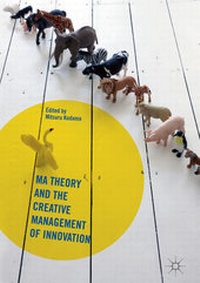
Ma Theory and the Creative Management of Innovation
1st Edition
Published on 17. October 2017
296 pages
978-1-137-59194-4 (ISBN)
Description

This book focuses on the core theoretical concept of 'Ma thinking' - an idea that serves as springboard for the thoughts and actions of distinguished practitioners, innovators, and researchers. The theoretical and practical importance of the Ma concept in new innovation activities lies in the thinking and activities of the leading practitioners. However, there is little academic research clarifying these characteristic dynamic transition mechanisms and the synthesis of diverse paradoxes through recursive activities between formal and informal organizations to achieve integration of dissimilar knowledge.
Mitsuru Kodama is a Professor of Innovation and Technology Management in the College of Commerce and Graduate School of Business Administration at Nihon
University, Japan.
More details
Other editions
Additional editions
Mitsuru Kodama
Ma Theory and the Creative Management of Innovation
Book
10/2017
Palgrave MacMillan
€106.99
Shipment within 10-20 days
Content
- Intro
- Preface and Acknowledgement
- Contents
- List of Figures
- List of Tables
- Chapter 1: "Ma" and Innovation Management
- 1.1 Ma Thinking: What Is "Ma?"
- 1.2 Examples of Ma in the Business Workplace
- 1.2.1 Apple and Cisco Systems
- 1.2.2 Knowledge Gained from Existing Research and New Challenges Ahead
- 1.3 Ma in Architecture and the Arts
- 1.3.1 Ma in Paintings
- 1.3.2 Ma in Architecture
- 1.3.3 Ma in Japanese Architecture: The Traditional Tea Room
- 1.4 Constructing a Theoretical Framework of Ma
- References
- Chapter 2: The Five Types of Ma Thinking and Five Architect Capabilities: Theoretical Concepts
- 2.1 The Theoretical Concept of Ma (1): Dynamic "Recursive Practice Activities" to Generate Ideas and Demonstrate Serendipity
- 2.2 The Theoretical Concept of Ma (2): The Five Architect Capabilities: Context, Ba, Human Networks, Boundaries and Willpower
- 2.3 The Theoretical Concept of Ma (3): Ma Thinking
- 2.4 The Theoretical Concept of Ma (4): The Formation of "Ba" and Communities Originating in "Ma"
- 2.5 Research on Ma that Transcend Disparate Academic Fields
- References
- Chapter 3: Ma Thinking and Innovation in Global High Tech Companies: The Lessons of Business Model Innovation in Apple and Cisco Systems
- 3.1 Ma Thinking in Innovative Companies
- 3.1.1 Apple and Cisco Systems
- 3.1.2 Balance Between Efficiency and Creativity
- 3.2 Dynamic "Recursive Practice Activities" to Generate Ideas and Demonstrate Serendipity
- 3.3 Five Architect Capabilities that Create Innovation: Context, Ba, Human Networks, Boundaries and Willpower
- 3.3.1 Context Architect Capability
- 3.3.2 Ba Architect Capability
- 3.3.3 Human Network Architect Capability
- 3.3.4 Boundaries Linking Capability
- 3.3.5 Willpower Architect Capability
- 3.3.6 The Five Architect Capabilities and Ma Thinking
- 3.4 Ma Thinking at Apple and Cisco
- 3.4.1 Ma of Context
- 3.4.2 Ma of Space-Time
- 3.4.3 Mental Ma
- 3.4.4 Ma of Dissimilars
- 3.4.5 Ma of the Spirit
- 3.5 Summary of the Chapter
- References
- Chapter 4: Managing Serendipity Through Ma Thinking: Lessons of the Invention and Commercialization of Blue LED (Awarded the Nobel Prize in Physics)
- 4.1 Serendipitous Invention of Blue Light-Emitting Diode (LED) and Its Practical Application
- 4.2 Ma Thinking and Architect Capabilities
- 4.2.1 The Ma of Context and Context Architect Capability
- 4.2.2 The Ma of Space-Time and Ba Architect Capability
- 4.2.3 Mental Ma and Human Network Architect Capability
- 4.2.4 The Ma of Dissimilars and Ba Linking Capability
- 4.2.5 The Ma of the Spirit and Willpower Architect Capability
- 4.3 Seven Elements Promoting the Five Architect Capabilities
- 4.3.1 Dynamic Range of Knowledge Boundaries
- 4.3.2 Creative Discipline
- 4.3.3 Creative Dialogue and Creative Abrasion
- 4.3.4 Boundary Vision and Creative Doubt
- 4.3.5 Creative Self-Denial
- 4.4 Summary of the Chapter
- References
- Chapter 5: Industrial Innovation with Ma Thinking: Lessons from Singapore's Economic Development
- 5.1 Introduction
- 5.2 The Creative City and Cultural Industries
- 5.2.1 The Concentration of Service Industries and the City
- 5.2.2 Regeneration of Cities and Cultural Industries
- 5.2.3 Knowledge Externality Effects on Cities
- 5.3 Singapore's Creative Cluster Strategy
- 5.3.1 Fostering the Development of the Creative Industries
- 5.3.2 Contribution of Creative Clusters to the Advancement of Industry
- 5.4 Building a Creative Environment in Singapore and Knowledge Externality
- 5.5 Policy Vision of the Singapore Government
- 5.5.1 Analysis of the Current Status
- 5.5.2 Development of Cultural Industries and the New Industrial Strategy
- 5.5.3 Renaissance City Plan III (RCP III) for Further Development of the Cultural Industries
- 5.6 Policies for the Formation of "Creative Ba" and Ma Thinking
- 5.6.1 Creative Ba and Architect Capability
- 5.6.2 Ma Thinking and Architect Capability
- 5.7 Conclusion: Issues in Singapore's Creative Cluster Strategy
- References
- Chapter 6: Use and Reproduction of Ma in Financial Cooperative Organizations in Japan: With a Focus on Ma in Japan and Financial Cooperatives
- 6.1 Introduction
- 6.2 Social Capital: The Process of Ma and Cooperative Accumulation
- 6.2.1 Overview of Social Capital
- 6.2.2 Concept of Social Capital from the Perspective of Financial Cooperatives
- 6.2.3 Functions of Ma: Significance in Financial Cooperatives
- 6.3 Substratum of Financial Cooperatives in Japan
- 6.3.1 Moyai
- 6.3.2 Yui
- 6.3.3 Tanomoshiko and Mujinko (Najita 2009)
- 6.4 Theory of Membership Banking and Relational Ma
- 6.4.1 Characteristic Features of Financial Cooperatives
- 6.4.2 Membership Banking: Finance that Deepens Relational Ma
- 6.5 Conclusion
- References
- Chapter 7: Green Innovation Based on Ma Thinking: The Lessons of the Japanese Smart City Vision
- 7.1 The Role of Smart Cities in Health Support Services
- 7.2 Status of Smart City Construction Projects
- 7.3 Review of Precedent Research on Smart Cities
- 7.4 Theoretical Framework of Analysis
- 7.5 Yokohama Smart City Project (YSCP)
- 7.5.1 Project Missions and Basic Principles
- 7.5.2 Seven Demonstration Experiments
- Large-Scale Introduction of Renewable Energy
- Home Energy Management Systems (HEMS)
- Building Energy Management Systems (BEMS)
- Thermal Energy Management at the Local Level
- Mutual Complementarity Between Community Energy Management Systems (CEMS) and Large-Scale Power System Networks
- Next-Generation Transport Systems
- Lifestyle Reforms
- 7.5.3 Demonstration Results
- Results for CEMS
- Results for HEMS (Examples of Success in Multiple Dwellings)
- Results for BEMS
- Next-Generation Transport Systems
- 7.6 Analysis and Review: Value Co-Creation in the Yokohama Smart City Project
- 7.6.1 Toshiba's Commitment to the Project
- 7.6.2 Hitachi's Commitment to the Project
- 7.7 Implications
- References
- Chapter 8: The Ma of Maeterlinck and Ma of Japanese Maeterlinckians
- 8.1 Introduction
- 8.2 Ma in Japanese Theater
- 8.3 Drama of Maeterlinck
- 8.4 Maeterlinckians in Japan and the Theater of that Day
- 8.5 Ma in the Plays of Maeterlinck and the Maeterlinckians in Japan
- References
- Chapter 9: Ma in Traditional Japanese Theater: The Ma of Space and Ma of Time
- 9.1 Space and Time in Traditional Japanese Performing Arts
- 9.2 Creation and Transformation of the Stage
- 9.3 The Concept of Time on the Hashigakari
- 9.4 Boundary and Time
- 9.5 The Blanks in Time and Space
- 9.6 The Ephemeral Element of Floors in Performing Arts
- 9.7 The Kabuki Goya: Birth of the Indoor Theater
- 9.8 Normalization of the Hanamichi
- 9.9 The Relationship Between the Audience and the Hanamichi
- References
- Chapter 10: Ma Thinking in Architectural Space, Mentality and Action: The Impact of Ma Thinking on Lifestyle Design
- 10.1 Introduction
- 10.2 Places of Cultural Creation with Ma in a Region or Village
- 10.3 Creation of New Places with Ma with Familiarity and Connections
- 10.4 Actual Creation of a Village Center in Depopulated Mountainous Areas with Ma that Connects People
- 10.5 Creating Opportunities for Attracting People from Wider Areas
- 10.6 Continuity from a Space with a Public Nature that Nurtures the Development of Actors to a "Box"
- 10.7 Conclusion
- References
- Chapter 11: Comparative Case Studies and New Implications
- 11.1 Knowledge from Case Studies
- 11.1.1 Knowledge of Ma Thinking Observed in Art and Architecture
- 11.1.2 Knowledge of Ma Thinking in the Areas of Business and Management, Industrial Organization Theory and Financial Economics
- 11.1.3 The Five Types of Ma Thinking and Five Architect Capabilities
- Context Architect Capability Through the Ma of Context
- Ba Architect Capability Through the Ma of Space-Time
- Human Network Architect Capability Through Mental Ma
- Boundary Linking Capability Through the Ma of Dissimilars
- Willpower Architect Capability Through the Ma of the Spirit
- 11.2 Dynamic Recursive Practice Activities Between Formal and Informal Organizations
- 11.3 Implications Based on Knowledge of a Complex Adaptive System and Leadership Theory
- 11.4 Ma Thinking as an Interdisciplinary Academic Field
- References
- Chapter 12: Conclusions and Issues for Future Research
- 12.1 Cognitive Capabilities for Ma Thinking
- 12.1.1 The Effects of Excessive Bias Towards Existing Research
- 12.1.2 The Impact of Reduced Dynamic Range of Knowledge Boundaries
- 12.2 Ma Thinking and Small-World Networks
- 12.3 The Building of Networked Collaborative Organizations Through Ma Thinking
- 12.4 Reinforcing Cognitive Capabilities for Ma Thinking
- 12.5 Future Research Issues in Ma Thinking
- References
- Index
