

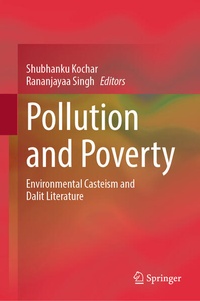
Pollution and Poverty
Description

This book offers a critical exploration of the intersections of poverty, pollution, and caste in India through the lens of Dalit literature from across regions. Introducing the concept of Environmental Casteism within Indian ecology, it examines how entrenched hierarchies and systemic discrimination shape environmental experiences and deepen socio-economic divides. Drawing from a rich corpus of Dalit literary works, this book provides a nuanced understanding of how literature serves as a potent medium for articulating ecological concerns, resistance, and resilience in the face of environmental injustices. Integrating perspectives from environmental studies, sociology, and postcolonial theory, it challenges dominant narratives and calls for inclusive and equitable ecological discourse. An essential resource for scholars, policymakers, and readers, it offers critical insights into the intertwined realities of caste, environment, and social justice in India.
More details
Other editions
Additional editions
Persons
Shubhanku Kochar teaches at University School of Humanities and Social Sciences at Guru Gobind Singh Indraprastha University, Delhi. He specializes in African and African Diasporic Literature along with Ecological literary criticism. His latest publications are: Environmental Post-Colonialism: A Literary Response (2021), Literature from the Peripheries: Refrigerated Culture and Pluralism (2023), both with Lexington Press, an imprint of Rowman and Littlefield, and Pastoral and Anti-Pastoral: Representation of City and Village in Literature (2024) by Ibidem/ Columbia University Press. At present, he is working on a project titled "Understanding Migration: Middle Passage, Interior Passage and African American Fiction", which is funded by Guru Gobind Singh Indraprastha University, New Delhi.
Rananjayaa Singh is a Tutor with Trivium Education Services, India, in collaboration with Tutor.com (Princeton, U.S.A.), since November 2024. She holds a PhD in English from Guru Gobind Singh Indraprastha University, New Delhi. She is an independent researcher and a freelance copyeditor and proofreader, helping students across the world refine their academic voices. Her research interests include literature and the environment, African American literature, and narratives from the margins. She serves on the editorial boards of Pacific Journal of Modern Theories and Research (PJMTR) (E-ISSN: 3108-3110) and The Criterion: An International Journal in English (ISSN: 0976-8165).
Content
Chapter I: Silent Echoes, Dalit Women and Environmental Justice: A Literary Exploration.- Chapter II: Voices of the Everyday: Dalit Aesthetics and Ecology in Select Malayalam Short Fiction.- Chapter III: Ecological Injustice and Dalit Narratives: A Reading of Hira Bansode's Select Poems.- Chapter V: Affective Land and Dystopian Environmental Desire in Raju K Vasu's Polappatham.- Chapter VI: The "People of mud and water": An Ecological Study of Surviving in My World.- Chapter VII: Ecology of Plight: A Reading of Selected Bangla Dalit Short Stories.- Chapter VIII: Stitched in Struggle: Dalit Clothing as Symbol of Environmental Hardships.- Chapter IX: Caste, Deprivation, and Ecological Disparities: A Narrative Exploration of Environment Injustice in Outcaste: A Memoir.
