

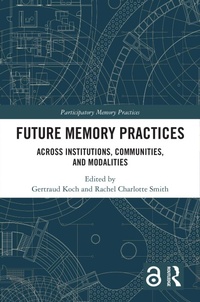
Future Memory Practices
Across Institutions, Communities, and Modalities
1st Edition
Published on 28. October 2024
248 pages
978-1-040-15073-3 (ISBN)
Description

Future Memory Work addresses a crucial challenge in contemporary pluralistic societies: the organisation of open, participatory and socially inclusive memory practices in digital media ecologies. It brings a novel relational approach to future memory work across institutions, people, and modalities.
Advancing inter- and transdisciplinary research and rich empirical cases from across Europe and beyond, the book examines how memory practices in digital media are open for engagement of people with diverse backgrounds. It analyses the modalities of memory making and how they can enable institutional and public memory making with a broad spectrum of people and groups in civil society at local, translocal, national and global levels. The chapters examine the mediatized character of memory making, whilst also critically considering what obstacles and potentials emerge from participatory memory work. As a whole, the book is a comprehensive source of knowledge and ideas for creating socially inclusive, sustainable memory practices and futures. It sets the multidisciplinary research agenda for advancing studies of heritage in contemporary digital media as an element and a driver of cultural and social change.
Future Memory Work is essential reading for academics, students and professionals working in the fields of Anthropology, Museum Studies, Digital Cultural Heritage, Memory Studies, Cultural Studies and Design.
Advancing inter- and transdisciplinary research and rich empirical cases from across Europe and beyond, the book examines how memory practices in digital media are open for engagement of people with diverse backgrounds. It analyses the modalities of memory making and how they can enable institutional and public memory making with a broad spectrum of people and groups in civil society at local, translocal, national and global levels. The chapters examine the mediatized character of memory making, whilst also critically considering what obstacles and potentials emerge from participatory memory work. As a whole, the book is a comprehensive source of knowledge and ideas for creating socially inclusive, sustainable memory practices and futures. It sets the multidisciplinary research agenda for advancing studies of heritage in contemporary digital media as an element and a driver of cultural and social change.
Future Memory Work is essential reading for academics, students and professionals working in the fields of Anthropology, Museum Studies, Digital Cultural Heritage, Memory Studies, Cultural Studies and Design.
More details
Series
Edition
1. Auflage
Language
English
Place of publication
London
United Kingdom
Publishing group
Taylor & Francis Ltd
Target group
College/higher education
Professional and scholarly
Illustrations
14 Halftones, black and white; 14 Illustrations, black and white
File size
7,32 MB
ISBN-13
978-1-040-15073-3 (9781040150733)
Copyright in bibliographic data and cover images is held by Nielsen Book Services Limited or by the publishers or by their respective licensors: all rights reserved.
Schweitzer Classification
Other editions
Additional editions
Gertraud Koch | Rachel Charlotte Smith
Future Memory Practices
Across Institutions, Communities, and Modalities
Book
approx. 07/2026
1st Edition
Routledge
€57.00
Not yet published
Gertraud Koch | Rachel Charlotte Smith
Future Memory Practices
Across Institutions, Communities, and Modalities
Book
10/2024
1st Edition
Routledge
€195.40
Shipment within 10-20 days
Persons
Gertraud Koch is Professor of Anthropological Studies in Culture and History at the University of Hamburg. Her research focus is on digital anthropology, cultural heritage and memory making, anthropology of work, and digital methods.
Rachel Charlotte Smith is Associate Professor of Human-Centred Design at Aarhus University. Her research focus is on digital and sustainable transformations, future heritage and memory making, through design anthropology and participatory design.
Rachel Charlotte Smith is Associate Professor of Human-Centred Design at Aarhus University. Her research focus is on digital and sustainable transformations, future heritage and memory making, through design anthropology and participatory design.
Content
1. Future Memory Work: A relational approach to social inclusion in digitalised media ecologies; I: Memory institutions: (shifting professional memory practices); 2. Shifting from 'inside-out' to 'outside in': Envisioning ways of structurally integrating participatory principles in museums; 3. Situating participation in the backstage: Infrastructural settings impacting museum work; 4. Ethical practices in participatory memory work - Examples from the Museum Europaeischer Kulturen in Berlin; II: People and groups: (digital memory making at the margins); 5. Pluriversal Futures: Design Anthropology for Contested Memory Making at the Margins; 6. Conducting Bereavement Interviews: Methodological Reflections on Talking About Death, Grief, and Mem; III: Memory modalities: (socio-material assemblages of memory formation); 7. Memory modalities: explorations into the socio-material arrangements of the past at the present for the future; 8. Memory loss: Youth and the fragility of personal digital remembering; IV: Future Memory work: (toolbox and approaches); 9. Towards a relational approach to social impact measurement of Participatory Memory Work: New concepts for future memory work; 10. Towards a toolbox for future envisioning memory practices; 11. Epilogue: Future Memory Work
