

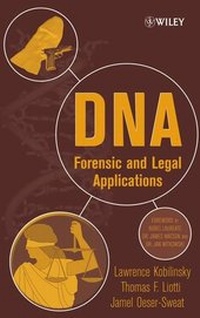
DNA
Description

Reviews / Votes
"There have been other forensic DNA books written before, but nonehas taken the reader through all aspects of DNA testing like thisone...this book alone could make you feel prepared to understand aDNA case..." (Clinical Chemistry, September 2005) "...a comprehensive, up-to-date discussion of forensic DNAtechnologies and their legal implications in the courtroom."(CHOICE, April 2005) "...a concise guide to the use of DNA forensic analysis andhow the information gained from such techniques are used in thelegal system." (E-STREAMS, February 2005) This valuable codebook will go a long way toward helping us winthe 'DNA battle'...we owe the authors a great debt of gratitude."(New York Law Journal, December 15, 2004)"DNA: Forensic and Legal Applications is a comprehensive andinvaluable guide to the field, covering topics ranging fromcollecting samples in the field to presenting the complex resultsto a jury. We are sure that it will play its part in promoting thismost powerful tool in the forensic scientist'sarmamentarium." -From the Foreword by Drs. James Watson and Jan WitkowskiMore details
Other editions
Additional editions
Persons
Content
Preface.
Acknowledgements.
1. Biochemistry, Genetics, and Replication of DNA.
1.1 Evolution of Identification: From Faces to Fingerprints to DNA.
1.2 DNA and Heredity.
1.2.1 A Look at DNA from the Outside In.
1.2.2 DNA-The Chemistry.
1.2.3 Unique Sequence and Repetitious DNA.
1.3 DNA Replication.
1.3.1 Replication in the Cell.
1.3.2 Cloning (Gene Amplification).
2. Biological Evidence-Science and Criminal Investigation.
2.1 Crime Scene Investigation-Biological Evidence.
2.1.1 Help the Victim.
2.1.2 Protect the Scene.
2.1.3 Document the Scene.
2.1.4 Search the Scene.
2.1.5 Schematic Drawing Showing Location and Photography of Items of Evidence.
2.1.6 Packaging and Preserving Evidence.
2.1.7 Transport to Laboratory.
2.1.8 Sexual Assault Evidence.
2.1.9 Evidence Handling in the Laboratory.
2.1.10 Report Writing.
2.2 Serology.
2.2.1 Blood.
2.2.2 Semen.
2.2.3 Saliva.
2.2.4 Urine.
2.2.5 Hair.
2.3 Chain of Custody.
3. Forensic DNA Analysis Methods.
3.1 Associative Evidence and Polymorphism.
3.2 Restriction Fragment-Length Polymorphism.
3.2.1 Isolation of DNA.
3.2.2 Quantification.
3.2.3 Restriction Enzymes: DNA Scissors.
3.2.4 Gel Electrophoresis.
3.2.5 Southern Blotting.
3.2.6 Hybridization.
3.2.7 Autoradiography and Visualization of DNA Banding Pattern.
3.2.8 Analysis of RFLP Results.
3.2.9 Probe Stripping from Membrane.
3.2.10 Match Criteria.
3.2.11 Statistics and the Product Rule.
3.3 Polymerase Chain Reaction.
3.3.1 Development and Theory.
3.3.2 Isolation of DNA.
3.3.3 Quantification
3.3.4 Techniques.
3.4 Analysis of Y-Chromosome STRS.
3.4.1 Y-Chromosome Single-Nucleotide Polymorphism Analysis.
3.5 Analysis of Mitochondrial DNA.
3.5.1 The Mitochondrial Genome.
3.5.2 Quantification.
3.5.3 Sequencing.
3.5.4 Interpretation of Sequence Data.
3.5.5 Heteroplasmy.
3.5.6 Statistics.
3.5.7 SNP Analysis of Mitochondrial DNA.
3.6 Problems with PCR.
3.6.1 Contamination.
3.6.2 Degradation.
3.6.3 Sunlight.
3.6.4 Inhibitors.
3.6.5 Allelic Dropout-Null Alleles.
3.6.6 Human Error.
3.7 Underlying Facts and Assumptions in Forensic DNA Testing.
4. Genetics, Statistics, and Databases.
4.1 Human Genetics, Population Genetics, and Statistics.
4.1.1 Power of Forensic DNA Analysis: How Significant Is the Match?
4.1.2 Genetics and Statistics.
4.1.3 Mendel's Laws of Genetics.
4.1.4 Meiosis.
4.2 Population Genetics.
4.2.1 Hardy-Weinberg Equilibrium.
4.2.2 Subpopulations and Substructure.
4.3 Need for Quality Control and Quality Assurance.
4.4 SWGDAM (Formerly Known as TWGDAM) Standards.
4.5 DNA Advisory Board.
4.6 Mitochondrial DNA and Y-Chromosome STR Analysis and Statistical Calculations.
4.7 Experimental Controls.
4.8 Validation of New DNA Methods.
4.9 Single-Nucleotide Polymorphism Analysis.
4.10 Database Size and Composition.
4.11 DNA Databases.
4.12 Power of Discrimination.
4.13 Mixtures and Statistics.
4.14 Probability of Exclusion.
4.15 Likelihood Ratio (LR).
4.16 Paternity Determinations.
4.16.1 Exclusion of the Alleged Father as the Biological Father.
4.16.2 Inclusion of the Alleged Father as the Biological Father.
4.17 Lab Accreditation, Certification, Reputation, and Facilities.
4.17.1 Quality Control.
4.17.2 Quality Assurance.
4.17.3 Proficiency Testing.
4.17.4 Certification.
4.17.5 Laboratory Accreditation.
4.18 Reviewing a DNA Report-A Sample RFLP Analysis.
4.19 Reviewing a DNA Report-A PCR-Based DNA Examination (HLADQA1, PM, D1S80, and CTT-CSF1PO, TPOX, THO1).
4.20 Reviewing a DNA Report-A PCR-STR-Based DNA Examination (CODIS Loci).
4.21 Reviewing a Paternity Report Based on Analysis of DNA.
5. Litigating a DNA Case.
5.1 Legal Theory.
5.1.1 Admissibility of Scientific Evidence: A Primer.
5.1.2 Common Law and The Creation of a Judicial Gatekeeping Function.
5.1.3 Federal Rules of Evidence and the Expansion of the Judicial Gatekeeping Function.
5.1.4 Daubert: The Supreme Court Sets Forth a Standard.
5.1.5 General Electric Company et al. v. Joiner et ux.
5.1.6 Kumho Tire: The Court Continues Its Expansion of the Judicial Gatekeeping Function.
5.1.7 Judicial Gatekeeping Function and Its Evolution in New York State.
5.2 Admissibility of DNA Evidence.
5.2.1 PCR-STR DNA Evidence.
5.2.2 Mitochondrial DNA.
5.2.3 Animal DNA.
5.2.4 Plant and Viral DNA.
5.2.5 Statistics.
5.2.6 Paternity.
5.3 Legal Practice.
5.3.1 Different Stages of a Trial.
5.4 DNA for Defense Attorneys-Contesting DNA Evidence.
5.5 DNA for Prosecutors.
5.6 DNA for Judges.
6. DNA Evidence at Trial.
6.1 Attacking and Defending DNA Evidence.
6.1.1 Theory of the Case/Plan of Attack.
6.1.2 What is Required for DNA Test Results to be Admitted into Evidence?
6.2 DNA for the Prosecutor or Those Who Seek to Admit DNA Evidence.
6.2.1 Effective Admission of DNA Evidence Takes Place in Three Stages.
6.3 DNA for the Defense or Those Who Seek to Mitigate the Effect of DNA Evidence.
6.3.1 Preventing the Admission of DNA Evidence in Part or in Its Entirety.
7. Exonerating the Innocent through DNA.
7.1 Postconviction Appeals Based upon DNA Evidence.
7.2 Postconviction DNA Testing: Recommendations for Handling Requests.
7.2.1 Role and Response of the Prosecutor.
7.2.2 Role and Response of the Defense Attorney.
7.3 Legal Standards Governing Postconviction Testing.
7.3.1 Argument for a Constitutional Right to Postconviction DNA Testing.
7.3.2 Other Non-Postconviction Testing Statute Arguments.
7.4 Postconviction DNA Testing Statutes.
7.5 Preventing Postconviction DNA Testing through Waiver.
7.6 The Future of DNA Technology.
Appendix A: Bibliography: Selected by Topic Area.
Appendix B: Cases Involving the Admissibility of DNA Evidence.
Appendix C: Information Pertinent to Attempts to Overturn Convictions Based Upon DNA Evidence.
Appendix D: Offenses in New York State Resulting in Mandatory DNA Testing for Database Inclusion.
Appendix E: Postconviction DNA Testing, Preservation of Evidence and Compensation for Wrongful Convictions: Relevant Legislative Information.
Appendix F: Items Obtained through Discovery.
Appendix G: Glossary.
Index.
