

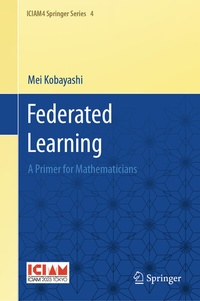
Federated Learning
Description

This book serves as a primer on a secure computing framework known as federated learning. Federated learning is the study of methods to enable multiple parties to collaboratively train machine learning/AI models, while each party retains its own, raw data on-premise, never sharing it with others. This book is designed to be accessible to anyone with a background in undergraduate applied mathematics. It covers the basics of topics from computer science that are needed to understand examples of simple federated computing frameworks. It is my hope that by learning basic concepts and technical jargon from computer science, readers will be able to start collaborative work with researchers interested in secure computing. Chap. 1 provides the background and motivation for data security and federated learning and the simplest type of neural network. Chap. 2 introduces the idea of multiparty computation (MPC) and why enhancements are needed to provide security and privacy. Chap. 3 discusses edge computing, a distributed computing model in which data processing takes place on local devices, closer to where it is being generated. Advances in hardware and economies of scale have made it possible for edge computing devices to be embedded in everyday consumer products to process large volumes of data quickly and produce results in near real-time. Chap. 4 covers the basics of federated learning. Federated learning is a framework that enables multiple parties to collaboratively train AI models, while each party retains control of its own raw data, never sharing it with others. Chap. 5 discusses two attacks that target weaknesses of federated learning systems: (1) data leakage, i.e., inferring raw data used to train an AI model by unauthorized parties, and (2) data poisoning, i.e., a cyberattack that compromises data used to train an AI model to manipulate its output.
More details
Other editions
Additional editions
Person
Mei Kobayashi holds an A.B. from Princeton University in Chemistry and a M.A. and Ph.D. in mathematics from the University of California at Berkeley. She was Researcher at IBM for 26 years working on: inverse problems, control theory, airflow simulations digital steganography, applications of wavelets, and text analysis. Subsequently, she joined NTT communications as Data Science Specialist, where she was Co-Manager of a team to initiate digital transformation in the Customer Services Division. She is currently Member of the Research and Development Team at EAGLYS. In addition to her work, she was Visiting Associate Professor at the University of Tokyo and Visiting Researcher at OIST, has taught at Japanese National Universities in: Kyoto, Tsukuba, Hiroshima, and Tokyo, and is currently teaching at Tsuda Women's University. She has been serving on the Editorial Board of the Communications of the ACM for over a decade and was Columnist for SIAM News.
Content
Introduction.- Multiparty Computation.- Edge Computing.- Federated Learning.- Data Leakage and Data Poisoning.
