

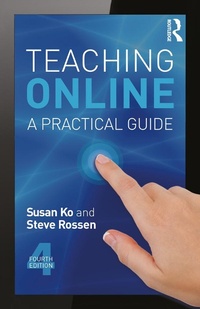
Teaching Online
A Practical Guide
4th Edition
Published on 24. February 2017
510 pages
978-1-135-05558-5 (ISBN)
Description

Teaching Online: A Practical Guide is an accessible, introductory, and comprehensive guide for anyone who teaches online. The fourth edition of this bestselling resource has been fully revised, maintains its reader-friendly tone, and offers exceptional practical advice, new teaching examples, faculty interviews, and an updated resource section.
New to this edition:
entire new chapter on MOOCs (massive open online courses);
expanded information on teaching with mobile devices, using open educational resources, and learning analytics;
additional interviews with faculty, case studies, and examples;
spotlight on new tools and categories of tools, especially multimedia.
Focusing on the "hows" and "whys" of implementation rather than theory, the fourth edition of Teaching Online is a must-have resource for anyone teaching online or thinking about teaching online.
New to this edition:
entire new chapter on MOOCs (massive open online courses);
expanded information on teaching with mobile devices, using open educational resources, and learning analytics;
additional interviews with faculty, case studies, and examples;
spotlight on new tools and categories of tools, especially multimedia.
Focusing on the "hows" and "whys" of implementation rather than theory, the fourth edition of Teaching Online is a must-have resource for anyone teaching online or thinking about teaching online.
Reviews / Votes
The newest edition is truly better than ever! This book is packed with great, useful information for the beginner and even the expert online teacher. The additions of mobile learning, analytics, and case studies to the 4th edition are exceptional, and the updated glossary and links section makes this a book to keep close at hand for ready reference as you go through the semester.--Ray Schroeder, Director of the UPCEA Center for Online Leadership
The 4th Edition of Teaching Online, even more than its predecessors, is invaluable for both novice and experienced online instructors. Online instruction, like teaching itself, has evolved, and so has this indispensable guide. What Teaching Online does best of all is put the emphasis on that first word, teaching, and put everything else at its service. What makes the book exciting is how it shows that teaching online is transformative, opening up possibilities that don't exist in the traditional classroom, better serving students' needs and realizing teachers' goals.
--George Otte, University Director of Academic Technology, The City University of New York and Associate Dean for Academic Affairs, The CUNY School of Professional Studies
More details
Edition
4th edition
Language
English
Place of publication
London
United Kingdom
Publishing group
Taylor & Francis Ltd
Target group
Professional and scholarly
Illustrations
13 s/w Abbildungen, 8 s/w Tabellen, 4 s/w Photographien bzw. Rasterbilder, 9 s/w Zeichnungen
8 Tables, black and white; 9 Line drawings, black and white; 4 Halftones, black and white; 13 Illustrations, black and white
File size
3,18 MB
ISBN-13
978-1-135-05558-5 (9781135055585)
Copyright in bibliographic data and cover images is held by Nielsen Book Services Limited or by the publishers or by their respective licensors: all rights reserved.
Schweitzer Classification
Other editions
Additional editions
Book
03/2017
4th Edition
Routledge
€232.90
Shipment within 15-20 days
Book
03/2017
4th Edition
Routledge
€70.50
Shipment within 15-20 days
Person
Susan Ko has spent more than twenty years creating and directing faculty development programs for online teaching at diverse institutions, including City University at New York and University of Maryland University College.
Steve Rossen, Instructional Technologist and Electronic Librarian, was formerly Manager of the Faculty New Media Center at UCLA.
Steve Rossen, Instructional Technologist and Electronic Librarian, was formerly Manager of the Faculty New Media Center at UCLA.
Content
Preface
Acknowledgements
Teaching Online: An Overview
Scouting the Territory: Exploring Your Institution's Resources
Course Design and Development
Working with Others to Develop a Course
Creating an Effective Online Syllabus
Building an Online Classroom
Student Activities in the Online Environment
Copyright, Intellectual Property, and Open Educational Resources
Creating Courseware: Selecting "Web 2.0" Tools and other Resources
Preparing Students for Online Learning
Classroom Management and Facilitation
Classroom Management: Special Issues
Teaching Web-Enhanced and Blended Classes
Teaching and Learning in a MOOC
Taking Advantage of New Opportunities
Glossary
Guide to Resources
Acknowledgements
Teaching Online: An Overview
Scouting the Territory: Exploring Your Institution's Resources
Course Design and Development
Working with Others to Develop a Course
Creating an Effective Online Syllabus
Building an Online Classroom
Student Activities in the Online Environment
Copyright, Intellectual Property, and Open Educational Resources
Creating Courseware: Selecting "Web 2.0" Tools and other Resources
Preparing Students for Online Learning
Classroom Management and Facilitation
Classroom Management: Special Issues
Teaching Web-Enhanced and Blended Classes
Teaching and Learning in a MOOC
Taking Advantage of New Opportunities
Glossary
Guide to Resources
