

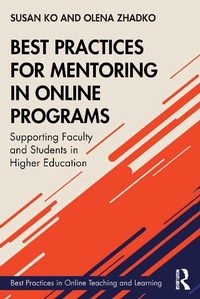
Best Practices for Mentoring in Online Programs
Supporting Faculty and Students in Higher Education
1st Edition
Published on 7. September 2022
170 pages
978-0-429-78594-8 (ISBN)
Description

Best Practices for Mentoring in Online Programs is a straightforward guide to creating meaningful, lasting mentoring programs for faculty or students enrolled in fully or predominantly online programs. Faculty and student mentoring programs are proliferating in higher education, including peer mentoring, group/network mentoring, and career mentoring, making it all the more important that administrators and instructors incorporate research-based best practices for effective and successful implementation. Divided into two sections - the first on mentoring programs for faculty, the second on programs for students - this volume engages a broad variety of mentoring models and contexts across disciplines, paying special attention to the effective strategies and common problems associated with online mentoring. The book addresses the practical aspects of setting up, running, structuring, and evaluating online mentoring programs, along with the recruitment, selection, compensation, and recognition of mentors. Case studies and interviews bring to life the challenges and opportunities of mentorship, including how to resolve discussions pertaining to difficult or controversial issues, while a wealth of resources, templates, and checklists will help administrators and faculty take concrete steps towards implementing or developing programs tailored to their needs and institutional contexts.
Reviews / Votes
"Thank you, Drs. Ko and Zhadko, for giving me just what I needed, but didn't have: a comprehensive handbook on how to do everything to launch a mentoring program. Especially noteworthy is this book's synergistically connected treatment of both faculty and student mentors. We need to be mindful that, when it comes to mentoring in the online context both faculty and staff have in common, many are new to online learning. This work has wonderful specificity in stipulating exactly what faculty and student mentors should do. Ko and Zhadko are scrupulous about pointing out the limitations of mentoring in online environments, while describing a balance of advantages and challenges. Thankfully, this is also a manual for administrators of mentoring initiatives, who often, like mentors, have little or no prior experience in designing and managing mentoring programs, let alone online. Ko and Zhadko also provide a vast array of institutional examples for the mentoring programs that they cite. These span all institutional types and hence are very inclusive. This work is so comprehensive that it also embraces peer tutoring and career mentoring. As a bonus, this work includes highly pertinent content on mentor training for both faculty and students, evaluation, and compensation and workloads. It is my sincere hope that this work will widely inspire, encourage, direct, train, evaluate, and reward all these mentors and those who supervise them."-John N. Gardner, Founder and Executive Chair, John N. Gardner Institute for Excellence in Undergraduate Education
"While much has been written about mentoring and supporting faculty and students in online learning environments as separate topics, Best Practices for Mentoring in Online Programs takes a fresh look at faculty and student mentoring frameworks to suggest new and innovative approaches in the specific context of online teaching and learning in our colleges and universities. Drs. Ko and Zhadko bring a wealth of combined knowledge and experience in faculty professional development, effective teaching, and online student support to the fore in this volume, resulting in a clear, well-organized integration of mentoring structures and strategies specifically designed for the online teaching and learning environment. They bring together student peer mentoring, tutoring, and career-focused mentoring to guide the development of online student mentoring programs, providing excellent descriptions and strategies for leveraging peer and professional online learning networks. Overall, this book is a wonderful resource for higher education faculty, administrators, and staff who are interested in building evidence-based, effective mentoring programs for their online instructors and learners."
-Elizabeth (Liz) Ciabocchi, Vice Provost for Academic Affairs at Adelphi University, USA, and President, Board of Directors, Online Learning Consortium (OLC)
"Best Practices for Mentoring in Online Programs provides a comprehensive introduction to all aspects of establishing, sustaining, and assessing mentoring programs. The discussion of mentoring models for faculty and for students is organized in a way that makes it easy to hone in on the exact information needed and invites one to browse and discover new models. It offers a wealth of successful examples, attractive models, and suggestions for implementation that help readers understand how such efforts might fit into their own institutions. I commend the authors for including so many voices from different institutional types and gathering a rich array of examples that can help us all think more broadly about the applications of mentoring in online courses."
-Fran Glazer, Associate Provost for Educational Innovation & Director, Center for Teaching and Learning, New York Institute of Technology, USA, and President of the Professional and Organizational Development (POD) Network in Higher Education
"Overall, this book is easy to read at just 149 pages. It offers relevant context, research, and background on the benefits of establishing mentoring programs for faculty and students. Any faculty involved in online teaching and learning as well as any administrators who oversee faculty who teach online courses would find this work useful. Additionally, support staff who might oversee setting up mentoring programs or be charged with their execution would benefit from reading this book. The practical tips and resources provided are the central part of this title. There is a clear emphasis on student mentoring programs, though, less text is related to faculty mentoring programs. Perhaps future works around online mentoring programs could produce a resource entirely dedicated to faculty as the area of peer mentoring continues to grow." - Emily Holmes, Ed.D., University of Southern Mississippi.
More details
Series
Edition
1. Auflage
Language
English
Place of publication
London
United Kingdom
Publishing group
Taylor & Francis Ltd
Target group
Professional and scholarly
ISBN-13
978-0-429-78594-8 (9780429785948)
Copyright in bibliographic data and cover images is held by Nielsen Book Services Limited or by the publishers or by their respective licensors: all rights reserved.
Schweitzer Classification
Other editions
Additional editions
Susan Ko | Olena Zhadko
Best Practices for Mentoring in Online Programs
Supporting Faculty and Students in Higher Education
Book
09/2022
1st Edition
Routledge
€185.60
Shipment within 10-20 days
Susan Ko | Olena Zhadko
Best Practices for Mentoring in Online Programs
Supporting Faculty and Students in Higher Education
Book
09/2022
1st Edition
Routledge
€53.60
Shipment within 10-20 days
Persons
Susan Ko is Faculty Development Consultant in the Office of Online Education at Lehman College, City University of New York, USA, and teaches Humanities and Asian Studies courses online for the University of Maryland Global Campus, USA. She is the author of Teaching Online: A Practical Guide, a leading book in the field of online teaching, and the series editor for the Best Practices in Online Teaching and Learning series. She has more than 20 years of online teaching and faculty development experience.
Olena Zhadko is Director of Online Education at Lehman College, City University of New York, USA. She has 15 years of experience providing leadership in online education and innovative use of technology in teaching and learning. With Susan Ko, she is the co-author of Best Practices in Designing Courses with Open Educational Resources.
Olena Zhadko is Director of Online Education at Lehman College, City University of New York, USA. She has 15 years of experience providing leadership in online education and innovative use of technology in teaching and learning. With Susan Ko, she is the co-author of Best Practices in Designing Courses with Open Educational Resources.
Content
Introduction, Part 1: Faculty Mentoring Models, 1. Faculty Group and Network Mentoring, 2. Faculty Peer Mentoring, 3. Campus Cultures, Compensation and Incentives, and Related Issues, 4. Training, Evaluation, Plus Resources, Checklists, and Templates for Setting Up Your Program, Part 2: Student Mentoring Models, 5. Student Peer Mentoring, 6. Peer Tutoring as Mentoring, 7. Career-Oriented Mentoring by Non-faculty and Faculty Mentors, 8. Special Issues: Modality, Recruitment, Workload, Compensation, and More, 9. Setting Up a Student Mentoring Program: Training, Evaluating, and Resources
