

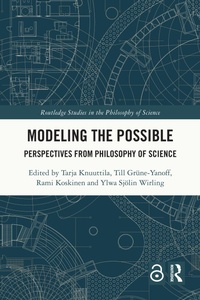
Modeling the Possible
Perspectives from Philosophy of Science
1st Edition
Published on 7. February 2025
296 pages
978-1-040-31881-2 (ISBN)
Description

Models are used to explore possibilities across all scientific fields. Climate models simulate the potential future climatic conditions under various emissions scenarios, macroeconomic models investigate the implications of various fiscal and monetary policy initiatives, and infectious diseases models study the spread of viral diseases under a range of conditions. Such modeling approaches have not gone ignored by philosophers of science, but they have only recently started to explicitly address modeling the possible. So far, the discussion has been spread across a variety of more or less isolated pockets of debate in the philosophy of science. Modeling the Possible: Perspectives from Philosophy of Science draws together these studies, focusing specifically on how various modeling practices probe possibilities and justify claims concerning them.
The volume is divided into three sections, plus an introductory chapter. The introductory chapter provides a state-of-the-art survey of the discussions of modeling possibilities within the philosophy of science, as well as an introduction to the book's main themes and individual papers. The three sections focus on different kinds of possibility concepts, possibility spaces, and how-possibly modeling in practical situations. The chapters contained in this volume address conceptual and theoretical issues while also presenting case studies from various scientific domains: physics, evolutionary and synthetic biology, network science, climate science, economics, and epidemiology.
Essential reading for philosophers of science, epistemologists, and modelers in various scientific disciplines, Modeling the Possible is also suitable for anyone interested in model-based scientific inferences, their validity, and the policy conclusions derived from them.
The volume is divided into three sections, plus an introductory chapter. The introductory chapter provides a state-of-the-art survey of the discussions of modeling possibilities within the philosophy of science, as well as an introduction to the book's main themes and individual papers. The three sections focus on different kinds of possibility concepts, possibility spaces, and how-possibly modeling in practical situations. The chapters contained in this volume address conceptual and theoretical issues while also presenting case studies from various scientific domains: physics, evolutionary and synthetic biology, network science, climate science, economics, and epidemiology.
Essential reading for philosophers of science, epistemologists, and modelers in various scientific disciplines, Modeling the Possible is also suitable for anyone interested in model-based scientific inferences, their validity, and the policy conclusions derived from them.
More details
Series
Edition
1. Auflage
Language
English
Place of publication
London
United Kingdom
Publishing group
Taylor & Francis Ltd
Target group
College/higher education
Illustrations
6 Line drawings, black and white; 6 Illustrations, black and white
File size
1,05 MB
ISBN-13
978-1-040-31881-2 (9781040318812)
Copyright in bibliographic data and cover images is held by Nielsen Book Services Limited or by the publishers or by their respective licensors: all rights reserved.
Schweitzer Classification
Other editions
Additional editions
Tarja Knuuttila | Till Gruene-Yanoff | Rami Koskinen
Modeling the Possible
Perspectives from Philosophy of Science
Book
approx. 07/2026
1st Edition
Routledge
€57.50
Not yet published

Tarja Knuuttila | Till Gruene-Yanoff | Rami Koskinen
Modeling the Possible
Perspectives from Philosophy of Science
Book
03/2025
Routledge
Unfortunately, price unknown
Article exhausted; check different version
Tarja Knuuttila | Till Gruene-Yanoff | Rami Koskinen
Modeling the Possible
Perspectives from Philosophy of Science
Book
02/2025
1st Edition
Routledge
€206.80
Shipment within 10-20 days
Persons
Tarja Knuuttila is a Professor of Philosophy of Science at the University of Vienna, Austria. Knuuttila's research focuses on scientific modeling, as well as artifactuality and interdisciplinarity in science. Her philosophical work is practice-oriented, with an emphasis on synthetic biology, engineering sciences, and economics.
Till Gruene-Yanoff is a Professor of Philosophy at the Royal Institute of Technology, Stockholm, Sweden. His research focuses on scientific modeling, decision theory, and behavioral policy. He often collaborates with psychologists, economists, and engineers on these topics.
Rami Koskinen is a Researcher at the University of Vienna, Austria. Koskinen's research focuses on the general philosophy of science and the philosophy of biology. He has studied especially the epistemology of modal inferences, ranging from scientific modeling to biological engineering.
Ylwa Sjoelin Wirling is a Reader in Theoretical Philosophy at the University of Gothenburg, Sweden, and a Pro Futura Scientia Fellow at the Swedish Collegium of Advanced Study. Her research concerns epistemology, philosophy of science, and metaphilosophy. She has worked on epistemological issues pertaining to modality, especially in the contexts of scientific modeling and philosophical inquiry.
Till Gruene-Yanoff is a Professor of Philosophy at the Royal Institute of Technology, Stockholm, Sweden. His research focuses on scientific modeling, decision theory, and behavioral policy. He often collaborates with psychologists, economists, and engineers on these topics.
Rami Koskinen is a Researcher at the University of Vienna, Austria. Koskinen's research focuses on the general philosophy of science and the philosophy of biology. He has studied especially the epistemology of modal inferences, ranging from scientific modeling to biological engineering.
Ylwa Sjoelin Wirling is a Reader in Theoretical Philosophy at the University of Gothenburg, Sweden, and a Pro Futura Scientia Fellow at the Swedish Collegium of Advanced Study. Her research concerns epistemology, philosophy of science, and metaphilosophy. She has worked on epistemological issues pertaining to modality, especially in the contexts of scientific modeling and philosophical inquiry.
Content
Introduction Tarja Knuuttila, Till Gruene-Yanoff, Ylwa Sjoelin Wirling, and Rami Koskinen Part 1: Possibility Concepts for Scientific Use 1. Through the Prism of Modal Epistemology: Perspectives on Modal Modeling Ylwa Sjoelin Wirling and Till Gruene-Yanoff 2. Which Possibilities Contribute to Scientific Understanding? Collin Rice 3. Actual Possibility Paul Teller 4. The Possibilities in Propensities: Emergence and Modality Mauricio Suarez Part 2: Possibility Spaces 5. Invariance, Modality, and Modeling Andreas Huettemann 6. Modeling the Biologically Possible: Evolvability as a Modal Concept Marcel Weber 7. The Combinatorial Possibilities of Synthetic Biology Tarja Knuuttila and Andrea Loettgers 8. Beyond Networks: Explaining the Dynamics in the Natural and Social Systems Johannes Jaeger, James DiFrisco, and Andrea Loettgers Part 3: Exploring How-Possibly in Practical Contexts 9. Three Strategies for Salvaging Explanatory Value in Deep Neural Network Modeling Philippe Verreault-Julien 10. Modeling Climate Possibilities Joe Roussos 11. Prospective Modeling Alfred Nordmann 12. Alternative Worlds: Reasonable Worlds? Plausible Worlds? Mary S. Morgan 13. Are Pandemics a Necessary Evil? The Role of Epidemiological and Immunological Models in Understanding and Preventing Diseases Gregor P. Greslehner. Index
