

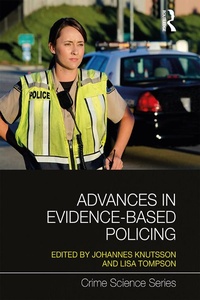
Advances in Evidence-Based Policing
Published on 21. April 2017
248 pages
978-1-315-51827-5 (ISBN)
Description

The evidence-based policing (EBP) movement has intensified in many countries around the world in recent years, resulting in a proliferation of policies and infrastructure to support such a transformation. This movement has come to be associated with particular methods of evaluation and systematic review, which have been drawn from what is assumed to prevail in medicine.
Given the credibility EBP is currently enjoying with both practitioners and government, it is timely to subject its underpinning logic to thoughtful scrutiny. This involves deliberating upon the meaning of evidence and what different models of knowledge accumulation and research methods have to offer in realising the aims of EBP. The communication and presentation of evidence to practitioner audiences is another important aspect of EBP, as are collaborative efforts to 'co-produce' new knowledge on police practice.
This is the first book that takes a kaleidoscopic approach to depict what EBP presently is and how it could develop. The chapters individually and collectively challenge the underlying logic to the mainstream EBP position, and the book concludes with an agenda for a more inclusive conceptualisation of evidence and EBP for the future. It is aimed at students and academics who are interested in being part of this movement, as well as policymakers and practitioners interested in integrating EBP principles into their practices.
Given the credibility EBP is currently enjoying with both practitioners and government, it is timely to subject its underpinning logic to thoughtful scrutiny. This involves deliberating upon the meaning of evidence and what different models of knowledge accumulation and research methods have to offer in realising the aims of EBP. The communication and presentation of evidence to practitioner audiences is another important aspect of EBP, as are collaborative efforts to 'co-produce' new knowledge on police practice.
This is the first book that takes a kaleidoscopic approach to depict what EBP presently is and how it could develop. The chapters individually and collectively challenge the underlying logic to the mainstream EBP position, and the book concludes with an agenda for a more inclusive conceptualisation of evidence and EBP for the future. It is aimed at students and academics who are interested in being part of this movement, as well as policymakers and practitioners interested in integrating EBP principles into their practices.
Reviews / Votes
"Recent years have seen the idea of 'evidence-based policing' really take hold in America, Europe and beyond. Yet institutional, political and cultural barriers remain, and some of the underpinning intellectual ideas continue to be contested. Advances in Evidence Based Policing couldn't be more timely therefore. With a truly stellar cast of authors, the volume offers a wonderfully comprehensive, reflexive, engaged and up-to-date exploration of the field. For anyone concerned with the future of policing this book will be absolutely essential."- Tim Newburn, Professor of Criminology and Social Policy, Department of Social Policy, London School of Economics and Political Science, UK
"Amidst the confusion of an increasingly demanding environment, EBP has emerged as a new paradigm that has enthused police leaders and policy makers alike. This book corrals internationally renowned academics to provide their unique perspectives on this dominant topic. The result is a stimulating and engaging book that delivers at many levels. Whilst exploring what evidence matters and how it should be applied, it extends to provide a fresh lens through which to explore the ongoing relationship between academia and the police. For practitioners, academics, or those just interested in policing, it provides fascinating insight during this distinctive period of development."
- Stuart Kirby, Professor of Policing and Criminal Investigation, School of Forensic and Applied Sciences, University of Central Lancashire, UK
"...the EBP movement is now entering its 20th year since Sherman put evidence in play. While there has been considerable critique of these issues over this period, Johannes Knutsson and Lisa Tompson, editors of Advances in Evidence-Based Policing, together with a notable array of social and crime scientists, parse the achievements and blind-spots in the EBP movement... the book is a solid, and appropriately critical assessment of the state-of-the art of EBP and pathways for its improvement. It is also a critique of some of the shortcomings of EBP conceptually, methodologically and pragmatically."
- Jack R. Greene, Professor Emeritus, School of Criminal Justice and Criminology, Northeastern University, USA
More details
Series
Language
English
Place of publication
London
United Kingdom
Publishing group
Taylor & Francis Ltd
Target group
College/higher education
Product notice
Reflowable
Illustrations
16 s/w Abbildungen, 9 s/w Tabellen, 16 s/w Zeichnungen
9 Tables, black and white; 16 Line drawings, black and white; 16 Illustrations, black and white
File size
1,40 MB
ISBN-13
978-1-315-51827-5 (9781315518275)
Copyright in bibliographic data and cover images is held by Nielsen Book Services Limited or by the publishers or by their respective licensors: all rights reserved.
Schweitzer Classification
Other editions
Additional editions
Johannes Knutsson | Lisa Tompson
Advances in Evidence-Based Policing
Book
03/2019
1st Edition
Routledge
€71.20
Shipment within 15-20 days
Johannes Knutsson | Lisa Tompson
Advances in Evidence-Based Policing
Book
05/2017
1st Edition
Routledge
€206.40
Shipment within 10-20 days
Persons
Johannes Knutsson is Professor of Police Research at the Norwegian Police University College. He has been employed at the Swedish National Police Academy and the Swedish National Police Board. He has conducted studies with and for the police for 40 years. Among other publications he has coedited several books on different aspects of policing - Putting Theory to Work: Implementing situational prevention and problem-oriented policing (with Ron Clarke), Evaluating Crime Reduction Initiatives (with Nick Tilley), Police Use of Force: A global perspective (with Joseph Kuhns), Preventing Crowd Violence (with Tamara Madensen) and Applied Police Research: Challenges and opportunities (with Ella Cockbain).
Lisa Tompson is a Lecturer at the UCL Department of Security and Crime Science. As a former police crime intelligence analyst, her work focuses on research which has immediate relevance and benefit to police and crime reduction agencies. She has recently worked on research that underpins the UK's What Works Centre for Crime Reduction, for which she and the team won a Chief Constable's commendation in 2015.
Lisa Tompson is a Lecturer at the UCL Department of Security and Crime Science. As a former police crime intelligence analyst, her work focuses on research which has immediate relevance and benefit to police and crime reduction agencies. She has recently worked on research that underpins the UK's What Works Centre for Crime Reduction, for which she and the team won a Chief Constable's commendation in 2015.
Content
1. Introduction (Johannes Knutsson and Lisa Tompson)
2. The why, what, when and how of evidence-based policing (Nick Tilley and Gloria Laycock)
3. Reconciling problem-oriented policing and evidence-based policing (Michael S. Scott)
4. Some solutions to the evidence-based crime prevention problem (John E. Eck)
5. Multiple research methods for evidence generation (Mike Maxfield, Youchen Hou, Jeffrey Butts, Jennifer Pipitone, Latifa T. Fletcher and Bryce Peterson)
6. How to morph experience into evidence (Ken Pease and Jason Roach)
7. Reviewing evidence for evidence-based policing (Kate Bowers, Lisa Tompson, Aiden Sidebottom, Shane Johnson and Karen Bullock)
8. Evidence-based policing as a disruptive innovation: the global policing database as a disruption tool (Lorraine Mazerolle, Elizabeth Eggins, Angela Higginson and Betsy Stanko)
9. The long and winding road: embedding evidence informed policing (Tiggey May, Gillian Hunter and Mike Hough)
10. Advancing policing by using, producing and diffusing evidence (Johannes Knutsson)
11. How to make police-researcher partnerships mutually effective (Lisa Tompson, Jyoti Belur, Julia Morris and Rachel Tuffin)
12. Research co-production and knowledge mobilisation in policing (Adam Crawford)
13. Conclusion: A realistic agenda for evidence-based policing (Lisa Tompson and Johannes Knutsson)
Index
2. The why, what, when and how of evidence-based policing (Nick Tilley and Gloria Laycock)
3. Reconciling problem-oriented policing and evidence-based policing (Michael S. Scott)
4. Some solutions to the evidence-based crime prevention problem (John E. Eck)
5. Multiple research methods for evidence generation (Mike Maxfield, Youchen Hou, Jeffrey Butts, Jennifer Pipitone, Latifa T. Fletcher and Bryce Peterson)
6. How to morph experience into evidence (Ken Pease and Jason Roach)
7. Reviewing evidence for evidence-based policing (Kate Bowers, Lisa Tompson, Aiden Sidebottom, Shane Johnson and Karen Bullock)
8. Evidence-based policing as a disruptive innovation: the global policing database as a disruption tool (Lorraine Mazerolle, Elizabeth Eggins, Angela Higginson and Betsy Stanko)
9. The long and winding road: embedding evidence informed policing (Tiggey May, Gillian Hunter and Mike Hough)
10. Advancing policing by using, producing and diffusing evidence (Johannes Knutsson)
11. How to make police-researcher partnerships mutually effective (Lisa Tompson, Jyoti Belur, Julia Morris and Rachel Tuffin)
12. Research co-production and knowledge mobilisation in policing (Adam Crawford)
13. Conclusion: A realistic agenda for evidence-based policing (Lisa Tompson and Johannes Knutsson)
Index
