

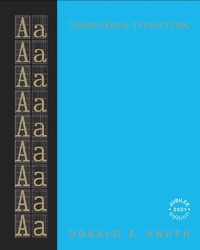
Computers & Typesetting, Volume A
The TeXbook
1st Edition
Published on 26. February 2022
496 pages
978-0-13-749417-0 (ISBN)
Description

A Complete User's Guide to Computer Typesetting with TeX
Now, 35 years after the first edition, the leading worldwide experts on these systems have spent several months inspecting every page thoroughly. We believe that every "i" has been properly dotted, every "t" has been properly crossed, and every bug has been properly exterminated.
Here is the definitive guide to the use of TeX, written by the system's creator, Donald E. Knuth.
TeX represents the state-of-the-art in computer typesetting. It is particularly valuable where the document, article, or book to be produced contains a lot of mathematics, and where the user is concerned about typographic quality. TeX software offers both writers and publishers the opportunity to produce technical text of all kinds, in an attractive form, with the speed and efficiency of a computer system.
Novice and expert users alike will gain from The TeXbook the level of information they seek. Knuth warns newcomers away from more difficult areas, while he entices experienced users with new challenges. The novice need not learn much about TeX to prepare a simple manuscript with it. But for the preparation of more complex documents, The TeXbook contains all the detail required.
Knuth's familiar wit, and illustrations specially drawn by Duane Bibby, add a light touch to an unusually readable software manual.
The TeXbook is the first in a five-volume series on Computers and Typesetting, all authored by Knuth. The TeXbook is also available in softcover.
Now, 35 years after the first edition, the leading worldwide experts on these systems have spent several months inspecting every page thoroughly. We believe that every "i" has been properly dotted, every "t" has been properly crossed, and every bug has been properly exterminated.
Here is the definitive guide to the use of TeX, written by the system's creator, Donald E. Knuth.
TeX represents the state-of-the-art in computer typesetting. It is particularly valuable where the document, article, or book to be produced contains a lot of mathematics, and where the user is concerned about typographic quality. TeX software offers both writers and publishers the opportunity to produce technical text of all kinds, in an attractive form, with the speed and efficiency of a computer system.
Novice and expert users alike will gain from The TeXbook the level of information they seek. Knuth warns newcomers away from more difficult areas, while he entices experienced users with new challenges. The novice need not learn much about TeX to prepare a simple manuscript with it. But for the preparation of more complex documents, The TeXbook contains all the detail required.
Knuth's familiar wit, and illustrations specially drawn by Duane Bibby, add a light touch to an unusually readable software manual.
The TeXbook is the first in a five-volume series on Computers and Typesetting, all authored by Knuth. The TeXbook is also available in softcover.
More details
Edition
1. Auflage
Language
English
Place of publication
Boston
United States
Publishing group
Pearson Education (US)
Target group
Professional and scholarly
File size
4,33 MB
ISBN-13
978-0-13-749417-0 (9780137494170)
Copyright in bibliographic data and cover images is held by Nielsen Book Services Limited or by the publishers or by their respective licensors: all rights reserved.
Schweitzer Classification
Other editions
Additional editions
Book
01/1986
Addison Wesley
€75.92
Article not available at the moment
Person
Donald E. Knuth is known throughout the world for his pioneering work on algorithms and programming techniques, for his invention of the Tex and Metafont systems for computer typesetting, and for his prolific and influential writing. Professor Emeritus of The Art of Computer Programming at Stanford University, he currently devotes full time to the completion of these fascicles and the seven volumes to which they belong.
Content
Preface v
Chapter 1: The Name of the Game 1
Chapter 2: Book Printing versus Ordinary Typing 3
Chapter 3: Controlling TeX 7
Chapter 4: Fonts of Type 13
Chapter 5: Grouping 19
Chapter 6: Running TeX 23
Chapter 7: How TeX Reads What You Type 37
Chapter 8: The Characters You Type 43
Chapter 9: TeX's Roman Fonts 51
Chapter 10: Dimensions 57
Chapter 11: Boxes 63
Chapter 12: Glue 69
Chapter 13: Modes 85
Chapter 14: How TEX Breaks Paragraphs into Lines 91
Chapter 15: How TEX Makes Lines into Pages 109
Chapter 16: Typing Math Formulas 127
Chapter 17: More about Math 139
Chapter 18: Fine Points of Mathematics Typing 161
Chapter 19: Displayed Equations 185
Chapter 20: Definitions (also called Macros) 199
Chapter 21: Making Boxes 221
Chapter 22: Alignment 231
Chapter 23: Output Routines 251
Chapter 24: Summary of Vertical Mode 267
Chapter 25: Summary of Horizontal Mode 285
Chapter 26: Summary of Math Mode 289
Chapter 27: Recovery from Errors 295
Appendix A: Answers to All the Exercises 305
Appendix B: Basic Control Sequences 339
Appendix C: Character Codes 367
Appendix D: Dirty Tricks 373
Appendix E: Example Formats 403
Appendix F: Font Tables 427
Appendix G: Generating Boxes from Formulas 441
Appendix H: Hyphenation 449
Appendix I: Index 457
Appendix J: Joining the TEX Community 483
Chapter 1: The Name of the Game 1
Chapter 2: Book Printing versus Ordinary Typing 3
Chapter 3: Controlling TeX 7
Chapter 4: Fonts of Type 13
Chapter 5: Grouping 19
Chapter 6: Running TeX 23
Chapter 7: How TeX Reads What You Type 37
Chapter 8: The Characters You Type 43
Chapter 9: TeX's Roman Fonts 51
Chapter 10: Dimensions 57
Chapter 11: Boxes 63
Chapter 12: Glue 69
Chapter 13: Modes 85
Chapter 14: How TEX Breaks Paragraphs into Lines 91
Chapter 15: How TEX Makes Lines into Pages 109
Chapter 16: Typing Math Formulas 127
Chapter 17: More about Math 139
Chapter 18: Fine Points of Mathematics Typing 161
Chapter 19: Displayed Equations 185
Chapter 20: Definitions (also called Macros) 199
Chapter 21: Making Boxes 221
Chapter 22: Alignment 231
Chapter 23: Output Routines 251
Chapter 24: Summary of Vertical Mode 267
Chapter 25: Summary of Horizontal Mode 285
Chapter 26: Summary of Math Mode 289
Chapter 27: Recovery from Errors 295
Appendix A: Answers to All the Exercises 305
Appendix B: Basic Control Sequences 339
Appendix C: Character Codes 367
Appendix D: Dirty Tricks 373
Appendix E: Example Formats 403
Appendix F: Font Tables 427
Appendix G: Generating Boxes from Formulas 441
Appendix H: Hyphenation 449
Appendix I: Index 457
Appendix J: Joining the TEX Community 483
