

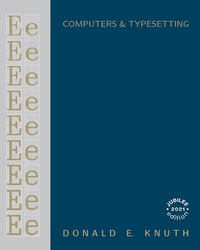
Computers & Typesetting, Volume E
Computer Modern Typefaces
1st Edition
Published on 29. November 2021
608 pages
978-0-13-749414-9 (ISBN)
Description

The Complete Design of a Large Family of Fonts
Now, 35 years after the first edition, the leading worldwide experts on these systems have spent several months inspecting every page thoroughly. We now believe that every "i" has been properly dotted, every "t" has been properly crossed, and every bug has been properly exterminated.
This volume contains precise definitions of about 500 letters, numerals, and other symbols, all described with METAFONT, Donald E. Knuth's revolutionary language for the design of typefaces.
Readers will learn how to make their own personal variations of the fonts, simply by changing a few parameters. Special symbols that are needed for unusual applications can also be created by using the many examples in this book as a model. More ambitious readers will be able to extend this work to other character sets, such as phonetic or Cyrillic alphabets. A close study of the details captured in these METAFONT programs will reveal many previously unpublished tricks that type designers have learned during the past centuries.
Computer Modern is a family of typefaces that includes 75 standard fonts, ranging from the sans-serif faces used to typeset the copy on this book jacket to the more formal alphabets and mathematical symbols used to typeset the text of the book itself. The 75 standard fonts can easily be extended to an essentially infinite number of further variations, because Computer Modern is a "meta-design" rather than a single design. In particular, this means that different point sizes of type can be drawn to different specifications, thereby obtaining better readability. Compatible typefaces can be generated for all sorts of printing equipment, ranging from low-resolution CRT displays to medium-resolution laser printers to high-resolution phototypesetters.
Charles Bigelow's introduction explains the history of the "modern" style of the type design, which originated 200 years ago and is being brought up to date by the developments in this book.
The type designs are accompanied by almost 750 illustrations, which are interesting in their own right as examples of mechanically constructed letterforms. Specimens of the 75 standard fonts appear near the close of this book, followed by several comprehensive indexes.
Computer Modern Typefaces is the fifth in a five-volume series on Computers and Typesetting, all authored by Knuth. This series presents the results of nearly a decade of innovative research on the problems of preparing publications of high typographic quality.
Now, 35 years after the first edition, the leading worldwide experts on these systems have spent several months inspecting every page thoroughly. We now believe that every "i" has been properly dotted, every "t" has been properly crossed, and every bug has been properly exterminated.
This volume contains precise definitions of about 500 letters, numerals, and other symbols, all described with METAFONT, Donald E. Knuth's revolutionary language for the design of typefaces.
Readers will learn how to make their own personal variations of the fonts, simply by changing a few parameters. Special symbols that are needed for unusual applications can also be created by using the many examples in this book as a model. More ambitious readers will be able to extend this work to other character sets, such as phonetic or Cyrillic alphabets. A close study of the details captured in these METAFONT programs will reveal many previously unpublished tricks that type designers have learned during the past centuries.
Computer Modern is a family of typefaces that includes 75 standard fonts, ranging from the sans-serif faces used to typeset the copy on this book jacket to the more formal alphabets and mathematical symbols used to typeset the text of the book itself. The 75 standard fonts can easily be extended to an essentially infinite number of further variations, because Computer Modern is a "meta-design" rather than a single design. In particular, this means that different point sizes of type can be drawn to different specifications, thereby obtaining better readability. Compatible typefaces can be generated for all sorts of printing equipment, ranging from low-resolution CRT displays to medium-resolution laser printers to high-resolution phototypesetters.
Charles Bigelow's introduction explains the history of the "modern" style of the type design, which originated 200 years ago and is being brought up to date by the developments in this book.
The type designs are accompanied by almost 750 illustrations, which are interesting in their own right as examples of mechanically constructed letterforms. Specimens of the 75 standard fonts appear near the close of this book, followed by several comprehensive indexes.
Computer Modern Typefaces is the fifth in a five-volume series on Computers and Typesetting, all authored by Knuth. This series presents the results of nearly a decade of innovative research on the problems of preparing publications of high typographic quality.
More details
Edition
1. Auflage
Language
English
Place of publication
Boston
United States
Publishing group
Pearson Education (US)
Target group
Professional and scholarly
File size
17,01 MB
ISBN-13
978-0-13-749414-9 (9780137494149)
Copyright in bibliographic data and cover images is held by Nielsen Book Services Limited or by the publishers or by their respective licensors: all rights reserved.
Schweitzer Classification
Other editions
Additional editions
Book
01/1986
Addison Wesley
€62.01
Article not available at the moment
