

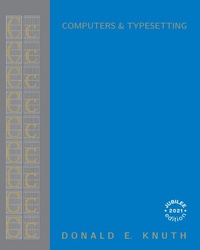
Computers & Typesetting, Volume C
The Metafont Book
1st Edition
Published on 29. November 2021
978-0-13-749422-4 (ISBN)
Description

A Complete User's Guide to Typeface Design with METAFONT
Now, 35 years after the first edition, the leading worldwide experts on these systems have spent several months inspecting every page thoroughly. We now believe that every "i" has been properly dotted, every "t" has been properly crossed, and every bug has been properly exterminated.
METAFONT, created by author Donald E. Knuth, is a computer language that allows you to produce professional quality typefaces using mathematical type design. The METAFONTbook, a users guide and reference manual, enables readers with only minimal computer science or word processing experience to master the basic as well as the more advanced areas of METAFONT programming.
Readers will learn how to write a program for each letter or symbol of a typeface. Using METAFONT, it is possible to customize a type design that already exists, or even to create an entire alphabet from scratch. It is particularly easy to create logos or special symbols. Advanced users will enjoy the freedom and artistry that METAFONT allows in creating original typefaces.
HIGHLIGHTS
Introduces concepts informally early in the text; in later chapters, these concepts are filled in with more detailed explanations.
Program exercises are found throughout the text with answers in an appendix.
Exercises and concepts of greater difficulty are marked with margin symbols. In this way, both beginning and experienced users of METAFONT can benefit.
The book is a companion text to Knuth's The TeXbook, since TeX can be used to typeset with fonts created using METAFONT.
Knuth's familiar wit, and illustrations specially drawn by Duane Bibby, add a light touch to an unusually readable software manual.
The METAFONTbook is the third in a five-volume series on Computers and Typesetting, all authored by Knuth.
Now, 35 years after the first edition, the leading worldwide experts on these systems have spent several months inspecting every page thoroughly. We now believe that every "i" has been properly dotted, every "t" has been properly crossed, and every bug has been properly exterminated.
METAFONT, created by author Donald E. Knuth, is a computer language that allows you to produce professional quality typefaces using mathematical type design. The METAFONTbook, a users guide and reference manual, enables readers with only minimal computer science or word processing experience to master the basic as well as the more advanced areas of METAFONT programming.
Readers will learn how to write a program for each letter or symbol of a typeface. Using METAFONT, it is possible to customize a type design that already exists, or even to create an entire alphabet from scratch. It is particularly easy to create logos or special symbols. Advanced users will enjoy the freedom and artistry that METAFONT allows in creating original typefaces.
HIGHLIGHTS
Introduces concepts informally early in the text; in later chapters, these concepts are filled in with more detailed explanations.
Program exercises are found throughout the text with answers in an appendix.
Exercises and concepts of greater difficulty are marked with margin symbols. In this way, both beginning and experienced users of METAFONT can benefit.
The book is a companion text to Knuth's The TeXbook, since TeX can be used to typeset with fonts created using METAFONT.
Knuth's familiar wit, and illustrations specially drawn by Duane Bibby, add a light touch to an unusually readable software manual.
The METAFONTbook is the third in a five-volume series on Computers and Typesetting, all authored by Knuth.
More details
Edition
1. Auflage
Language
English
Place of publication
Boston
United States
Publishing group
Pearson Education (US)
Target group
Professional and scholarly
File size
3,99 MB
ISBN-13
978-0-13-749422-4 (9780137494224)
Copyright in bibliographic data and cover images is held by Nielsen Book Services Limited or by the publishers or by their respective licensors: all rights reserved.
Schweitzer Classification
Other editions
Additional editions
Person
Donald E. Knuth is known throughout the world for his pioneering work on algorithms and programming techniques, for his invention of the Tex and Metafont systems for computer typesetting, and for his prolific and influential writing. Professor Emeritus of The Art of Computer Programming at Stanford University, he currently devotes full time to the completion of these fascicles and the seven volumes to which they belong.
Content
Preface v
Chapter 1: The Name of the Game 1
Chapter 2: Coordinates 5
Chapter 3: Curves 13
Chapter 4: Pens 21
Chapter 5: Running METAFONT 31
Chapter 6: How METAFONT Reads What You Type 49
Chapter 7: Variables 53
Chapter 8: Algebraic Expressions 59
Chapter 9: Equations 75
Chapter 10: Assignments 87
Chapter 11: Magnification and Resolution 91
Chapter 12: Boxes 101
Chapter 13: Drawing, Filling, and Erasing 109
Chapter 14: Paths 123
Chapter 15: Transformations 141
Chapter 16: Calligraphic Effects 147
Chapter 17: Grouping 155
Chapter 18: Definitions (also called Macros) 159
Chapter 19: Conditions and Loops 169
Chapter 20: More About Macros 175
Chapter 21: Random Numbers 183
Chapter 22: Strings 187
Chapter 23: Online Displays 191
Chapter 24: Discreteness and Discretion 195
Chapter 25: Summary of Expressions 209
Chapter 26: Summary of the Language 217
Chapter 27: Recovery from Errors 223
Appendix A: Answers to All the Exercises 233
Appendix B: Basic Operations 257
Appendix C: Character Codes 281
Appendix D: Dirty Tricks 285
Appendix E: Examples 301
Appendix F: Font Metric Information 315
Appendix G: Generic Font Files 323
Appendix H: Hardcopy Proofs 327
Appendix I: Index 345
Appendix J: Joining the TEX Community 361
Chapter 1: The Name of the Game 1
Chapter 2: Coordinates 5
Chapter 3: Curves 13
Chapter 4: Pens 21
Chapter 5: Running METAFONT 31
Chapter 6: How METAFONT Reads What You Type 49
Chapter 7: Variables 53
Chapter 8: Algebraic Expressions 59
Chapter 9: Equations 75
Chapter 10: Assignments 87
Chapter 11: Magnification and Resolution 91
Chapter 12: Boxes 101
Chapter 13: Drawing, Filling, and Erasing 109
Chapter 14: Paths 123
Chapter 15: Transformations 141
Chapter 16: Calligraphic Effects 147
Chapter 17: Grouping 155
Chapter 18: Definitions (also called Macros) 159
Chapter 19: Conditions and Loops 169
Chapter 20: More About Macros 175
Chapter 21: Random Numbers 183
Chapter 22: Strings 187
Chapter 23: Online Displays 191
Chapter 24: Discreteness and Discretion 195
Chapter 25: Summary of Expressions 209
Chapter 26: Summary of the Language 217
Chapter 27: Recovery from Errors 223
Appendix A: Answers to All the Exercises 233
Appendix B: Basic Operations 257
Appendix C: Character Codes 281
Appendix D: Dirty Tricks 285
Appendix E: Examples 301
Appendix F: Font Metric Information 315
Appendix G: Generic Font Files 323
Appendix H: Hardcopy Proofs 327
Appendix I: Index 345
Appendix J: Joining the TEX Community 361
