

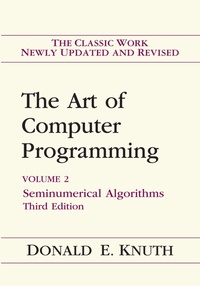
Art of Computer Programming, The
Seminumerical Algorithms, Volume 2
3rd Edition
Published on 6. May 2014
784 pages
978-0-321-63576-1 (ISBN)
Description

The bible of all fundamental algorithms and the work that taught many of today's software developers most of what they know about computer programming.
-Byte, September 1995
I can't begin to tell you how many pleasurable hours of study and recreation they have afforded me! I have pored over them in cars, restaurants, at work, at home... and even at a Little League game when my son wasn't in the line-up.
-Charles Long
If you think you're a really good programmer... read [Knuth's] Art of Computer Programming... You should definitely send me a resume if you can read the whole thing.
-Bill Gates
It's always a pleasure when a problem is hard enough that you have to get the Knuths off the shelf. I find that merely opening one has a very useful terrorizing effect on computers.
-Jonathan Laventhol
The second volume offers a complete introduction to the field of seminumerical algorithms, with separate chapters on random numbers and arithmetic. The book summarizes the major paradigms and basic theory of such algorithms, thereby providing a comprehensive interface between computer programming and numerical analysis. Particularly noteworthy in this third edition is Knuth's new treatment of random number generators, and his discussion of calculations with formal power series.
Ebook (PDF version) produced by Mathematical Sciences Publishers (MSP),http://msp.org
-Byte, September 1995
I can't begin to tell you how many pleasurable hours of study and recreation they have afforded me! I have pored over them in cars, restaurants, at work, at home... and even at a Little League game when my son wasn't in the line-up.
-Charles Long
If you think you're a really good programmer... read [Knuth's] Art of Computer Programming... You should definitely send me a resume if you can read the whole thing.
-Bill Gates
It's always a pleasure when a problem is hard enough that you have to get the Knuths off the shelf. I find that merely opening one has a very useful terrorizing effect on computers.
-Jonathan Laventhol
The second volume offers a complete introduction to the field of seminumerical algorithms, with separate chapters on random numbers and arithmetic. The book summarizes the major paradigms and basic theory of such algorithms, thereby providing a comprehensive interface between computer programming and numerical analysis. Particularly noteworthy in this third edition is Knuth's new treatment of random number generators, and his discussion of calculations with formal power series.
Ebook (PDF version) produced by Mathematical Sciences Publishers (MSP),http://msp.org
More details
Edition
3rd edition
Language
English
Place of publication
United States
Publishing group
Pearson Education (US)
Target group
College/higher education
File size
9,51 MB
ISBN-13
978-0-321-63576-1 (9780321635761)
Copyright in bibliographic data and cover images is held by Nielsen Book Services Limited or by the publishers or by their respective licensors: all rights reserved.
Schweitzer Classification
Other editions
Additional editions
Book
01/1998
3rd Edition
Addison Wesley
€74.50
Shipment within 3-4 weeks
Person
Donald E. Knuth is known throughout the world for his pioneering work on algorithms and programming techniques, for his invention of the Tex and Metafont systems for computer typesetting, and for his prolific and influential writing. Professor Emeritus of The Art of Computer Programming at Stanford University, he currently devotes full time to the completion of these fascicles and the seven volumes to which they belong.
Content
3. Random Numbers.
Introduction.
Generating Uniform Random Numbers.
The Linear Congruential Method.
Other Methods.
Statistical Tests.
General Test Procedures for Studying Random Data.
Empirical Tests.
Theoretical Tests.
The Spectral Test.
Other Types of Random Quantities.
Numerical Distributions.
Random Sampling and Shuffling.
What Is a Random Sequence?
Summary.
4. Arithmetic.
Positional Number Systems.
Floating Point Arithmetic.
Single-Precision Calculations.
Accuracy of Floating Point Arithmetic.
Double-Precision Calculations.
Distribution of Floating Point Numbers.
Multiple Precision Arithmetic.
The Classical Algorithms.
Modular Arithmetic.
How Fast Can We Multiply?
Radix Conversion.
Rational Arithmetic.
Fractions.
The Greatest Common Divisor.
Analysis of Euclid's Algorithm.
Factoring into Primes.
Polynomial Arithmetic.
Division of Polynomials.
Factorization of Polynomials.
Evaluation of Powers.
Evaluation of Polynomials.
Manipulation of Power Series.
Answers to Exercises.
Appendix A. Tables of Numerical Quantities.
Fundamental Constants (decimal).
Fundamental Constants (octal).
Harmonic Numbers, Bernoulli Numbers, Fibonacci Numbers.
Appendix B. Index to Notations.
Index and Glossary. 0201896842T03062003
Introduction.
Generating Uniform Random Numbers.
The Linear Congruential Method.
Other Methods.
Statistical Tests.
General Test Procedures for Studying Random Data.
Empirical Tests.
Theoretical Tests.
The Spectral Test.
Other Types of Random Quantities.
Numerical Distributions.
Random Sampling and Shuffling.
What Is a Random Sequence?
Summary.
4. Arithmetic.
Positional Number Systems.
Floating Point Arithmetic.
Single-Precision Calculations.
Accuracy of Floating Point Arithmetic.
Double-Precision Calculations.
Distribution of Floating Point Numbers.
Multiple Precision Arithmetic.
The Classical Algorithms.
Modular Arithmetic.
How Fast Can We Multiply?
Radix Conversion.
Rational Arithmetic.
Fractions.
The Greatest Common Divisor.
Analysis of Euclid's Algorithm.
Factoring into Primes.
Polynomial Arithmetic.
Division of Polynomials.
Factorization of Polynomials.
Evaluation of Powers.
Evaluation of Polynomials.
Manipulation of Power Series.
Answers to Exercises.
Appendix A. Tables of Numerical Quantities.
Fundamental Constants (decimal).
Fundamental Constants (octal).
Harmonic Numbers, Bernoulli Numbers, Fibonacci Numbers.
Appendix B. Index to Notations.
Index and Glossary. 0201896842T03062003
