

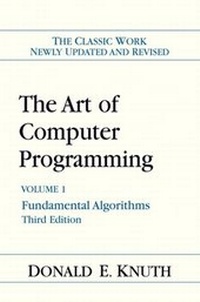
Art of Computer Programming, The
Volume 1: Fundamental Algorithms
3rd Edition
Published on 4. July 1997
672 pages
978-0-13-348878-4 (ISBN)
Description

&>The bible of all fundamental algorithms and the work that taught many of today's software developers most of what they know about computer programming.
-Byte, September 1995
I can't begin to tell you how many pleasurable hours of study and recreation they have afforded me! I have pored over them in cars, restaurants, at work, at home... and even at a Little League game when my son wasn't in the line-up.
-Charles Long
If you think you're a really good programmer... read [Knuth's] Art of Computer Programming... You should definitely send me a resume if you can read the whole thing.
-Bill Gates
It's always a pleasure when a problem is hard enough that you have to get the Knuths off the shelf. I find that merely opening one has a very useful terrorizing effect on computers.
-Jonathan Laventhol
This first volume in the series begins with basic programming concepts and techniques, then focuses more particularly on information structures-the representation of information inside a computer, the structural relationships between data elements and how to deal with them efficiently. Elementary applications are given to simulation, numerical methods, symbolic computing, software and system design. Dozens of simple and important algorithms and techniques have been added to those of the previous edition. The section on mathematical preliminaries has been extensively revised to match present trends in research.
Ebook (PDF version) produced by Mathematical Sciences Publishers (MSP),http://msp.org
-Byte, September 1995
I can't begin to tell you how many pleasurable hours of study and recreation they have afforded me! I have pored over them in cars, restaurants, at work, at home... and even at a Little League game when my son wasn't in the line-up.
-Charles Long
If you think you're a really good programmer... read [Knuth's] Art of Computer Programming... You should definitely send me a resume if you can read the whole thing.
-Bill Gates
It's always a pleasure when a problem is hard enough that you have to get the Knuths off the shelf. I find that merely opening one has a very useful terrorizing effect on computers.
-Jonathan Laventhol
This first volume in the series begins with basic programming concepts and techniques, then focuses more particularly on information structures-the representation of information inside a computer, the structural relationships between data elements and how to deal with them efficiently. Elementary applications are given to simulation, numerical methods, symbolic computing, software and system design. Dozens of simple and important algorithms and techniques have been added to those of the previous edition. The section on mathematical preliminaries has been extensively revised to match present trends in research.
Ebook (PDF version) produced by Mathematical Sciences Publishers (MSP),http://msp.org
All prices
More details
Edition
3rd edition
Language
English
Place of publication
Boston
United States
Publishing group
Pearson Education (US)
Target group
Professional and scholarly
File size
37,22 MB
ISBN-13
978-0-13-348878-4 (9780133488784)
Copyright in bibliographic data and cover images is held by Nielsen Book Services Limited or by the publishers or by their respective licensors: all rights reserved.
Schweitzer Classification
Other editions
Additional editions

KNUTH
The Art of Computer Programming: Volume One Fundamental Algorithms Wss: Knuth: Art Comp Prog 3e Wss
Volume One Fundamental Algorithms Wss
Book
08/1997
3rd Edition
Addison Wesley
€52.00
Article exhausted; check for reprint
Donald Knuth | Donald E. Knuth
Art of Computer Programming, The: Fundamental Algorithms, Volume 1
Fundamental Algorithms, Volume 1
Book
08/1997
3rd Edition
Addison Wesley
€74.50
Article in reprint
Person
Donald E. Knuth is known throughout the world for his pioneering work on algorithms and programming techniques, for his invention of the Tex and Metafont systems for computer typesetting, and for his prolific and influential writing. Professor Emeritus of The Art of Computer Programming at Stanford University, he currently devotes full time to the completion of these fascicles and the seven volumes to which they belong.
Content
1. Basic Concepts.
Algorithms.
Mathematical Preliminaries.
Mathematical Induction.
Numbers, Powers, and Logarithms.
Sums and Products.
Integer Functions and Elementary Number Theory.
Permutations and Factorials.
Binomial Coefficients.
Harmonic Numbers.
Fibonacci Numbers.
Generating Functions.
Analysis of an Algorithm.
Asymptotic Representations.
MIX.
Description of MIX.
The MIX Assembly Language.
Applications to Permutations.
Some Fundamental Programming Techniques.
Subroutines.
Coroutines.
Interpretive Routines.
Input and Output.
History and Bibliography.
2. Information Structures.
Introduction.
Linear Lists.
Stacks, Queues, and Deques.
Sequential Allocation.
Linked Allocation.
Circular Lists.
Doubly Linked Lists.
Arrays and Orthogonal Lists.
Trees.
Traversing Binary Trees.
Binary Tree Representation of Trees.
Other Representations of Trees.
Basic Mathematical Properties of Trees.
Lists and Garbage Collection.
Multilinked Structures.
Dynamic Storage Allocation.
History and Bibliography.
Answers to Exercises.
Appendix A. Tables of Numerical Quantities.
1. Fundamental Constants (decimal).
2. Fundamental Constants (octal).
3. Harmonic Numbers, Bernoulli Numbers, Fibonacci Numbers.
Appendix B. Index to Notations.
Index and Glossary. 0201896834T02272003
Algorithms.
Mathematical Preliminaries.
Mathematical Induction.
Numbers, Powers, and Logarithms.
Sums and Products.
Integer Functions and Elementary Number Theory.
Permutations and Factorials.
Binomial Coefficients.
Harmonic Numbers.
Fibonacci Numbers.
Generating Functions.
Analysis of an Algorithm.
Asymptotic Representations.
MIX.
Description of MIX.
The MIX Assembly Language.
Applications to Permutations.
Some Fundamental Programming Techniques.
Subroutines.
Coroutines.
Interpretive Routines.
Input and Output.
History and Bibliography.
2. Information Structures.
Introduction.
Linear Lists.
Stacks, Queues, and Deques.
Sequential Allocation.
Linked Allocation.
Circular Lists.
Doubly Linked Lists.
Arrays and Orthogonal Lists.
Trees.
Traversing Binary Trees.
Binary Tree Representation of Trees.
Other Representations of Trees.
Basic Mathematical Properties of Trees.
Lists and Garbage Collection.
Multilinked Structures.
Dynamic Storage Allocation.
History and Bibliography.
Answers to Exercises.
Appendix A. Tables of Numerical Quantities.
1. Fundamental Constants (decimal).
2. Fundamental Constants (octal).
3. Harmonic Numbers, Bernoulli Numbers, Fibonacci Numbers.
Appendix B. Index to Notations.
Index and Glossary. 0201896834T02272003
