

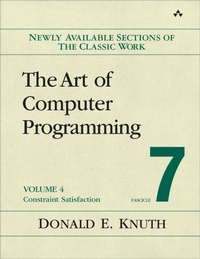
Art of Computer Programming, Volume 4, Fascicle 7, The
Constraint Satisfaction
Published on 6. March 2025
304 pages
978-0-13-532834-7 (ISBN)
Description

The Art of Computer Programming is a multivolume work on the analysis of algorithms and has long been recognized as the definitive description of classical computer science. The five volumes published to date--Volumes 1, 2, 3, 4A, and 4B--already comprise a unique and invaluable resource in programming theory and practice. Countless readers have spoken about the profound personal influence of Knuth's writings. Scientists have marveled at the beauty and elegance of his analysis, while practicing programmers have successfully applied his "cookbook" solutions to their day-to-day problems. All have admired Knuth for the breadth, clarity, accuracy, and good humor found in his books.
To continue the set, and to update parts of the existing volumes, Knuth has created a series of small books called fascicles, which are published at regular intervals. Each fascicle encompasses a section or more of wholly new or revised material. Ultimately, the content of these fascicles will be rolled up into the comprehensive, final versions of each volume, and the enormous undertaking that began in 1962 will be complete.
Volume 4, Fascicle 7, which is brimming with lively examples, forms the first third of what will eventually become hardcover Volume 4C. It introduces and explores an important general framework for modeling and solving combinatorial problems, called the Constraint Satisfaction Problem (CSP). The concluding sections of Volume 4B contain expositions of two analogous frameworks, namely XCC ("exact covering with colors") and SAT ("Boolean satisfiability"); the XCC solvers and SAT solvers are now joined by CSP solvers, completing a powerful trio of techniques. Each member of the trio has its own strengths, while separately helping to understand the other two.
This fascicle illuminates how the CSP framework is tied to dozens of other parts of computer science: Scene analysis (computer vision); efficient algorithms that embed one graph in another; fascinating instances of "graceful graphs"; new ways to look ahead when backtracking; new heuristics to guide a search that backtracks through a massive space of possibilities; situations when backtracking isn't necessary.
New sparse-set data structures are introduced, leading to a technique called "dancing cells"--which often is even better than "dancing links"! Recreational topics appear throughout, including some new takes on the classic problem of a knight's tour, as well as modern puzzles such as fillomino.
Nearly 500 exercises are provided, arranged carefully for self-instruction, together with detailed answers (in fact, sometimes also with answers to the answers). All the while, the author pays significant attention to the history of the subject and its human dimensions.
To continue the set, and to update parts of the existing volumes, Knuth has created a series of small books called fascicles, which are published at regular intervals. Each fascicle encompasses a section or more of wholly new or revised material. Ultimately, the content of these fascicles will be rolled up into the comprehensive, final versions of each volume, and the enormous undertaking that began in 1962 will be complete.
Volume 4, Fascicle 7, which is brimming with lively examples, forms the first third of what will eventually become hardcover Volume 4C. It introduces and explores an important general framework for modeling and solving combinatorial problems, called the Constraint Satisfaction Problem (CSP). The concluding sections of Volume 4B contain expositions of two analogous frameworks, namely XCC ("exact covering with colors") and SAT ("Boolean satisfiability"); the XCC solvers and SAT solvers are now joined by CSP solvers, completing a powerful trio of techniques. Each member of the trio has its own strengths, while separately helping to understand the other two.
This fascicle illuminates how the CSP framework is tied to dozens of other parts of computer science: Scene analysis (computer vision); efficient algorithms that embed one graph in another; fascinating instances of "graceful graphs"; new ways to look ahead when backtracking; new heuristics to guide a search that backtracks through a massive space of possibilities; situations when backtracking isn't necessary.
New sparse-set data structures are introduced, leading to a technique called "dancing cells"--which often is even better than "dancing links"! Recreational topics appear throughout, including some new takes on the classic problem of a knight's tour, as well as modern puzzles such as fillomino.
Nearly 500 exercises are provided, arranged carefully for self-instruction, together with detailed answers (in fact, sometimes also with answers to the answers). All the while, the author pays significant attention to the history of the subject and its human dimensions.
More details
Language
English
Place of publication
Boston
United States
Publishing group
Pearson Education (US)
Target group
Professional and scholarly
College/higher education
File size
22,81 MB
ISBN-13
978-0-13-532834-7 (9780135328347)
Copyright in bibliographic data and cover images is held by Nielsen Book Services Limited or by the publishers or by their respective licensors: all rights reserved.
Schweitzer Classification
Other editions
Additional editions
Donald Knuth | Donald E. Knuth
Art of Computer Programming, Volume 4, Fascicle 7, The: Constraint Satisfaction
Constraint Satisfaction
Book
05/2025
1st Edition
Addison Wesley
€34.49
Available immediately
Person
Donald E. Knuth is known throughout the world for his pioneering work on algorithms and programming techniques, for his invention of the TeX and METAFONT systems for computer typesetting, and for his prolific and influential writing (26 books, 161 papers). Professor Emeritus of The Art of Computer Programming at Stanford University, he currently devotes full time to the completion of his seminal multivolume series on classical computer science, begun in 1962 when he was a graduate student at California Institute of Technology. Professor Knuth is the recipient of numerous awards and honors, including the ACM Turing Award, the Medal of Science presented by President Carter, the AMS Steele Prize for expository writing, and, in November, 1996, the prestigious Kyoto Prize for advanced technology. He lives on the Stanford campus with his wife, Jill.
Content
Preface iii
7.2.2.3 Constraint satisfaction 1
Answers to Exercises 158
Index to Algorithms and Theorems 262
Answers to Puzzles in the Answers 263
Index and Glossary 264
7.2.2.3 Constraint satisfaction 1
Answers to Exercises 158
Index to Algorithms and Theorems 262
Answers to Puzzles in the Answers 263
Index and Glossary 264
