

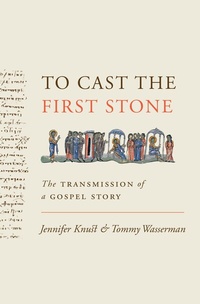
To Cast the First Stone
The Transmission of a Gospel Story
1st Edition
Published on 14. January 2019
464 pages
978-0-691-18446-3 (ISBN)
Description

The story of the woman taken in adultery features a dramatic confrontation between Jesus and the Pharisees over whether the adulteress should be stoned as the law commands. In response, Jesus famously states, "Let him who is without sin be the first to throw a stone at her." To Cast the First Stone traces the history of this provocative story from its first appearance to its enduring presence today.
Likely added to the Gospel of John in the third century, the passage is often held up by modern critics as an example of textual corruption by early Christian scribes and editors, yet a judgment of corruption obscures the warm embrace the story actually received. Jennifer Knust and Tommy Wasserman trace the story's incorporation into Gospel books, liturgical practices, storytelling, and art, overturning the mistaken perception that it was either peripheral or suppressed, even in the Greek East. The authors also explore the story's many different meanings. Taken as an illustration of the expansiveness of Christ's mercy, the purported superiority of Christians over Jews, the necessity of penance, and more, this vivid episode has invited any number of creative receptions. This history reveals as much about the changing priorities of audiences, scribes, editors, and scholars as it does about an "original" text of John.
To Cast the First Stone calls attention to significant shifts in Christian book cultures and the enduring impact of oral tradition on the preservation-and destabilization-of scripture.
Likely added to the Gospel of John in the third century, the passage is often held up by modern critics as an example of textual corruption by early Christian scribes and editors, yet a judgment of corruption obscures the warm embrace the story actually received. Jennifer Knust and Tommy Wasserman trace the story's incorporation into Gospel books, liturgical practices, storytelling, and art, overturning the mistaken perception that it was either peripheral or suppressed, even in the Greek East. The authors also explore the story's many different meanings. Taken as an illustration of the expansiveness of Christ's mercy, the purported superiority of Christians over Jews, the necessity of penance, and more, this vivid episode has invited any number of creative receptions. This history reveals as much about the changing priorities of audiences, scribes, editors, and scholars as it does about an "original" text of John.
To Cast the First Stone calls attention to significant shifts in Christian book cultures and the enduring impact of oral tradition on the preservation-and destabilization-of scripture.
More details
Other editions
Additional editions
Book
01/2020
Princeton University Press
€40.00
Shipment within 10-20 days
Book
11/2018
Princeton University Press
€55.71
Shipment within 10-20 days
Persons
Jennifer Knust is associate professor of New Testament and Christian origins at Boston University. Her books include Unprotected Texts: The Bible's Surprising Contradictions about Sex and Desire. Tommy Wasserman is professor of Biblical studies at Ansgar Teologiske Høgskole in Norway. His books include The Epistle of Jude: Its Text and Transmission.
Content
- Cover
- Title
- Copyright
- Dedication
- CONTENTS
- List of Illustrations and Tables
- Acknowledgments
- Abbreviations
- Introduction: Loose Texts, Loose Women
- Plan of the Work
- PART I. A CASE OF TEXTUAL CORRUPTION?
- 1 The Pericope Adulterae and the Rise of Modern New Testament Scholarship
- The Pericope Adulterae and the Rise of Modern Textual Criticism
- The Demise of the Textus Receptus
- The Defense of the "Majority Text"
- The Pericope Adulterae and Biblical Scholarship
- A History of the Pericope Adulterae
- PART II. THE PRESENT AND ABSENT PERICOPE ADULTERAE
- 2 The Strange Case of the Missing Adulteress
- Citation Habits and Ancient Literary Methods
- Allusions to the Pericope Adulterae
- The Transmission of the Gospel of John in the Second and Third Centuries
- Book Copying, Book Collecting, and the Material Gospels
- The Format of John
- Textual Correction (??????s??) and the Text of John in the Third Century
- Agrapha and the Gospel Tradition
- Introducing the Adulteress
- 3 Was the Pericope Adulterae Suppressed? Part I: Ancient Editorial Practice and the (Un)Likelihood of Outright Deletion
- The Suppression Theory from Augustine until Today
- Marcion, Theological Bowdlerizing, and "Taking Away from" the Scriptures
- Marcion's New Testament
- Scribal Habits, Textual Omissions, and the Possible Deletion of the Pericope Adulterae
- The Pericope Adulterae and the Discipline of Textual Correction
- Correction (d?????s??), the Corrector (d?????t??), and the Scholarly Edition (??d?s??)
- Origen the ??????t??
- An Unlikely Deletion
- 4 Was the Pericope Adulterae Suppressed? Part II: Adulteresses and Their Opposites
- Prostitutes and Adulteresses from the Gospels to Roman Law
- Heroines of Israel
- Roman Chastity
- Stories People Want
- A Slandered Adulteress
- An Adulteress Forgiven
- Driving Out the Adulteress
- The Adulteress Found
- PART III. A DIVIDED TRADITION? THE PERICOPE ADULTERAE EAST AND WEST
- 5 "In Certain Gospels"? The Pericope Adulterae and the Fourfold Gospel Tradition
- The Pericope Adulterae and the Fourth-Century Greek Text of John
- Eusebius, the Bible, and the Text of the Gospels in the Fourth Century
- Eusebius and Fourth-Century Biblical Production
- Sinaiticus, Vaticanus, and the Problem of Provenance
- Was the Johannine Pericope Adulterae Deleted at a Later Date?
- Didymus the Blind and the Text of John in Egypt
- In Some Copies
- In the Gospels
- Jesus, the Adulteress, and Didymus the Blind
- Traces of the Pericope Adulterae in Egypt
- 6 "In Many Copies": The Pericope Adulterae in the Latin West
- Ambrose and the Old Latin Text of the Pericope Adulterae
- The Pericope Adulterae and the Making of the Vulgate Gospels
- "In Many Copies": The Pericope Adulterae in Jerome's Against the Pelagians
- Codex Bezae and the Johannine Pericope Adulterae
- In Certain Gospels
- PART IV. LITURGICAL AND SCHOLARLY AFTERLIVES OF THE PERICOPE ADULTERAE
- 7 A Pearl of the Gospel: The Pericope Adulterae in Late Antiquity
- The Tenacity of the Pericope Adulterae
- Capitula, Kephalaia, and the Johannine Pericope Adulterae
- Latin Capitula and the Greek Pericope Adulterae
- The Greek Kephalaia and the History of the Pericope Adulterae
- The Pericope Adulterae and the Development of the Byzantine Liturgy
- The Significance of Skipping
- The Constantinopolitan Liturgy and the Transmission of the Pericope Adulterae
- A Treasured Pearl
- 8 Telling Stories in Church: The Early Medieval Liturgy and the Reception of the Pericope Adulterae
- The Roman and Constantinopolitan Lectionaries and the Reception of the Pericope Adulterae
- The Impact of the Roman Lectionary
- What Is Heard: Traces of the Pericope Adulterae in the Byzantine Liturgy
- What Is Seen: Traces of the Pericope Adulterae in Byzantine Art
- The Pericope Adulterae between East and West
- Concluding Reflections: An Enduring Memory
- Bibliography
- Index of Scripture and Other Ancient Writings
- Index of Manuscripts
- Subject Index
