

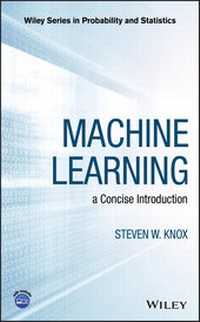
Machine Learning
Description

PROSE Award Finalist 2019
Association of American Publishers Award for Professional and Scholarly Excellence
Machine Learning: a Concise Introduction offers a comprehensive introduction to the core concepts, approaches, and applications of machine learning. The author--an expert in the field--presents fundamental ideas, terminology, and techniques for solving applied problems in classification, regression, clustering, density estimation, and dimension reduction. The design principles behind the techniques are emphasized, including the bias-variance trade-off and its influence on the design of ensemble methods. Understanding these principles leads to more flexible and successful applications. Machine Learning: a Concise Introduction also includes methods for optimization, risk estimation, and model selection-- essential elements of most applied projects. This important resource:
* Illustrates many classification methods with a single, running example, highlighting similarities and differences between methods
* Presents R source code which shows how to apply and interpret many of the techniques covered
* Includes many thoughtful exercises as an integral part of the text, with an appendix of selected solutions
* Contains useful information for effectively communicating with clients
A volume in the popular Wiley Series in Probability and Statistics, Machine Learning: a Concise Introduction offers the practical information needed for an understanding of the methods and application of machine learning.
STEVEN W. KNOX holds a Ph.D. in Mathematics from the University of Illinois and an M.S. in Statistics from Carnegie Mellon University. He has over twenty years' experience in using Machine Learning, Statistics, and Mathematics to solve real-world problems. He currently serves as Technical Director of Mathematics Research and Senior Advocate for Data Science at the National Security Agency.
More details
Other editions
Additional editions
Person
STEVEN W. KNOX holds a Ph.D. in Mathematics from the University of Illinois and an M.S. in Statistics from Carnegie Mellon University. He has over twenty years' experience in using Machine Learning, Statistics, and Mathematics to solve real-world problems. He currently serves as Technical Director of Mathematics Research and Senior Advocate for Data Science at the National Security Agency.
Content
Preface xi
Organization-How to Use This Book xiii
Acknowledgments xvii
About the Companion Website xix
1 Introduction-Examples from Real Life 1
2 The Problem of Learning 3
2.1 Domain 4
2.2 Range 4
2.3 Data 4
2.4 Loss 6
2.5 Risk 8
2.6 The Reality of the Unknown Function 12
2.7 Training and Selection of Models, and Purposes of Learning 12
2.8 Notation 13
3 Regression 15
3.1 General Framework 16
3.2 Loss 17
3.3 Estimating the Model Parameters 17
3.4 Properties of Fitted Values 19
3.5 Estimating the Variance 22
3.6 A Normality Assumption 23
3.7 Computation 24
3.8 Categorical Features 25
3.9 Feature Transformations, Expansions, and Interactions 27
3.10 Variations in Linear Regression 28
3.11 Nonparametric Regression 32
4 Survey of Classification Techniques 33
4.1 The Bayes Classifier 34
4.2 Introduction to Classifiers 37
4.3 A Running Example 38
4.4 Likelihood Methods 40
4.4.1 Quadratic Discriminant Analysis 41
4.4.2 Linear Discriminant Analysis 43
4.4.3 Gaussian Mixture Models 45
4.4.4 Kernel Density Estimation 47
4.4.5 Histograms 51
4.4.6 The Naive Bayes Classifier 54
4.5 Prototype Methods 54
4.5.1 k-Nearest-Neighbor 55
4.5.2 Condensed k-Nearest-Neighbor 56
4.5.3 Nearest-Cluster 56
4.5.4 Learning Vector Quantization 58
4.6 Logistic Regression 59
4.7 Neural Networks 62
4.7.1 Activation Functions 62
4.7.2 Neurons 64
4.7.3 Neural Networks 65
4.7.4 Logistic Regression and Neural Networks 73
4.8 Classification Trees 74
4.8.1 Classification of Data by Leaves (Terminal Nodes) 74
4.8.2 Impurity of Nodes and Trees 75
4.8.3 Growing Trees 76
4.8.4 Pruning Trees 79
4.8.5 Regression Trees 81
4.9 Support Vector Machines 81
4.9.1 Support Vector Machine Classifiers 81
4.9.2 Kernelization 88
4.9.3 Proximal Support Vector Machine Classifiers 92
4.10 Postscript: Example Problem Revisited 93
5 Bias-Variance Trade-off 97
5.1 Squared-Error Loss 98
5.2 Arbitrary Loss 101
6 Combining Classifiers 107
6.1 Ensembles 107
6.2 Ensemble Design 110
6.3 Bootstrap Aggregation (Bagging) 112
6.4 Bumping 115
6.5 Random Forests 116
6.6 Boosting 118
6.7 Arcing 121
6.8 Stacking and Mixture of Experts 121
7 Risk Estimation and Model Selection 127
7.1 Risk Estimation via Training Data 128
7.2 Risk Estimation via Validation or Test Data 128
7.2.1 Training, Validation, and Test Data 128
7.2.2 Risk Estimation 129
7.2.3 Size of Training, Validation, and Test Sets 130
7.2.4 Testing Hypotheses About Risk 131
7.2.5 Example of Use of Training, Validation, and Test Sets 132
7.3 Cross-Validation 133
7.4 Improvements on Cross-Validation 135
7.5 Out-of-Bag Risk Estimation 137
7.6 Akaike's Information Criterion 138
7.7 Schwartz's Bayesian Information Criterion 138
7.8 Rissanen's Minimum Description Length Criterion 139
7.9 R2 and Adjusted R2 140
7.10 Stepwise Model Selection 141
7.11 Occam's Razor 142
8 Consistency 143
8.1 Convergence of Sequences of Random Variables 144
8.2 Consistency for Parameter Estimation 144
8.3 Consistency for Prediction 145
8.4 There Are Consistent and Universally Consistent Classifiers 145
8.5 Convergence to Asymptopia Is Not Uniform and May Be Slow 147
9 Clustering 149
9.1 Gaussian Mixture Models 150
9.2 k-Means 150
9.3 Clustering by Mode-Hunting in a Density Estimate 151
9.4 Using Classifiers to Cluster 152
9.5 Dissimilarity 153
9.6 k-Medoids 153
9.7 Agglomerative Hierarchical Clustering 154
9.8 Divisive Hierarchical Clustering 155
9.9 How Many Clusters Are There? Interpretation of Clustering 155
9.10 An Impossibility Theorem 157
10 Optimization 159
10.1 Quasi-Newton Methods 160
10.1.1 Newton's Method for Finding Zeros 160
10.1.2 Newton's Method for Optimization 161
10.1.3 Gradient Descent 161
10.1.4 The BFGS Algorithm 162
10.1.5 Modifications to Quasi-Newton Methods 162
10.1.6 Gradients for Logistic Regression and Neural Networks 163
10.2 The Nelder-Mead Algorithm 166
10.3 Simulated Annealing 168
10.4 Genetic Algorithms 168
10.5 Particle Swarm Optimization 169
10.6 General Remarks on Optimization 170
10.6.1 Imperfectly Known Objective Functions 170
10.6.2 Objective Functions Which Are Sums 171
10.6.3 Optimization from Multiple Starting Points 172
10.7 The Expectation-Maximization Algorithm 173
10.7.1 The General Algorithm 173
10.7.2 EM Climbs the Marginal Likelihood of the Observations 173
10.7.3 Example-Fitting a Gaussian Mixture Model Via EM 176
10.7.4 Example-The Expectation Step 177
10.7.5 Example-The Maximization Step 178
11 High-Dimensional Data 179
11.1 The Curse of Dimensionality 180
11.2 Two Running Examples 187
11.2.1 Example 1: Equilateral Simplex 187
11.2.2 Example 2: Text 187
11.3 Reducing Dimension While Preserving Information 190
11.3.1 The Geometry of Means and Covariances of Real Features 190
11.3.2 Principal Component Analysis 192
11.3.3 Working in "Dissimilarity Space" 193
11.3.4 Linear Multidimensional Scaling 195
11.3.5 The Singular Value Decomposition and Low-Rank Approximation 197
11.3.6 Stress-Minimizing Multidimensional Scaling 199
11.3.7 Projection Pursuit 199
11.3.8 Feature Selection 201
11.3.9 Clustering 202
11.3.10 Manifold Learning 202
11.3.11 Autoencoders 205
11.4 Model Regularization 209
11.4.1 Duality and the Geometry of Parameter Penalization 212
11.4.2 Parameter Penalization as Prior Information 213
12 Communication with Clients 217
12.1 Binary Classification and Hypothesis Testing 218
12.2 Terminology for Binary Decisions 219
12.3 ROC Curves 219
12.4 One-Dimensional Measures of Performance 224
12.5 Confusion Matrices 225
12.6 Multiple Testing 226
12.6.1 Control the Familywise Error 226
12.6.2 Control the False Discovery Rate 227
12.7 Expert Systems 228
13 Current Challenges in Machine Learning 231
13.1 Streaming Data 231
13.2 Distributed Data 231
13.3 Semi-supervised Learning 232
13.4 Active Learning 232
13.5 Feature Construction via Deep Neural Networks 233
13.6 Transfer Learning 233
13.7 Interpretability of Complex Models 233
14 R Source Code 235
14.1 Author's Biases 236
14.2 Libraries 236
14.3 The Running Example (Section 4.3) 237
14.4 The Bayes Classifier (Section 4.1) 241
14.5 Quadratic Discriminant Analysis (Section 4.4.1) 243
14.6 Linear Discriminant Analysis (Section 4.4.2) 243
14.7 Gaussian Mixture Models (Section 4.4.3) 244
14.8 Kernel Density Estimation (Section 4.4.4) 245
14.9 Histograms (Section 4.4.5) 248
14.10 The Naive Bayes Classifier (Section 4.4.6) 253
14.11 k-Nearest-Neighbor (Section 4.5.1) 255
14.12 Learning Vector Quantization (Section 4.5.4) 257
14.13 Logistic Regression (Section 4.6) 259
14.14 Neural Networks (Section 4.7) 260
14.15 Classification Trees (Section 4.8) 263
14.16 Support Vector Machines (Section 4.9) 267
14.17 Bootstrap Aggregation (Section 6.3) 272
14.18 Boosting (Section 6.6) 274
14.19 Arcing (Section 6.7) 275
14.20 Random Forests (Section 6.5) 275
A List of Symbols 277
B Solutions to Selected Exercises 279
C Converting Between Normal Parameters and Level-Curve Ellipsoids 299
D Training Data and Fitted Parameters 301
References 305
Index 315
2
The Problem of Learning
Far better an approximate answer to the right question, which is often vague, than an exact answer to the wrong question, which can always be made precise.
-John Tukey, The Future of Data Analysis, 1962
This book treats The Problem of Learning, which can be stated generally and succinctly as follows.
The Problem of Learning. There are a known set and an unknown function f on . Given data, construct a good approximation of f. This is called learning f.
The problem of learning has been studied in many guises and in different fields, such as statistics, computer science, mathematics, and the natural and social sciences. An advantage of this situation is that the set of methods now available for addressing the problem has benefited from a tremendous diversity of perspective and knowledge. A disadvantage is a certain lack of coherence in the language used to describe the problem: there are, perhaps, more names for things than there are things which need names, and this can make the study of the problem of learning appear more complicated and confusing than it really is.
This chapter introduces the main ideas which occur in almost any applied problem in learning, and introduces language commonly used to describe these ideas. The ideas and language introduced here will be used in every other chapter of this book.
2.1 Domain
The set is called feature space and an element is called a feature vector (or an input). The coordinates of X are called features. Individual features may take values in a continuum, a discrete, ordered set, or a discrete, unordered set.
In Problem 1 ("Shuttle"), is an interval of possible air temperatures: (- 60, 140) Fahrenheit, say, or [0, 8) Kelvin. In Problem 4 ("ZIP Code"), is the set of all 8 × 8 matrices with entries in {0, 1, ., 255}. In Problem 2 ("Ballot"), is {0, 1, 2, .}m for the given number of features m, each feature being a count of people or votes, though in practice might well be taken to be the m-dimensional real numbers, .
2.2 Range
The range is usually either a finite, unordered set, in which case learning is called classification,1 or it is a continuum, in which case learning is called regression.2 An element is called a class in classification and a response in regression.
In Problem 1 ("Shuttle"), , the set of probabilities that an O-ring is damaged.3 In Problem 4 ("Postal Code"), {"0", "1", "2", "3", "4", "5", "6", "7", "8", "9"}, the quotes indicating that these are unordered labels rather than numbers. In Problem 2 ("Ballot"), is the set of non-negative integers less than or equal to the number of registered voters in Palm Beach County, but in practice would usually be taken to be , the set of real numbers.
2.3 Data
In principle, data are random draws (X, Y) from a probability distribution on . Depending on the problem at hand, the data which are observed may either consist of domain-range pairs (X, Y) or just domain values X: learning is called supervised in the former case and unsupervised in the latter.
In supervised learning, the data are
where each (xi, yi) is drawn from a joint probability distribution on . Such data are called marked data.4 It is sometimes useful to consider the data as produced by a two-step process, in one of two ways: by drawing y from marginal distribution on and then drawing a corresponding feature vector x from conditional distribution on ; or by drawing feature vector x from marginal distribution on and then drawing a corresponding y from conditional distribution on . These two points of view correspond to the two factorizations,5
Both are useful in classification. The latter is more useful in regression, where the function f to be learned is often, though not necessarily, the expected value of the conditional distribution of Y | X, that is,
In unsupervised learning, the data are6
Such data are called unmarked data. The range is either assumed to be finite, in which case unsupervised learning is called clustering, or it is [0, 8) and the function f to be learned is the mass or density function of the marginal distribution of the features,
in which case unsupervised learning is called density estimation. In clustering problems, the size of the range, , may or may not be known: usually it is not.
Problem 1 ("Shuttle") is supervised learning, since the data are of the form
Problem 6 ("Vaults") is unsupervised learning, and is unknown (though archaeologists might have other evidence outside the data - such as artifacts recovered from the vaults or related sites - which indicates that, for example, ).
Figure 2.1 summarizes some of the terminology introduced so far and illustrates some connections between the four learning problems mentioned.
Figure 2.1 Four categories of learning problems, in bold type, split according to whether the range of f is finite (and unordered) or continuous, and whether or not elements of the range are observed directly. Some solutions to these problems are devised by transforming one problem into another: examples of this are shown in red and described in Chapters 3, 4, 6, and 9.
Sometimes both marked and unmarked data are available. This situation is called semi-supervised learning.7
2.4 Loss
What does "a good approximation" mean? This is specified by a loss function
where for each , is the loss, or penalty, incurred by approximating y with . Common examples are:
In classification, an arbitrary loss function can be specified by the cells of a C × C loss matrix, usually with all-zero diagonal elements and positive off-diagonal elements (so correct classification incurs no loss and misclassification incurs positive loss). Zero-one loss is represented by the C × C matrix with 0's on the diagonal and 1's everywhere off the diagonal.
Some techniques for solving classification problems focus on estimating the conditional probability distribution on class labels, given the feature vector,
(such techniques translate a classification problem into a regression problem, following the top-most red arrow in Figure 2.1). Let
denote an estimate of this vector. Predicted class labels, , are obtained from this estimated probability distribution in some way: for example, by predicting the most probable class. Techniques which do this essentially convert a classification problem into a regression problem, solve the regression problem, and apply the solution to classification. A loss function8 often used in such cases is
The choice of loss function is subjective and problem-dependent.9 An asymmetric loss function is sometimes appropriate: for example, in Problem 3 ("Heart"), declaring a healthy person to be sick may be viewed as a much less costly error than declaring a sick person to be healthy.10 That said, loss functions are often chosen for convenience and computational tractability.11 Exercises in Sections 3.6 and 4.6, respectively, derive squared-error loss and cross-entropy loss from the (subjective) principle that the best model in a class of models is one which assigns maximal likelihood to the observed data.
Exercise 2.1 The Kullback-Leibler information12 (also called cross-entropy) for discriminating between discrete probability distributions p and q on the set {1, ., C} is
It is sometimes interpreted as "the cost of using q in place of p when the true distribution is p," where the "cost" refers to loss of efficiency in encoding data drawn from distribution p (see Cover and Thomas (2006) for a full explanation). When a datum is class y, the true class probability vector is t = (0, ., 0, 1, 0, ., 0), where the single 1 occurs in position y.13 Show that cross-entropy loss is the same as Kullback-Leibler information:
2.5 Risk
A standard criterion for a "good" approximation of f is one which minimizes the expected loss,14 known as the generalization error or risk. Usually the expectation is with respect to the joint probability distribution on points .
The risk of approximation at point is the expected loss incurred by using in place of Y for new data (X, Y) such that X = x,
The response variable Y is treated as random, with the conditional distribution , while the input X = x and trained classifier are treated as fixed.15 Choosing an approximation to minimize the risk of at...
