

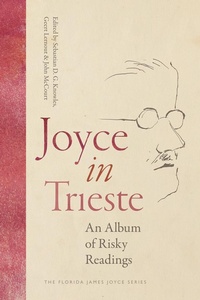
Joyce in Trieste
Description

A celebration of the transformative effects of James Joyce's time in Trieste
Joyce in Trieste is a record of the transformation in text, meaning, and language that Trieste worked upon James Joyce. This volume begins with three path-breaking essays: Michael Groden's discussion of the manuscripts acquired by the National Library of Ireland in 2002, Margot Norris's introduction of the paradigm of ?risky reading? to describe the provocative re-contextualizations in history, theory, and culture that reveal something new about Joyce's work, and Zack Bowen's celebration of the Platonic and erotic qualities of Joyce's language.
Each essay opens up to a section that follows the opening lead: essays on manuscript genetics following Groden, a political set of essays following Norris, and a set of essays on language following Bowen. This volume provides a lively and useful summary of recent and future directions of Joyce scholarship and will be of particular interest to Joyce and Irish studies scholars as well as those interested in provocative readings of twentieth-century literature.
More details
Other editions
Additional editions
Persons
Sebastian D. G. Knowles is professor emeritus of English at Ohio State University. Geert Lernout is professor emeritus at the University of Antwerp. He is general editor of European Joyce Studies and Genetic Joyce Studies. John McCourt is codirector of the University of Trieste's Trieste Joyce School. He is the author of The Years of Bloom: Joyce in Trieste, 1904?1920.
Contributors: Hugo Azerad | Zack Bowen | Austin Briggs | Brian G. Caraher | Nick De Marco | Michael Groden | Arye Kendi | Hugh Kenner | Borislav Knezevic | Sebastian D. G. Knowles | Ira B. Nadel | Margot Norris | Vike Martina Plock | Richard Robinson | Andre Topia | Carla Marengo Vaglio | Dirk Van Hulle
Content
List of Illustrations
Foreword
Acknowledgments
List of Abbreviations
Introduction
Sebastian D. G. Knowles
I. Reading Joyce: Text, Meaning, and Language
1. The National Library of Ireland's New Joyce Manuscripts
Michael Groden
2. Risky Reading of Risky Writing
Margot Norris
3. Plato, Homer, and Joyce: Involving Orientalism, a Smidgeon of Smut, and a Pinch of Perverse Egotism
Zack Bowen
II. Text: Genetic Readings
4. Narrative as Potential: The Virus and the Program
Andre Topia
5. ?Oxen of the Sun? and the Gestation of the Word
Nick De Marco
6. Dame Plurabelle: Joyce's Art of Decomposition and Recombination
Dirk Van Hulle
7. ?Negative Utopia? in James Joyce, Walter Benjamin, and Ernst Bloch
Hugo Azerad
III. Meaning: Political Readings
8. Why Does Gerty Limp?
Vike Martina Plock
9. A ?ruin of all space, shattered glass and toppling masonry?: Reading Nightmares of Orientalist History in Joyce's Ulysses
Brian G. Caraher
10. ?Nothing doing. Still an idea behind it?: The Restoration of Zion
Arye Kendi
11. Is There a Class to Renounce in This Text? Gentlemanly Ideology in A Portrait of the Artist
Borislav Knezevic
12. Buckley in a General Russia: Finnegans Wake and Political Space
Richard Robinson
IV. Language: Joycean Readings
13. Jim the Comedian
Hugh Kenner
14. Breakfast at 7 Eccles Street: Oeufs Sacher-Masoch?
Austin Briggs
15. Molly's Mediterranean Meals and Other Joycean Cuisines: An Essay with Recipes
Ira B. Nadel
16. Cinematic Joyce: Mediterranean Joyce
Carla Marengo Vaglio
List of Contributors
Index
