
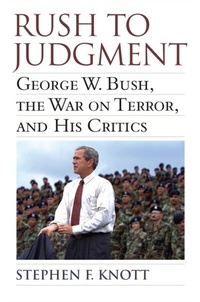
Rush to Judgment
Description
Alles über E-Books | Antworten auf Fragen rund um E-Books, Kopierschutz und Dateiformate finden Sie in unserem Info- & Hilfebereich.
George W. Bush has been branded the worst president in history and forced to endure accusations that he abused his power while presiding over a ?lawless? administration. Stephen Knott, however, contends that Bush has been treated unfairly, especially by presidential historians and the media. He argues that from the beginning scholars abandoned any pretense at objectivity in their critiques and seemed unwilling to place Bush's actions into a broader historical context.
In this provocative book, Knott offers a measured critique of the professoriate for its misuse of scholarship for partisan political purposes, a defense of the Hamiltonian perspective on the extent and use of executive power, and a rehabilitation of Bush's reputation from a national security viewpoint. He argues that Bush's conduct as chief executive was rooted in a tradition extending as far back as George Washington?not an ?imperial presidency? but rather an activist one that energetically executed its constitutional prerogatives.
Given that one of the main indictments of Bush focuses on his alleged abuse of presidential war power, Knott takes on academic critics like Sean Wilentz and Arthur Schlesinger Jr. and journalists like Charlie Savage to argue instead that Bush conducted the War on Terror in a manner faithful to the Framers' intent?that in situations involving national security he rightly assumed powers that neither Congress nor the courts can properly restrain. Knott further challenges Bush's detractors for having applied a relatively recent, revisionist understanding of the Constitution in arguing that Bush's actions were out of bounds.
Ultimately, Knott makes a worthy case that, while Bush was not necessarily a great president, his national security policies were in keeping with the practices of America's most revered presidents and, for that reason alone, he deserves a second look by those who have condemned him to the ash heap of history. All readers interested in the presidency and in American history writ large will find Rush to Judgment a deftly argued, perhaps deeply unsettling, yet balanced account of the Bush presidency?and a clarion call for a reexamination of how scholars determine presidential greatness and failure.
All prices
More details
Other editions
Additional editions
Person
Content
Introduction: The Worst President in History?
1. Bush's Role Models
2. Bush's Inheritance: An Imperiled Presidency
3. John Paul Stevens, Commander in Chief
4. Slouching Toward 9/11
5. War President
6. A Bold but Excessively Loyal Commander in Chief
7. Bush's "Diabolical" Signing Statements
Conclusion: An Unfair Indictment
Notes
Index

System requirements
File format: ePUB
Copy protection: Adobe-DRM (Digital Rights Management)
System requirements:
- Computer (Windows; MacOS X; Linux): Install the free reader Adobe Digital Editions prior to download (see eBook Help).
- Tablet/smartphone (Android; iOS): Install the free app Adobe Digital Editions or the app PocketBook before downloading (see eBook Help).
- E-reader: Bookeen, Kobo, Pocketbook, Sony, Tolino and many more (not Kindle).
The file format ePub works well for novels and non-fiction books – i.e., „flowing” text without complex layout. On an e-reader or smartphone, line and page breaks automatically adjust to fit the small displays.
This eBook uses Adobe-DRM, a „hard” copy protection. If the necessary requirements are not met, unfortunately you will not be able to open the eBook. You will therefore need to prepare your reading hardware before downloading.
Please note: We strongly recommend that you authorise using your personal Adobe ID after installation of any reading software.
For more information, see our ebook Help page.
File format: PDF
Copy-Protection: Adobe-DRM (Digital Rights Management)
System requirements:
- Computer (Windows; MacOS X; Linux): Install the free reader Adobe Digital Editions prior to download (see eBook Help).
- Tablet/smartphone (Android; iOS): Install the free app Adobe Digital Editions or the app PocketBook before downloading (see eBook Help).
- E-reader: Bookeen, Kobo, Pocketbook, Sony, Tolino and many more (only limited: Kindle).
The file format PDF always displays a book page identically on any hardware. This makes PDF suitable for complex layouts such as those used in textbooks and reference books (images, tables, columns, footnotes). Unfortunately, on the small screens of e-readers or smartphones, PDFs are rather annoying, requiring too much scrolling.
This eBook uses Adobe-DRM, a „hard” copy protection. If the necessary requirements are not met, unfortunately you will not be able to open the eBook. You will therefore need to prepare your reading hardware before downloading.
Please note: We strongly recommend that you authorise using your personal Adobe ID after installation of any reading software.
For more information, see our eBook Help page.
File format: ePUB
Copy protection: Watermark-DRM (Digital Rights Management)
System requirements:
- Computer (Windows; MacOS X; Linux): Use a reading software that can process the file format ePUB: e.g., Adobe Digital Editions or FBReader – both free (see eBook Help).
- Tablet/Smartphone (Android; iOS): Before downloading, install the free app Adobe Digital Editions (see eBook Help).
- E-reader: Bookeen, Kobo, Pocketbook, Sony, Tolino and many more (not Kindle).
The file format ePUB works well for novels and non-fiction books – i.e., „flowing” text without complex layout. On an e-reader or smartphone, line and page breaks automatically adjust to fit the small displays.
This eBook uses Watermark-DRM, a „soft” copy protection. This means that there are no technical restrictions to prevent illegal distribution. However, there is a personalised watermark embedded in the eBook that can be used to identify the purchaser of the eBook in the event of misuse and to provide evidence for legal purposes.
For more information, see our eBook Help page.
