

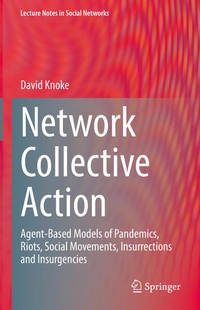
Network Collective Action
Description

Collective action asks a fundamental question in social science: How do sets of actors
choose courses of action and work together to achieve desired outcomes, often in
opposition to other coalitions? Psychological and economic rationality explanations are
incomplete in emphasizing the mental decision processes of individuals. Collective
action must be understood at the level analysis of interpersonal and interorganizational
relations. Social network theories and methods provide optimal frameworks for
explaining collective action in a variety of settings. This book reviews theories and
empirical research on collective action in several substantive areas, demonstrates how
agent-based models can analyze collective action networks (pandemics, riots, social
movements, insurrections, insurgencies), and concludes with speculations about future
research directions.
More details
Other editions
Additional editions
Person
David Knoke is a professor of sociology at the University of Minnesota, where he
teaches courses in social networks, organizations, healthcare systems, terrorism, social
science fiction, and statistics. He received a Ph.D. from the University of Michigan in
1972 and was professor of sociology at Indiana University from 1972 to 1985. Knoke
was a Fulbright research scholar at Kiel University in Germany (1989) and a fellow at
the Center for Advanced Study in the Behavioral Sciences (1992). In 1996-99 he was
named a University of Minnesota College of Liberal Arts Scholar of the College. In 2008,
he received the University of Minnesota College of Liberal Arts' Arthur "Red" Motley
Exemplary Teaching Award. With various colleagues, David Knoke received several
National Science Foundation research grants and published the results in research
monographs on political, organizational, and social network behavior. Some of these
books are
The Organizational State, Organizing for Collective Action, Political Networks,
Organizations in America, Comparing Policy Networks, Changing Organizations, Social Network Analysis, Economic Networks, and Multimodal Political Networks. His current research investigates diverse social networks, including intra- and interorganizational, healthcare, economic, financial, terrorist and counterterror networks.
Content
Chapter 1. Theories of Collective Action.- Chapter 2. Agent-Based Models of Collective Action.- Chapter 3. Contagious Social Networks.- Chapter 4. Social Movement Networks.- Chapter 5. Insurgent Networks.- Chapter 6. Economic Networks and Global Warming.- Chapter 7. Looking Forward.
