

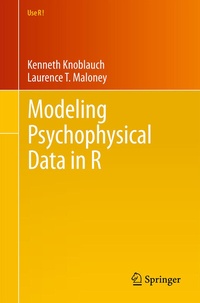
Modeling Psychophysical Data in R
Description

Many of the commonly used methods for modeling and fitting psychophysical data are special cases of statistical procedures of great power and generality, notably the Generalized Linear Model (GLM). This book illustrates how to fit data from a variety of psychophysical paradigms using modern statistical methods and the statistical language R. The paradigms include signal detection theory, psychometric function fitting, classification images and more. In two chapters, recently developed methods for scaling appearance, maximum likelihood difference scaling and maximum likelihood conjoint measurement are examined. The authors also consider the application of mixed-effects models to psychophysical data.
R is an open-source programming language that is widely used by statisticians and is seeing enormous growth in its application to data in all fields. It is interactive, containing many powerful facilities for optimization, model evaluation, model selection, and graphical display of data. The reader who fits data in R can readily make use of these methods. The researcher who uses R to fit and model his data has access to most recently developed statistical methods.
This book does not assume that the reader is familiar with R, and a little experience with any programming language is all that is needed to appreciate this book. There are large numbers of examples of R in the text and the source code for all examples is available in an R package MPDiR available through R.
Kenneth Knoblauch is a researcher in the Department of Integrative Neurosciences in Inserm Unit 846, The Stem Cell and Brain Research Institute and associated with the University Claude Bernard, Lyon 1, in France.
Laurence T. Maloney is Professor of Psychology and Neural Science at New York University. His research focusses on applications of mathematical models to perception, motor control and decision making.
Reviews / Votes
Although the applications of R presented in this text are focused on the analysis of psychophysical data, the methodology is generalizable to many other areas in statistics. For example, coverage of solving equations by maximum likelihood and the various general linear model functions are applicable in many situations which occur in statistical data analysis. I found the discussion of ROC analysis to be very useful in many other areas of statistics also. Therefore, I would recommend this text to anyone who works with, or is interested in, psychophysical data or even to anyone who wants to increase their knowledge of R.
Technometrics, 56:1 2014
More details
Other editions
Additional editions
Persons
Laurence T. Maloney is Professor of Psychology and Neural Science at New York University. His research focusses on applications of mathematical models to perception, motor control and decision making.
