

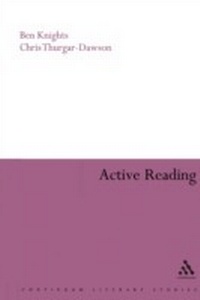
Active Reading
Transformative Writing in Literary Studies
1st Edition
Published on 1. June 2008
208 pages
978-1-4411-7150-4 (ISBN)
Description

The subject of this book is the crossover between critical study and creative writing. 'Active reading' is a structured process of writing activities using imitation, variation and experimentation. Through practical composition techniques such as 'transformational writing', 're-writing' or 'translation', students can use writing activities to develop their critical imagination.
This book bridges the gap between theories of learning and Literary studies in Higher Education. Setting the argument in an historical and theoretical context, it outlines the importance of writing as a medium of learning and argues for its usefulness in aiding English students' understanding of theoretical as well as literary and cultural texts. The authors provide a reflective account of teaching and assessment methods using writing activities and critical thinking techniques and the forms of learning they promote. In the last section, they explore the connections with other forms of writing practice in related disciplines and argue for the role of transformational writing in promoting independent learning.
Appendices provide examples of the range of activities that can be used and an indicative list of literary examples.
This book bridges the gap between theories of learning and Literary studies in Higher Education. Setting the argument in an historical and theoretical context, it outlines the importance of writing as a medium of learning and argues for its usefulness in aiding English students' understanding of theoretical as well as literary and cultural texts. The authors provide a reflective account of teaching and assessment methods using writing activities and critical thinking techniques and the forms of learning they promote. In the last section, they explore the connections with other forms of writing practice in related disciplines and argue for the role of transformational writing in promoting independent learning.
Appendices provide examples of the range of activities that can be used and an indicative list of literary examples.
Reviews / Votes
'...a terrific addition to any English department. It describes a practical rather than theoretical route to understanding English literature. The writing is meticulous, thoroughly researched and trustworthy...This way of learning makes sense to me...In many ways, this is the bridge-building book...between creative writing and literature, between the elitism of the critics and the writing process and between all the other disciplines that could benefit from this approach. I would recommend it.' Rosie Garner, Lapidus Autumn 2007 'This is an important book, valuable in the first instance not only to student teachers and NQTs but also to those teaching in HE who need convincing of the value of using transformative writing as a literary tool...The enthusiasm of both students and teachers comes across clearly. There is a wide variety of examples given not only of students' writing in response to specified passages and authors but also, and very revealingly, of the ways in which this writing was assessed...' Adrian Barlow, Newsletter of The English Association. 'Active Reading is a welcome contribution to the transformation of English from a subject in which ideological suspicion, inexperience and uneven institutional support ... conspire with other factors against the lecturer who ventures beyond self-improvement into scholarly enquiry into teaching ... Ben Knights is a key figure in an emerging pedagogical research culture in English... engrossing and insightful.' Dr Greg Garrard, Staff and Educational Development Association Mention -Book News, February 2009 Reviewed in The Use of English. "Rosie Garner of Lapidus declares that this well-produced book is 'a terrific addition to any English deparment' and reveals that 'it describes a practical rather than a theoretical route to understanding English literature' : but it is no 'addition' at all precisely because its terms of reference are so very 'theoretical'and 'professionalized' . No less respected an authority than Adrian Barlow adds that this book will be 'valuable...not only to student teachers and NQTs but also to those teaching in HE" The Use of EnglishMore details
Series
Edition
1. Auflage
Language
English
Place of publication
New York
United States
Target group
Professional and scholarly
ISBN-13
978-1-4411-7150-4 (9781441171504)
Copyright in bibliographic data and cover images is held by Nielsen Book Services Limited or by the publishers or by their respective licensors: all rights reserved.
Schweitzer Classification
Other editions
Additional editions
Book
06/2008
Continuum International Publishing Group Ltd.
€83.70
Shipment within 3-4 weeks
Persons
Professor Ben Knights is Director of the English Subject Centre (part of the Higher Education Academy) and is a National Teaching Fellow at the University of Teesside, UK. Chris Thurgar-Dawson is a Senior Lecturer in English at the University of Teesside, UK.
Content
Preface
PART I: Pedagogic Context
1. Contexts
2. History and theory of a practice
3. From influence to intertextuality: literary production as re-making
4. Writing and literary criticism
PART II: Teaching, Learning and Assessment
5. Introductions, starters
6. Developing the group
7. As the work matures
8. Assessment
PART III: Beyond the Classroom
9. Creative and transformative writing in psychotherapy, counselling and CPD
10. Towards the autonomous learner
Annotated bibliography
Appendices:
Examples of activities
Notes on choosing texts and anthologies
Indicative list of literary examples
Bibliography
Index
PART I: Pedagogic Context
1. Contexts
2. History and theory of a practice
3. From influence to intertextuality: literary production as re-making
4. Writing and literary criticism
PART II: Teaching, Learning and Assessment
5. Introductions, starters
6. Developing the group
7. As the work matures
8. Assessment
PART III: Beyond the Classroom
9. Creative and transformative writing in psychotherapy, counselling and CPD
10. Towards the autonomous learner
Annotated bibliography
Appendices:
Examples of activities
Notes on choosing texts and anthologies
Indicative list of literary examples
Bibliography
Index
