

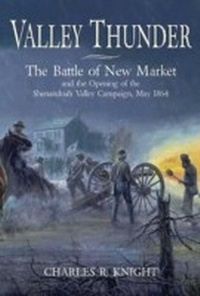
Valley Thunder
The Battle of New Market and the Opening of the Shenandoah Valley Campaign May 1864
1st Edition
Published on 30. December 2007
264 pages
978-1-61121-054-5 (ISBN)
Description

An "exciting and informative" account of the Civil War battle that opened the 1864 Shenandoah Valley Campaign, with illustrations included (
Lone Star Book Review).
Charles Knight's Valley Thunder is the first full-length account in decades to examine the combat at New Market on May 15, 1864 that opened the pivotal Shenandoah Valley Campaign.
Lt. Gen. Ulysses S. Grant, who set in motion the wide-ranging operation to subjugate the South in 1864, intended to attack on multiple fronts so the Confederacy could no longer "take advantage of interior lines." A key to success in the Eastern Theater was control of the Shenandoah Valley, an agriculturally abundant region that helped feed Gen. Robert E. Lee's Army of Northern Virginia. Grant tasked Maj. Gen. Franz Sigel, a German immigrant with a mixed fighting record, and a motley collection of units numbering some 10,000 men to clear the Valley and threaten Lee's left flank. Opposing Sigel was Maj. Gen. (and former US Vice President) John C. Breckinridge, who assembled a scratch command to repulse the Federals. Included in his 4,500-man army were Virginia Military Institute cadets under the direction of Lt. Col. Scott Ship, who'd marched eighty miles in four days to fight Sigel.
When the armies faced off at New Market, Breckinridge told the cadets, "Gentlemen, I trust I will not need your services today; but if I do, I know you will do your duty." The sharp fighting seesawed back and forth during a drenching rainstorm, and wasn't concluded until the cadets were inserted into the battle line to repulse a Federal attack and launch one of their own.
The Union forces were driven from the Valley, but would return, reinforced and under new leadership, within a month. Before being repulsed, they would march over the field at New Market and capture Staunton, burn VMI in Lexington (partly in retaliation for the cadets' participation at New Market), and very nearly capture Lynchburg. Operations in the Valley on a much larger scale that summer would permanently sweep the Confederates from the "Bread Basket of the Confederacy."
Valley Thunder is based on years of primary research and a firsthand appreciation of the battlefield terrain. Knight's objective approach includes a detailed examination of the complex prelude leading up to the battle, and his entertaining prose introduces soldiers, civilians, and politicians who found themselves swept up in one of the war's most gripping engagements.
Charles Knight's Valley Thunder is the first full-length account in decades to examine the combat at New Market on May 15, 1864 that opened the pivotal Shenandoah Valley Campaign.
Lt. Gen. Ulysses S. Grant, who set in motion the wide-ranging operation to subjugate the South in 1864, intended to attack on multiple fronts so the Confederacy could no longer "take advantage of interior lines." A key to success in the Eastern Theater was control of the Shenandoah Valley, an agriculturally abundant region that helped feed Gen. Robert E. Lee's Army of Northern Virginia. Grant tasked Maj. Gen. Franz Sigel, a German immigrant with a mixed fighting record, and a motley collection of units numbering some 10,000 men to clear the Valley and threaten Lee's left flank. Opposing Sigel was Maj. Gen. (and former US Vice President) John C. Breckinridge, who assembled a scratch command to repulse the Federals. Included in his 4,500-man army were Virginia Military Institute cadets under the direction of Lt. Col. Scott Ship, who'd marched eighty miles in four days to fight Sigel.
When the armies faced off at New Market, Breckinridge told the cadets, "Gentlemen, I trust I will not need your services today; but if I do, I know you will do your duty." The sharp fighting seesawed back and forth during a drenching rainstorm, and wasn't concluded until the cadets were inserted into the battle line to repulse a Federal attack and launch one of their own.
The Union forces were driven from the Valley, but would return, reinforced and under new leadership, within a month. Before being repulsed, they would march over the field at New Market and capture Staunton, burn VMI in Lexington (partly in retaliation for the cadets' participation at New Market), and very nearly capture Lynchburg. Operations in the Valley on a much larger scale that summer would permanently sweep the Confederates from the "Bread Basket of the Confederacy."
Valley Thunder is based on years of primary research and a firsthand appreciation of the battlefield terrain. Knight's objective approach includes a detailed examination of the complex prelude leading up to the battle, and his entertaining prose introduces soldiers, civilians, and politicians who found themselves swept up in one of the war's most gripping engagements.
More details
Other editions
Additional editions
Book
05/2010
Savas Beatie
€44.76
Article exhausted; check different version
Person
Charles R. Knight is a native of Richmond, Virginia. He is a former Historical Interpreter at New Market Battlefield State Historical Park, and currently serves as the curator of the Douglas MacArthur Memorial. Charlie has written articles for various Civil War and railroad publications, including Blue & Gray, Classic Trains, and NRHS Bulletin. He lives in Norfolk, Virginia, with his wife and son.
Content
- Intro
- Cover Page
- Title Page
- Copyright Page
- Dedication Page
- Frontmatter1
- Contents
- Maps
- Frontmatter2
- Foreword
- Introduction
- Acknowledgments
- Chapter 1: The Breadbasket of the Confederacy
- Chapter 2: Fighting Mit Sigel
- Chapter 3: "We are in for business now"
- Chapter 4: Into the Valley of Defeat
- Chapter 5: "We will give them a warm reception"
- Chapter 6: "Hold New Market at all hazards"
- Chapter 7: "We can whip them here"
- Chapter 8: "Are they driving us?"
- Chapter 9: "I felt so confident of success"
- Chapter 10: "Fame!"
- Appendix 1: Order of Battle at New Market (with strengths)
- Appendix 2: After-Action Battle Reports for John C. Breckinridge (CSA) and Franz Sigel (USA)
- Appendix 3: The 54th Pennsylvania Infantry at New Market
- Appendix 4: The Bushong family, George Collins, and New Market Battlefield State Historical Park
- Appendix 5: The Role of the 23rd Virginia Cavalry at New Market
- Appendix 6: Breckinridge, Imboden, and the Confederate Flanking Operation East of Smith' s Creek
- Appendix 7: John C. Breckinridge and the "Shell-struck Post"
- Appendix 8: Where Woodson' s Heroes Fell: The 1st Missouri Cavalry at New Market
- Footnotes
- Bibliography
- About the author
