

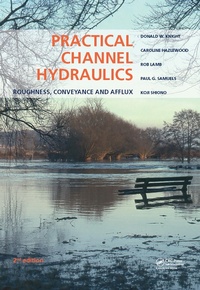
Practical Channel Hydraulics, 2nd edition
Roughness, Conveyance and Afflux
1st Edition
Published on 5. March 2018
634 pages
978-1-351-65464-7 (ISBN)
Description

Practical Channel Hydraulics is a technical guide for estimating flood water levels in rivers using the innovative software known as the Conveyance and Afflux Estimation System (CES-AES). The stand alone software is freely available at HR Wallingford's website www.river-conveyance.net. The conveyance engine has also been embedded within industry standard river modelling software such as InfoWorks RS and Flood Modeller Pro. This 2nd Edition has been greatly expanded through the addition of Chapters 6-8, which now supply the background to the Shiono and Knight Method (SKM), upon which the CES-AES is largely based.
With the need to estimate river levels more accurately, computational methods are now frequently embedded in flood risk management procedures, as for example in ISO 18320 ('Determination of the stage-discharge relationship'), in which both the SKM and CES feature. The CES-AES incorporates five main components: A Roughness Adviser, A Conveyance Generator, an Uncertainty Estimator, a Backwater Module and an Afflux Estimator. The SKM provides an alternative approach, solving the governing equation analytically or numerically using Excel, or with the short FORTRAN program provided.
Special attention is paid to calculating the distributions of boundary shear stress distributions in channels of different shape, and to appropriate formulations for resistance and drag forces, including those on trees in floodplains. Worked examples are given for flows in a wide range of channel types (size, shape, cover, sinuosity), ranging from small scale laboratory flumes (Q = 2.0 1s-1) to European rivers (~2,000 m3s-1), and large-scale world rivers (> 23,000 m3s-1), a ~ 107 range in discharge. Sites from rivers in the UK, France, China, New Zealand and Ecuador are considered.
Topics are introduced initially at a simplified level, and get progressively more complex in later chapters. This book is intended for post graduate level students and practising engineers or hydrologists engaged in flood risk management, as well as those who may simply just wish to learn more about modelling flows in rivers.
With the need to estimate river levels more accurately, computational methods are now frequently embedded in flood risk management procedures, as for example in ISO 18320 ('Determination of the stage-discharge relationship'), in which both the SKM and CES feature. The CES-AES incorporates five main components: A Roughness Adviser, A Conveyance Generator, an Uncertainty Estimator, a Backwater Module and an Afflux Estimator. The SKM provides an alternative approach, solving the governing equation analytically or numerically using Excel, or with the short FORTRAN program provided.
Special attention is paid to calculating the distributions of boundary shear stress distributions in channels of different shape, and to appropriate formulations for resistance and drag forces, including those on trees in floodplains. Worked examples are given for flows in a wide range of channel types (size, shape, cover, sinuosity), ranging from small scale laboratory flumes (Q = 2.0 1s-1) to European rivers (~2,000 m3s-1), and large-scale world rivers (> 23,000 m3s-1), a ~ 107 range in discharge. Sites from rivers in the UK, France, China, New Zealand and Ecuador are considered.
Topics are introduced initially at a simplified level, and get progressively more complex in later chapters. This book is intended for post graduate level students and practising engineers or hydrologists engaged in flood risk management, as well as those who may simply just wish to learn more about modelling flows in rivers.
More details
Edition
1. Auflage
Language
English
Place of publication
London
United Kingdom
Publishing group
Taylor & Francis Ltd
Target group
College/higher education
File size
164,38 MB
ISBN-13
978-1-351-65464-7 (9781351654647)
Copyright in bibliographic data and cover images is held by Nielsen Book Services Limited or by the publishers or by their respective licensors: all rights reserved.
Schweitzer Classification
Other editions
Additional editions
Donald W. Knight | Caroline Hazlewood | Rob Lamb
Practical Channel Hydraulics, 2nd edition
Roughness, Conveyance and Afflux
Book
03/2021
1st Edition
CRC Press
€60.75
Shipment within 15-20 days
Donald W. Knight | Caroline Hazlewood | Rob Lamb
Practical Channel Hydraulics, 2nd edition
Roughness, Conveyance and Afflux
Book
03/2018
1st Edition
CRC Press
€290.17
Shipment within 10-20 days
Persons
Professor Donald Knight retired from the University of Birmingham in December 2007, after teaching and undertaking research in the Department of Civil Engineering for just over 39 years. He continues research as an Emeritus Professor at Birmingham. He has co-authored several books and published over 160 refereed journal and conference papers on open channel flow, modelling, boundary shear stress, sediment mechanics and flooding, including several review articles. Donald is assistant Editor of the Journal of Disaster Research (Tokyo University) and of Water and Sediment Erosion Research (Beijing & Tsinghua Universities).
Caroline Hazlewood is Group Manager at HR Wallingford. She has a PhD and MSc in Hydraulic Engineering and a BSc in Civil Engineering. She is a member of International Association for Hydro-Environment Engineering and Research (IAHR) and member of the Journal of Flood Risk Management (JFRM) Editorial Board.
Rob Lamb is Managing Director of the JBA Trust, a research and educational charity funded by the JBA Group. His background is in hydrology and numerical modelling, with research interests in flooding and risk analysis in environmental and engineered systems. He has worked at the Centre for Ecology and Hydrology in Wallingford, and, from 2002, at JBA Consulting. Since 2013, he has been an Honorary Professor at Lancaster University's Environment Centre. In 2016 he was part of the British government's scientific advisory group on flooding.
Professor Paul Samuels is a Technical Director at HR Wallingford and a Visiting Industrial Professor at the University of Bristol, UK.
Shiono Koji is Emeritus Professor at Loughborough University since 2017. He studied his PhD on vertical turbulent exchange in stratified flow at the Department of Civil Engineering, Birmingham University 1978-1981 and was appointed as a research follow at Birmingham University from 1981-1986, specialising on estuarine flows. In 1989 he took up a lectureship at the Department of Civil Engineering, Bradford University. In 1994 he was appointed as a Senior Lecture at Department of Civil and Building, Loughborough University, and promoted to Professor of Environmental Hydrodynamics in 1999. Hiono was awarded Emeritus Professor at Loughborough University in 2017.
Caroline Hazlewood is Group Manager at HR Wallingford. She has a PhD and MSc in Hydraulic Engineering and a BSc in Civil Engineering. She is a member of International Association for Hydro-Environment Engineering and Research (IAHR) and member of the Journal of Flood Risk Management (JFRM) Editorial Board.
Rob Lamb is Managing Director of the JBA Trust, a research and educational charity funded by the JBA Group. His background is in hydrology and numerical modelling, with research interests in flooding and risk analysis in environmental and engineered systems. He has worked at the Centre for Ecology and Hydrology in Wallingford, and, from 2002, at JBA Consulting. Since 2013, he has been an Honorary Professor at Lancaster University's Environment Centre. In 2016 he was part of the British government's scientific advisory group on flooding.
Professor Paul Samuels is a Technical Director at HR Wallingford and a Visiting Industrial Professor at the University of Bristol, UK.
Shiono Koji is Emeritus Professor at Loughborough University since 2017. He studied his PhD on vertical turbulent exchange in stratified flow at the Department of Civil Engineering, Birmingham University 1978-1981 and was appointed as a research follow at Birmingham University from 1981-1986, specialising on estuarine flows. In 1989 he took up a lectureship at the Department of Civil Engineering, Bradford University. In 1994 he was appointed as a Senior Lecture at Department of Civil and Building, Loughborough University, and promoted to Professor of Environmental Hydrodynamics in 1999. Hiono was awarded Emeritus Professor at Loughborough University in 2017.
Author
Emeritus Professor of Water Engineering, Department of Civil Engineering, The University of Birmingham, Birmingham, UK
HR Wallingford, Wallingford, UK
JBA Consulting, Skipton, UK
HR Wallingford, Wallingford, UK
Emeritus Professor of Environmental Hydrodynamics, School of Architecture, Building and Civil Engineering, Loughborough University, Loughborough, UK
Content
Introduction. Practical issues in channel hydraulics. Understanding roughness, conveyance and afflux or Scientific issues - roughness, conveyance and afflux. Practical issues - roughness, conveyance and afflux. Further issues. Further issues on the Shiono & Knight Method (SKM). Worked examples using SKM. Worked examples using CES. Worked examples using AES. Concluding remarks. Appendices.
