

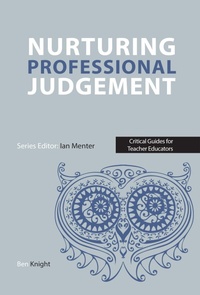
Nurturing Professional Judgement
Published on 28. February 2025
88 pages
978-1-040-37217-3 (ISBN)
Description

In-the-moment dilemmas and situational awareness are central to teachers' work, but these concepts may not always find their way into teacher education - as they often get pushed aside in favour of curriculum coverage and compliance agendas.
This book challenges a technicist and mechanistic view of teaching and learning to examine how teacher educators might best prepare soon-to-be teachers to make sound professional judgements in their classroom practice. It discusses evidence in the literature that teaching does not directly 'produce' learning and that nurturing learning is a complex business which relies on both 'art and science'. Current policies and compliancy agendas influencing the content of ITE programmes are analysed, and the text provides practical suggestions for how to nurture professional judgement in trainee teachers through HE provision and school-based mentoring.
It describes the dynamism of those who teach in classrooms and reminds teacher educators of the value and necessity of managing structure and improvisation, protocol and intuition which are at the heart of what it means to be a professional.
A new addition to our Critical Guides for Teacher Educators series.
This book challenges a technicist and mechanistic view of teaching and learning to examine how teacher educators might best prepare soon-to-be teachers to make sound professional judgements in their classroom practice. It discusses evidence in the literature that teaching does not directly 'produce' learning and that nurturing learning is a complex business which relies on both 'art and science'. Current policies and compliancy agendas influencing the content of ITE programmes are analysed, and the text provides practical suggestions for how to nurture professional judgement in trainee teachers through HE provision and school-based mentoring.
It describes the dynamism of those who teach in classrooms and reminds teacher educators of the value and necessity of managing structure and improvisation, protocol and intuition which are at the heart of what it means to be a professional.
A new addition to our Critical Guides for Teacher Educators series.
Reviews / Votes
Nurturing Professional Judgement is an inspiring, thought-provoking, and useful book. It has been inspiring for me, as it has led me to explore ways of inquiring into what underpins my own, and colleagues' professional judgement.It is thought-provoking, as it poses questions about how teachers make decisions in classrooms and how judgement can be categorised and made explicit.
It is useful, as it provides answers to the question, 'How can we nurture professional judgement in new teachers?'...
Professor Joy Jarvis, University of Hertfordshire
Nurturing Professional Judgement focuses on the essence of teacher expertise. In doing so, it affirms the knowledge, understanding and skill of being a teacher, and the pleasure which comes from deploying judgement in action to support learning. The analysis is grounded in authentic teacher experience, and builds on decades of similar insights by teachers, teacher educators and researchers.
Today, it constitutes a challenge to the reductive, authoritarian and disrespectful policies which have characterised recent approaches to teacher education in England. The book should be read as an affirmation of teacher expertise and as a contribution to a more enlightened future.
Andrew Pollard, Emeritus Professor, IOE, UCL's Faculty of Education and Society
More details
Series
Language
English
Place of publication
London
United Kingdom
Publishing group
Taylor & Francis Ltd
Target group
Professional and scholarly
File size
6,02 MB
ISBN-13
978-1-040-37217-3 (9781040372173)
Copyright in bibliographic data and cover images is held by Nielsen Book Services Limited or by the publishers or by their respective licensors: all rights reserved.
Schweitzer Classification
Other editions
Additional editions
Ben Knight
Nurturing Professional Judgement
Book
10/2023
1st Edition
Critical Publishing Ltd
€41.70
Shipment within 3-4 weeks
Person
Ben Knight has been a teacher educator in higher education for the past 13 years and before that was a primary school teacher and senior leader in both suburban and inner-city schools for 11 years. Ben has relationships with a wide range of schools in rural and township locations in South Africa and is the founder and director of an education development partnership initiative. His research and publications reflect his interest in encouraging teachers and pre-service teachers to develop their professional instincts, judgement and intuition.
Ian Menter is former President of BERA, 2013-2015. At Oxford University Department of Education he was Director of Professional Programmes and led the development of the Oxford Education Deanery. Prior to that he was Professor of Teacher Education at the University of Glasgow and held posts at the University of the West of Scotland, London Metropolitan University, University of the West of England and the University of Gloucestershire. Ian was President of the Scottish Educational Research Association from 2005-07 and chaired the Research and Development Committee of the Universities' Council for the Education of Teachers (UCET) from 2008-11. He is a Visiting Professor at Bath Spa University and Ulster University and an Honorary Professor at the University of Exeter. Since 2018 he has been a Senior Research Associate at Kazan Federal University, Russia.
Ian Menter is former President of BERA, 2013-2015. At Oxford University Department of Education he was Director of Professional Programmes and led the development of the Oxford Education Deanery. Prior to that he was Professor of Teacher Education at the University of Glasgow and held posts at the University of the West of Scotland, London Metropolitan University, University of the West of England and the University of Gloucestershire. Ian was President of the Scottish Educational Research Association from 2005-07 and chaired the Research and Development Committee of the Universities' Council for the Education of Teachers (UCET) from 2008-11. He is a Visiting Professor at Bath Spa University and Ulster University and an Honorary Professor at the University of Exeter. Since 2018 he has been a Senior Research Associate at Kazan Federal University, Russia.
Content
1. Introduction 2. What is professional judgement and why is it important? 3. Exploring the complexities of classroom teaching. 4. Teaching novice teachers to develop and use their judgement. 5. Judgements about what? Analysis of some case studies. 6. Conclusion
