

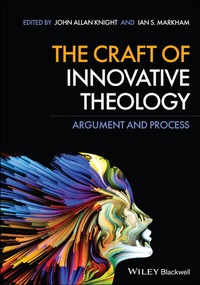
The Craft of Innovative Theology
Description

The Craft of Innovative Theology: Argument and Process delivers a thorough examination of the method of producing and writing creative theological theses and projects, explaining to students how to write elegant, innovative research-oriented articles. Through a collection of papers written by distinguished scholars, the text exhibits numerous examples of well-executed creative writing on topics as varied as theodicy and evolution, and artificial intelligence and baptism.
Each article includes an introduction by the editor that serves to guide the student through the material and elucidates what makes the work stand out as exceptional. The articles are also annotated to assist with the appreciation of the methodology and style used by the author. The Craft of Innovative Theology assists theology students in improving their research writing to a point where they'll be ready for a Masters' thesis or PhD dissertation, and is an excellent resource for a research methods course in a graduate program.
The works incorporated by the editors include:
* A thorough introduction to God and the Incarnation, including knowing God through religious pluralism
* An exploration of God and church, including racial stigma and the southern Baptist public discourse in the twentieth century, and the appropriateness of baptizing artificial intelligence
* A discussion of God and the world, including where humanity has come from and where we're going, and the challenges posed by biological evolution to Christian theology
* A treatment of God and ethics, including sin and the faces of responsibility
Perfect for students of postgraduate theology and research methods courses, The Craft of Innovative Theology: Argument and Process will also earn a place in the libraries of students in courses that prepare them to write a Masters' thesis in theology or to begin shaping their PhD dissertation topic.
More details
Other editions
Additional editions
Persons
John Allan Knight is Associate Professor of Religious Studies at Marist College, where he teaches courses in religion and the U.S. Constitution, philosophy of religion, religion and politics, and a number of other religious studies courses. He holds degrees from Southern Nazarene University, George Washington University Law School, and the University of Chicago. Knight is the author of Liberalism vs. Postliberalism: The Great Divide in Twentieth Century Theology (2012), and a number of articles in both scholarly and popular journals. He is currently working on a book on religious freedom and the nature of religious claims.
Ian S. Markham is the Dean and President of Virginia Theological Seminary and a priest in the Episcopal Church. He has degrees from King's College London, the University of Cambridge, and a PhD from the University of Exeter. He is the author of numerous books, including Against Atheism: Why Dawkins, Hitchens and Harris are Fundamentally Wrong (Wiley Blackwell, 2010), The New Apologetics (2020), A Theology of Engagement (Blackwell, 2003), Truth and the Reality of God (1998), and Plurality and Christian Ethics (1994).
Content
The Acknowledgments ix
Contributors xi
Introduction xiii
Part I God and the Incarnation 1
1 Knowing God through Religious Pluralism 3
Tinu Ruparell
Research Level 2 3
2 Is It Possible for the Eternal Word to Be Made Manifest in a Person with Down's Syndrome? 19
Ian S. Markham
Research Level 1 19
Part II God and Church 31
3 Racial Stigma and Southern Baptist Public Discourse in the Twentieth Century 33
Pamela D. Jones
Research Level 1 33
4 The Plugged-in Church: Is it Appropriate to Baptize Artificial Intelligence 50
Ian S. Markham
Research Level 1 50
Part III God and the World 63
5 Humanity: Where on Earth Have We Come From and Where Are We Going To? 65
Celia Deane-Drummond
Research Level 3 65
6 What Challenges Does the Theory of Biological Evolution Pose to Christian Theology? 81
Christopher Southgate
Research Level 3 81
Part IV God and Ethics 97
7 Sin and the Faces of Responsibility 99
Leigh Vicens
Research Level 4 99
8 A Good Story: Human-Animal Friendship and Meat Eating 114
Trevor Bechtel
Research Level 2 114
9 Just Business: It's Not What You Think 127
Kathryn D. Blanchard
Research Level 2 127
Part V The End of the World 149
10 Relentless Love and the Afterlife 151
Thomas J. Oord
Research Level 1 151
11 Hell: Retributivism, Escapism, and Universal Reconciliation 164
Andrei A. Buckareff
Research Level 3 164
12 Christ Will Come Again 183
Keith Ward
Research Level 2 183
Part VI Method in Theology 195
13 Theological Language and Method in Liberal Theology: Schubert Ogden's Response to the Falsification Controversy 197
John Allan Knight
Research Level 4 197
14 Does Culture Determine Belief? The Relationship between the Social Sciences and Theology 212
Martyn Percy
Research Level 3 212
15 Theological Reference and Theological Creativity in Judaism 226
Cass Fisher
Research Level 4 226
16 Marshall's Slingshot: Truth Theory, Realism, and Liberal Theological Method 245
John Allan Knight
Research Level 4 245
Glossary 261
Index 266
1
Knowing God through Religious Pluralism
Tinu Ruparell
RESEARCH LEVEL 2
Editors' Introduction
Good academic writing is clear and elegant. This opening essay meets both of those conditions. It is a provocative thesis: All serious theology must be shaped by religious pluralism. He believes that this has always been the case; and now it must continue to be "consciously" so in the future. He suggests five characteristics of such theology, which he sets out as the heart of the essay. He then concludes by responding to some of the objections that the reader might have to his argument.
Theology is always hybrid (see Box 1.1).
Tinu Ruparell puts his thesis front and center. All theology draws on a range of traditions and sources. He then unpacks this assertion by insisting that all serious theological systems must take religious pluralism seriously. This is a shocking assertion. It means that all those who primarily work as theologians within a tradition are, in the view of Ruparell, not doing serious theology. The opening of this essay is controversial and provocative. The reader is invited to engage with the argument.
I propose this statement as axiomatic for any theology which takes religious pluralism seriously, and of course all theology must take religious pluralism seriously. Indeed I contend that no theological system can be taken seriously if it does not countenance the facts of religious plurality at its very foundation. To fail to do so is to be blind to the conditions of human thinking about the religious. The religious traditions we encounter, study, may participate in, critique, and/or promote have all originated, developed, and continue to exist within a context of religious plurality. This, I submit, is an empirical fact needing little further argument.1 Moreover, all theology, like all theorization, is inherently comparative.2 In order to understand and create theology the scholar partakes in comparative and generalizing activity, which requires emic and etic reference. Religious pluralism is thus an intra-religious concern as much as it is an interreligious one. No tradition, and therefore no theology, can thus be considered without conscious reference to the Other since all traditions were originated and continue to develop with explicit or implicit reference to other traditions which form their contexts. The importance of religious pluralism for our understanding of the theology, as well as for the production of novel, creative theology, cannot be understated. In what follows I will argue that the practice of theology must be recast to be explicitly pluralistic in a way that has not hitherto been the case. Theology must be more obviously interreligious and hybrid because theology is already interreligious and hybrid, but currently does not recognize itself as such (see Box 1.2).3
Footnote 3 is a lovely note. The author is anticipating an obvious objection: If all theology is - as a matter of current reality - hybrid, then why is this program so radical and provocative? He uses the footnote to answer this objection. He is writing alert to potential criticisms to his arguments.
In redescribing theology through religious pluralism, I argue, it becomes more powerful, more relevant, and more useful. More powerful in its increased capacity to accurately describe the human condition; more relevant as it breaks out of its chains as a chauvinist practice of merely priestly interest; and more useful as it regains a role in broader economic, social, political, and cultural spheres.
Before I proceed to describe some elements of a pluralistically remade theology, an issue of terminology needs to be clarified (see Box 1.3).
Ruparell is a careful scholar. He knows that there is considerable discussion over the language. So he clarifies precisely what he means by the terms "religious pluralism" and "a theology of religious pluralism." He does not want the reader thinking of a different meaning of these terms that then leads to a misunderstanding of his argument.
Religious pluralism refers simply to the existence of many different religious traditions in any given context (let us avoid for now the question of the definition of religion or religious tradition.) A theology of religious pluralism, however, has most often signified a particular view or theory concerning the status of multiple, different religious traditions - their beliefs, truth claims, and practices, etc. - in terms of one tradition held to be normative. So, for instance, theological projects with which many will be familiar, using well-worn distinctions such as religious inclusivism, exclusivism, and pluralism, describe views from within a given (mostly Christian) tradition considering the truth claims and the soteriological status of other (mostly non-Christian) traditions. In what follows I do not intend to propose a theological redescription in this vein - though certain kinds of theologies of religious pluralism may follow from what I argue. What I wish to do, in keeping with the general aim of this collection, is to propose how one should do creative, novel, interesting, and useful theology in the light of religious pluralism, viz. allowing the facts of religious plurality more forcefully and creatively to impinge directly on theology. Eschewing a "view from nowhere," I wish to highlight what any attempt at doing theology should look like if it is shaped and guided by the facts of religious plurality from the outset. I shall use the terms pluralistic theology to refer to this project. While I will focus on Christian, or broadly Semitic, traditions, there is no reason why the claims and arguments should be limited to Christian theology. Indeed, creative theologizing concerning any religious tradition should be thoroughly pluralistic in the senses I shall elaborate. A throughgoing pluralistic theology thus construes its religious tradition to be merely one among others, even if it shows special concern for its "home" tradition. The nuances of the tension inherent in this definition should become clearer as we proceed.
What does it mean, then, to speak about God - that is, do theology, and specifically creative theology - in the face of our religious Others? I suggest that it will or should display, minimally, the following characteristics (see Box 1.4):
He helpfully lists the characteristics of a theology that takes religious pluralism seriously. The following five characteristics are his own listing. Although he is drawing on approaches found throughout the literature, his own listing of these five characteristics is his contribution to the debate.
- Theology must be radically humble (principle of fallibilism).
- Theology must be radically flexible (principle of indeterminacy).
- Theology must be radically open (principle of contingency).
- Theology must be radically poetic (principle of attraction).
- Theology must be radically risky (principle of irony).
These are in no way meant to be an exhaustive set of characteristics, nor should we imagine that they will be present in equal measure, however, I argue that these are at least necessary features of knowing and speaking about God in the context of religious plurality. We will see, moreover, that these principles are interwoven, one often implying or melding into the others. Let us take them in turn before drawing some concluding insights and responding to some potential concerns.
Radical Fallibilism: The Principle of Humility
Pluralistic theology must be conducted according to the fundamental idea that on matters both large and small, we may be significantly wrong in the end. One must therefore engage in creative theology with a spirit of humility. There are both internal and external reasons for this epistemic fallibilism (see Box 1.5).
One feature of this essay is to draw a contrast with other approaches to theology. So this pluralistic theology will operate with a spirit of humility. It is not a conceited theology - one that is sure that it is right and everyone else is wrong. This is an important part of Ruparell's argument.
Firstly, within Christian scriptures and theological tradition, there are many proscriptions against the idea that human beings can adequately grasp the true nature of the divine. The Hebrew Bible and New Testament clearly state that God is beyond all reckoning,4 and that to believe and act as if one knows God's being, nature, and acts is liable to leave one mistaken in the end, as evidenced by the parable of the sheep and goats (Matthew 25: 31-46)In this parable, those who presumably followed religious law but failed to act according to its deeper meaning were judged to be wicked. Surely one lesson to take from this parable is that one shouldn't be quite so certain that one's religious beliefs and practices are correct, or that one has fulfilled all of God's requirements. And in the Hebrew Bible perhaps no greater scriptural evidence for fallibilism can be had than the epiphany of Job. While notoriously difficult to square with traditional teaching about God's nature as well as the theodical questions which give rise to the...
