

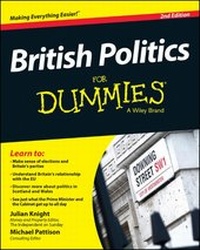
British Politics For Dummies
Description

So, you want to be knowledgeable about British politics butdon't know where to start? You've come to the right place!British Politics For Dummies is your essential guide tounderstanding even the trickiest questions surrounding politics inthe UK. In no time, you'll have the confidence to discuss the insand outs of past and present elections, political leaders, partiesand ideologies.
Packed with understandable information on the origins, historyand structure of the UK parliamentary system, British PoliticsFor Dummies offers a fascinating glimpse into the rollercoasterworld of politics. Explaining everything from key politicalideologies and the spread of democracy to the current electionprocess and the differences between political parties, thishands-on, friendly guide is an ideal companion to British politicsand elections.
* Includes expanded coverage of coalition governments, devolutionand independence efforts
* Provides updated information on UKIP and Britain's place inEurope
* Serves as a helpful guide to elections and British politicalparties--electoral systems, voting behaviour and trends andthe role of pressure groups and the media
* Offers a fascinating examination of British politics on theworld stage
Whether you want to get to grips with British politics andgovernment or build your knowledge beyond the basics, this updatededition of British Politics For Dummies is the placeto start.
More details
Other editions
Additional editions
Persons
Content
Part I: Getting Started with British Politics 5
Chapter 1: Taking in the Political Universe 7
Chapter 2: Understanding Why Politics and Politicians are Important 21
Chapter 3: Looking at Participatory Democracy 35
Chapter 4: Examining Political Ideologies 49
Chapter 5: Forming the British Political State 67
Part II: Elections and Britain's Parties 81
Chapter 6: Counting the Votes: Differing Electoral Systems 83
Chapter 7: Voting Behaviour and Trends 99
Chapter 8: Homing in on Political Parties 117
Chapter 9: Piling on the Pressure Groups 141
Chapter 10: Scrutinising Politics and the Media 161
Chapter 11: Taking Politics to the Masses: Social Media 175
Part III: The Ins and Outs of Parliament 183
Chapter 12: Examining Britain's Constitution 185
Chapter 13: Britain's Parliamentary Democracy 199
Chapter 14: Gazing at the Summit: The PM and Cabinet 221
Chapter 15: Assessing Ministers and Civil Servants 237
Chapter 16: Taking in the Courts and Judiciary 249
Chapter 17: Laying Bare Local Government and Devolution 261
Chapter 18: Focusing on Devolution and the Independence Debate 271
Part IV: Politics Worldwide 291
Chapter 19: Understanding Britain's Place in the World 293
Chapter 20: Taking In the International Stage 303
Chapter 21: Expanding Horizons: Europe and the EU 317
Chapter 22: Leading the Free World: US Politics 335
Part V: The Part of Tens 353
Chapter 23: Ten Great Prime Ministers 355
Chapter 24: Ten Major Political Scandals 363
Chapter 25: Ten Political Events That Shaped the Modern World 371
Chapter 26: Ten Political Trends for the Future 379
Index 385
Chapter 1
Taking in the Political Universe
In This Chapter
Differentiating between local and national politics
Building a very British democracy
Legislating within the parliament
Gauging the strength of the democracy
Scrutinising politicians and the media
Defining Britain's place in the world
Those who are too smart to engage in politics are punished by being governed by those who are dumber.
- Plato, Greek philosopher
Plato's quote highlights one - very cynical - way of looking at the wacky (and not so wacky) world of politics. But whatever your view of politics (or, for that matter, politicians), one thing's for sure: the laws made by politicians have a direct impact on your life.
In this chapter I take a speed-of-light trip around the political universe, through the town hall, the newspaper rooms, Buckingham Palace and the UK Houses of Parliament, to the outer reaches of big international bodies such as the European Union and United Nations.
Time to set out on a political journey of discovery!
Understanding the Difference between Local and National Politics
How many politicians do you think you can name? Five, ten, twenty? Well, there are literally thousands of politicians in the UK and many times that number around the globe. The fact that you and I may only be able to name a handful isn't because we're not very bright; it's because most of the politicians out there have a very low profile in the public eye. They may be big figures in their local community but they don't make any sort of splash on the national stage.
You can divide politicians into local and national ones. Local politicians get to decide what goes on in a particular village, town or city, whereas national politicians have a say in the laws that govern all our lives. Politicians who're elected to the House of Commons and the European Parliament are national ones because they make laws that apply to the whole country, not just to a particular village, town or city.
Here are some of the other key differences between local and national politicians:
- National politicians receive a salary from the state, whereas local politicians are volunteers with normal lives and everyday jobs.
- The national media, such as national newspapers and television/radio networks, covers the actions of national politicians, whereas local politicians gain coverage in local newspapers and on local radio and regional television news.
- The UK is a highly centralised state, which means that the national politicians have lots of power, including the main tax-raising powers, whereas local politicians have to do roughly what the central government says and have much smaller tax-raising powers.
The overwhelming majority of politicians in the UK are local councillors and parish councillors, often elected by a few hundred or thousand voters.
An election for membership of the House of Commons is called a general election, a European parliamentary election is called an election to the European Parliament and a local council election is called - guess what? - a local election.
Usually, voter turnout (the percentage of eligible voters actually going to the polls to vote) is much higher for general elections than for local or European elections. General elections tend to get much greater media coverage and voters are more interested in who wins. (Chapter 7 talks about the other factors influencing voter turnout.)
Splitting the Difference: The Devolved Parliament and Assemblies
The British are noted around the globe for a few things: producing great rock music, drinking too much (but let's not put that one on the tourist brochures!), writing great literature, creating great art and providing a world centre for financial services. But ask any foreigner to name a word that sums up Britain and the British, and 'tradition' would come fairly high up the list. Put simply, we're not supposed to do change.
But over the past decade we've gone in for political change in a big way. The Labour government of Tony Blair in 1999 set up the Scottish parliament and Welsh and Northern Ireland assemblies.
The big idea was to move some power away from the government in Westminster and hand it to the peoples - through an elected parliament or assembly - in Scotland, Wales and Northern Ireland. This process was called devolution and some say it's the biggest constitutional change in the UK for 100 years.
Why introduce devolution? Well, the Scottish, Welsh and Northern Irish have different identities and traditions, and many in these parts of the UK felt that these had been swamped over many hundreds of years by the more populous English.
Every four years the people of Scotland, Wales and Northern Ireland get to elect who they want to sit in their own parliament or assembly. These representatives then make the laws in the policy areas that have been devolved from the UK parliament; for example, health care, education or the environment. Plans are afoot to increase the number of powers devolved to the Scottish parliament and Welsh and Northern Ireland assemblies. (For a full rundown of which parliament or assembly does what, check out Chapter 17.)
Why do the Scottish have a parliament, while the Welsh and Northern Irish have an assembly? Well, this situation reflects the number of devolved powers that each institution has. A parliament is considered a more important and august body than an assembly. So the Scottish, who have more devolved powers than the Welsh and Northern Irish, thus have a parliament rather than an assembly.
In Wales and Scotland, nationalist movements want either greater autonomy from the UK or full-blown independence. This nationalism is most developed in Scotland. The Scottish National Party became the governing party and used that position to call a referendum on whether Scotland should be independent. The referendum was held in September 2014, with the Scottish people voting to stay within the UK. The result was very close, with 45% of votes cast in favour of full independence. In the final few days of the campaign the leaders of the UK's three main political parties - Conservative, Labour and Liberal Democrat - promised the Scottish people even greater devolution (in other words more power for the Scottish parliament) should they choose to remain in the UK. This promise won the day and now politicians in Westminster are looking at ways of delivering it. See Chapter 18 for full details on the great independence debate.
Evolving to Democracy: A Very British Story
Each democratic nation has trodden its very own path to the political system it has today. The US democracy was born when rebels beat the British in the American Revolution, and the French democracy can trace its roots back to the deposition and execution of Louis XVI in 1793 and the revolution that followed.
The UK too has had its fair share of strife - the odd bloody civil war - and has even chopped one king's head off (the singularly useless Charles I). But instead of one cataclysmic event, such as a war or revolution, leading to democracy, the UK has progressed more gradually to the modern liberal democratic society we have today. In fact, the UK is one of only a handful of countries to get rid of its monarch (between 1649 and 1660) and then decide to reinstate it.
Put simply, the British prefer political evolution to revolution, and the web of government is built up through a combination of laws, traditions and customs. For example, in legal terms the monarchy is hugely important in the British state; in fact, the government itself is there to serve the monarch. However, through custom and tradition the monarch actually plays a very minor role in the government of the country. Much of the power is vested in the hands of the prime minister (PM) and the cabinet.
The UK - unlike the US, for instance - doesn't have a written constitution. Instead, the government works through laws, traditions and customs. This situation is referred to as the UK's unwritten constitution, which I discuss in Chapter 5.
An unwritten constitution may sound weak and impracticable, but the UK system has stood the test of time. In fact, the UK was one of the few major European countries not to have seen its democracy suppressed by a dictatorship during the 20th century.
Assessing the Health of British Democracy
Some experts suggest that Britons are becoming less interested in politics and the following evidence does seem to bear that analysis out:
- Falling voter turnout: At election time fewer and fewer people are turning out to exercise their democratic right to vote.
- Falling party membership: The three nationwide major political parties - Labour, Conservative and Liberal Democrat (and by major I mean these parties always have Members of Parliament elected) - have seen their membership numbers plummet over the past decade. Politicians who stand as party candidates rely on help from party members but fewer members exist to offer help.
However, evidence...
