

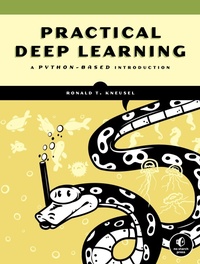
Practical Deep Learning
A Python-Based Introduction
Published on 16. March 2021
464 pages
978-1-7185-0075-4 (ISBN)
Description

This book is for people with no experience with machine learning and who are looking for an intuition-based, hands-on introduction to deep learning using Python.
Deep Learning for Complete Beginners: A Python-Based Introduction is for complete beginners in machine learning. It introduces fundamental concepts such as classes and labels, building a dataset, and what a model is and does before presenting classic machine learning models, neural networks, and modern convolutional neural networks. Experiments in Python--working with leading open-source toolkits and standard datasets--give you hands-on experience with each model and help you build intuition about how to transfer the examples in the book to your own projects.
You'll start with an introduction to the Python language and the NumPy extension that is ubiquitous in machine learning. Prominent toolkits, like sklearn and Keras/TensorFlow are used as the backbone to enable you to focus on the elements of machine learning without the burden of writing implementations from scratch. An entire chapter on evaluating the performance of models gives you the knowledge necessary to understand claims on performance and to know which models are working well and which are not. The book culminates by presenting convolutional neural networks as an introduction to modern deep learning. Understanding how these networks work and how they are affected by parameter choices leaves you with the core knowledge necessary to dive into the larger, ever-changing world of deep learning.
Deep Learning for Complete Beginners: A Python-Based Introduction is for complete beginners in machine learning. It introduces fundamental concepts such as classes and labels, building a dataset, and what a model is and does before presenting classic machine learning models, neural networks, and modern convolutional neural networks. Experiments in Python--working with leading open-source toolkits and standard datasets--give you hands-on experience with each model and help you build intuition about how to transfer the examples in the book to your own projects.
You'll start with an introduction to the Python language and the NumPy extension that is ubiquitous in machine learning. Prominent toolkits, like sklearn and Keras/TensorFlow are used as the backbone to enable you to focus on the elements of machine learning without the burden of writing implementations from scratch. An entire chapter on evaluating the performance of models gives you the knowledge necessary to understand claims on performance and to know which models are working well and which are not. The book culminates by presenting convolutional neural networks as an introduction to modern deep learning. Understanding how these networks work and how they are affected by parameter choices leaves you with the core knowledge necessary to dive into the larger, ever-changing world of deep learning.
More details
Other editions
Additional editions
Book
02/2021
No Starch Press
€56.00
Shipment within 3-4 weeks
Person
Ron Kneusel has been working in the machine learning industry since 2003 and has been programming in Python since 2004. He received a PhD in Computer Science from UC Boulder in 2016 and is the author of two previous books: Numbers and Computers and Random Numbers and Computers.
Content
Foreword by Michael C. Mozer, PhD
Acknowledgments
Introduction
Chapter 1: Getting Started
Chapter 2: Using Python
Chapter 3: Using NumPy
Chapter 4: Working With Data
Chapter 5: Building Datasets
Chapter 6: Classical Machine Learning
Chapter 7: Experiments with Classical Models
Chapter 8: Introduction to Neural Networks
Chapter 9: Training A Neural Network
Chapter 10: Experiments with Neural Networks
Chapter 11: Evaluating Models
Chapter 12: Introduction to Convolutional Neural Networks
Chapter 13: Experiments with Keras and MNIST
Chapter 14: Experiments with CIFAR-10
Chapter 15: A Case Study: Classifying Audio Samples
Chapter 16: Going Further
Index
Acknowledgments
Introduction
Chapter 1: Getting Started
Chapter 2: Using Python
Chapter 3: Using NumPy
Chapter 4: Working With Data
Chapter 5: Building Datasets
Chapter 6: Classical Machine Learning
Chapter 7: Experiments with Classical Models
Chapter 8: Introduction to Neural Networks
Chapter 9: Training A Neural Network
Chapter 10: Experiments with Neural Networks
Chapter 11: Evaluating Models
Chapter 12: Introduction to Convolutional Neural Networks
Chapter 13: Experiments with Keras and MNIST
Chapter 14: Experiments with CIFAR-10
Chapter 15: A Case Study: Classifying Audio Samples
Chapter 16: Going Further
Index
