

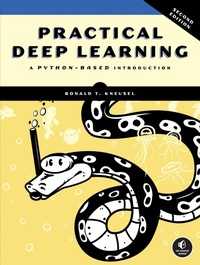
Practical Deep Learning, 2nd Edition
A Python-Based Introduction
Published on 8. July 2025
584 pages
978-1-7185-0421-9 (ISBN)
Description

Practical Deep Learning, 2nd Edition is your gateway into AI, equipping you with the knowledge and confidence to build powerful AI models using the latest architectures and techniques.
If you've been curious about artificial intelligence and machine learning but didn't know where to start, this is the book you've been waiting for. Focusing on the subfield of machine learning known as deep learning, it explains core concepts and gives you the foundation you need to start building your own models. Rather than simply outlining recipes for using existing toolkits, Practical Deep Learning, 2nd Edition teaches you the why of deep learning and will inspire you to explore further.
All you need is basic familiarity with computer programming and high school math-the book will cover the rest. After an introduction to Python, you'll move through key topics like how to build a good training dataset, work with the scikit-learn and Keras libraries, and evaluate your models' performance.
You'll also learn:
- How to use classic machine learning models like k-Nearest Neighbors, Random Forests, and Support Vector Machines
- How neural networks work and how they're trained
- How to use convolutional neural networks
- How to develop a successful deep learning model from scratch
More details
Other editions
Additional editions
Book
07/2025
2nd Edition
No Starch Press
€65.00
Available immediately
Person
Ronald T. Kneusel is a computer scientist, an expert in machine learning, and a lover of fine craft beers. Kneusel has been working with machine learning in industry since 2003 and completed a PhD in machine learning from the University of Colorado, Boulder, in 2016. He's the author of many books with No Starch Press: How AI Works (2023), Strange Code (2022), and Math for Deep Learning (2021).
Content
Foreword
Introduction
Chapter 0: Environment and Mathematical Preliminaries
Part I: Data Is Everything
Chapter 1: It's All About the Data
Chapter 2: Building the Datasets
Part II: Classical Machine Learning
Chapter 3: Introduction to Machine Learning
Chapter 4: Experiments with Classical Models
Part III: Neural Networks
Chapter 5: Introduction to Neural Networks
Chapter 6: Training a Neural Network
Chapter 7: Experiments with Neural Networks
Chapter 8: Evaluating Models
Part IV: Convolutional Neural Networks
Chapter 9: Introduction to Convolutional Neural Networks
Chapter 10: Experiments with Keras and MNIST
Chapter 11: Experiments with CIFAR-10
Chapter 12: A Case Study: Classifying Audio Samples
Part V: Advanced Networks and Generative AI
Chapter 13: Advanced CNN Architectures
Chapter 14: Fine-Tuning and Transfer Learning
Chapter 15: From Classification to Localization
Chapter 16: Self-Supervised Learning
Chapter 17: Generative Adversarial Networks
Chapter 18: Large Language Models
Afterword
Introduction
Chapter 0: Environment and Mathematical Preliminaries
Part I: Data Is Everything
Chapter 1: It's All About the Data
Chapter 2: Building the Datasets
Part II: Classical Machine Learning
Chapter 3: Introduction to Machine Learning
Chapter 4: Experiments with Classical Models
Part III: Neural Networks
Chapter 5: Introduction to Neural Networks
Chapter 6: Training a Neural Network
Chapter 7: Experiments with Neural Networks
Chapter 8: Evaluating Models
Part IV: Convolutional Neural Networks
Chapter 9: Introduction to Convolutional Neural Networks
Chapter 10: Experiments with Keras and MNIST
Chapter 11: Experiments with CIFAR-10
Chapter 12: A Case Study: Classifying Audio Samples
Part V: Advanced Networks and Generative AI
Chapter 13: Advanced CNN Architectures
Chapter 14: Fine-Tuning and Transfer Learning
Chapter 15: From Classification to Localization
Chapter 16: Self-Supervised Learning
Chapter 17: Generative Adversarial Networks
Chapter 18: Large Language Models
Afterword
