

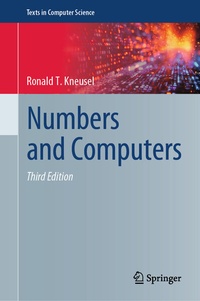
Numbers and Computers
Description

This textbook details the variety of number formats used by computers, thereby helping to ground readers in what can and cannot be represented accurately, especially by floating-point numbers.
The book's first part details standard representations of integers and floating-point numbers. The second explores other number representations, including the wide variety recently developed to support artificial intelligence (AI) and its demand for efficiency in representation to accommodate the ever-expanding scope of neural network models. Chapters describe each format, with examples in code (Python and C) and exercises. This new edition includes three new chapters on posits, AI number formats, and a collaborative experiment with an AI to generate novel number formats.
Topics and features:
- Explores how computers use numbers to complete operations
- Adds new chapters on posits and AI number formats
- Includes exercises and examples that are code snippets in C or Python
- Implements and tests new AI-designed number formats (as designed by GPT-4)
- Provides thorough grounding on what can and cannot be represented accurately
A textbook eminently suitable for undergraduates in computer science, the work also will appeal to software developers, engineers, scientists, AI experts, and anyone who programs for fun.
More details
Other editions
Additional editions
Person
Dr. Ronald T. Kneusel is a Senior Data Scientist with L3Harris. He received his Ph.D. in Computer Science from the University of Colorado, Boulder, in machine learning, and his M.S. in Physics from Michigan State University. His background includes work in breast cancer research and early functional MRI (Medical College of Wisconsin) through medical device development (MR, CT, US) to medical imaging and remote sensing image analysis. He has been deeply involved with software development at all levels since his first forays with an 8-bit Apple II+ computer in the early 1980s hooked him for life. Dr. Kneusel is currently working with L3Harris on the application of modern machine learning techniques to remote sensing imagery and related modalities. He is the author of multiple books and peer-reviewed research articles.
Content
1. Number Systems.- 2. Integers.- 3. Floating Point.- 4. Pitfalls of Floating-Point Numbers (and How to Avoid Them).- 5. Big Integers and Rational Arithmetic.- 6. Fixed-Point Numbers.- 7. Decimal Floating Point.- 8. Interval Arithmetic.- 9. Arbitrary Precision Floating-Point.- 10. Other Number Systems.
