

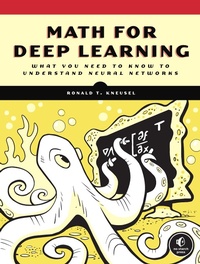
Math for Deep Learning
What You Need to Know to Understand Neural Networks
Published on 23. November 2021
344 pages
978-1-7185-0191-1 (ISBN)
Description

Math for Deep Learning provides the essential math you need to understand deep learning discussions, explore more complex implementations, and better use the deep learning toolkits.
With Math for Deep Learning, you'll learn the essential mathematics used by and as a background for deep learning.
You'll work through Python examples to learn key deep learning related topics in probability, statistics, linear algebra, differential calculus, and matrix calculus as well as how to implement data flow in a neural network, backpropagation, and gradient descent. You'll also use Python to work through the mathematics that underlies those algorithms and even build a fully-functional neural network.
In addition you'll find coverage of gradient descent including variations commonly used by the deep learning community: SGD, Adam, RMSprop, and Adagrad/Adadelta.
With Math for Deep Learning, you'll learn the essential mathematics used by and as a background for deep learning.
You'll work through Python examples to learn key deep learning related topics in probability, statistics, linear algebra, differential calculus, and matrix calculus as well as how to implement data flow in a neural network, backpropagation, and gradient descent. You'll also use Python to work through the mathematics that underlies those algorithms and even build a fully-functional neural network.
In addition you'll find coverage of gradient descent including variations commonly used by the deep learning community: SGD, Adam, RMSprop, and Adagrad/Adadelta.
More details
Other editions
Additional editions
Book
12/2021
No Starch Press
€47.00
Available immediately
Person
Ronald T. Kneusel earned a PhD in machine learning from the University of Colorado, Boulder. He has over 20 years of machine learning industry experience. Kneusel is also the author of Numbers and Computers (2nd ed., Springer 2017), Random Numbers and Computers (Springer 2018), and Practical Deep Learning: A Python-Based Introduction (No Starch Press 2021).
Content
Introduction
Chapter 1: Setting the Stage
Chapter 2: Probability
Chapter 3: More Probability
Chapter 4: Statistics
Chapter 5: Linear Algebra
Chapter 6: More Linear Algebra
Chapter 7: Differential Calculus
Chapter 8: Matrix Calculus
Chapter 9: Data Flow in Neural Networks
Chapter 10: Backpropagation
Chapter 11: Gradient Descent
Appendix: Going Further
Chapter 1: Setting the Stage
Chapter 2: Probability
Chapter 3: More Probability
Chapter 4: Statistics
Chapter 5: Linear Algebra
Chapter 6: More Linear Algebra
Chapter 7: Differential Calculus
Chapter 8: Matrix Calculus
Chapter 9: Data Flow in Neural Networks
Chapter 10: Backpropagation
Chapter 11: Gradient Descent
Appendix: Going Further
