

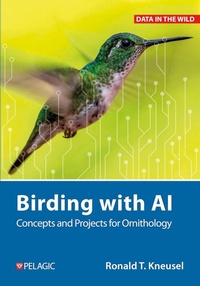
Birding with AI
Concepts and Projects for Ornithology
Published on 21. October 2025
212 pages
978-1-78427-603-4 (ISBN)
Description

Birding with AI introduces readers to the increasingly ubiquitous realm of artificial intelligence and its applications in ornithology and wildlife biology. As well as showcasing the potential utility of deep learning in ornithology, the book demonstrates how to understand, design, implement and evaluate AI models for ornithology and related fields.
Readers will learn:
- The background of AI, specifically deep learning, and how it applies to image interpretation.
- How to build deep-learning models for computer vision and how to compile bird image
- About the use of pretrained models, especially CLIP, which alone is capable of out-of-the-box bird detection with high accuracy.
- Tailoring CLIP-embedding models with small datasets for specific classification tasks.
- How to create models that go beyond classification to localization.
- How to classify bird audio recordings.
- How to use open source tools like Merlin and BirdNet to augment research-question specific models.
This ground-breaking volume adopts an approach based on exploring existing birding tools using AI, leading to an overview of artificial intelligence that will help build intuition about how it works. This provides a foundation for the example projects that follow, enhancing the reader's confidence in their ability to engage and participate in research involving AI. The projects are designed to guide the reader through the model-building process from dataset creation to training, testing and deployment - whether this be for image recognition, classification of calls or other new frontiers birding.
Readers will learn:
- The background of AI, specifically deep learning, and how it applies to image interpretation.
- How to build deep-learning models for computer vision and how to compile bird image
- About the use of pretrained models, especially CLIP, which alone is capable of out-of-the-box bird detection with high accuracy.
- Tailoring CLIP-embedding models with small datasets for specific classification tasks.
- How to create models that go beyond classification to localization.
- How to classify bird audio recordings.
- How to use open source tools like Merlin and BirdNet to augment research-question specific models.
This ground-breaking volume adopts an approach based on exploring existing birding tools using AI, leading to an overview of artificial intelligence that will help build intuition about how it works. This provides a foundation for the example projects that follow, enhancing the reader's confidence in their ability to engage and participate in research involving AI. The projects are designed to guide the reader through the model-building process from dataset creation to training, testing and deployment - whether this be for image recognition, classification of calls or other new frontiers birding.
More details
Series
Language
English
Place of publication
Exeter
United Kingdom
Target group
Professional and scholarly
Illustrations
41 Figures
File size
25,80 MB
ISBN-13
978-1-78427-603-4 (9781784276034)
Copyright in bibliographic data and cover images is held by Nielsen Book Services Limited or by the publishers or by their respective licensors: all rights reserved.
Schweitzer Classification
Other editions
Additional editions
Book
10/2025
Pelagic Publishing
€98.70
Shipment within 10-15 days
Person
Ronald T. Kneusel has been working with machine learning in industry since 2003 and completed a PhD in artificial intelligence at the University of Colorado, Boulder, in 2016. Ron lives in Colorado, which is a great place to foster his interest in birding. Ron's other AI books include: How AI Works (2023), Practical Deep Learning (2nd edn, 2024), and Math for Deep Learning (2021).
Content
Introduction
1. AI in a Nutshell 1.1 Defining AI 1.2 A Brief History of AI 1.3 Neural Networks 1.4 Datasets, Training and Testing
2. The Process 2.1 Data Collection 2.2 Data Preprocessing 2.3 Data Splitting and Augmentation 2.4 Architecture Selection and Training 2.5 Using the Validation Set 2.6 Final Testing and Deployment
3. Configuring the Desktop Environment 3.1 Introducing the Toolkits 3.2 Configuring Linux 3.3 Configuring macOS 3.4 Configuring Windows
4. Building a Bird Dataset 4.1 Planning, Acquiring and Preprocessing 4.2 Building Train and Test Sets 4.3 Initial Testing 4.4 Reviewing the Code 4.5 Discussion
5. Exploring the Bird6 Dataset 5.1 Exploring Hyperparameters 5.2 Data Augmentation 5.3 Decision Thresholds 5.4 Ensembling 5.5 Discussion
6. Using Pretrained Models 6.1 Understanding Transfer Learning and Fine Tuning 6.2 Using Birds 25 6.3 Using ResNet-50 and MobileNet 6.4 Using CLIP 6.5 Discussion
7. Generic Bird Classifiers 7.1 North American Bird Features 7.2 Using NA Bird Features 7.3 Understanding the Models 7.4 Generic Images and Text 7.5 Discussion
8. Detection 8.1 The Detection Hierarchy 8.2 Experiment: CLIP Embeddings 8.3 Experiment: Fully Convolutional Networks 8.4 Discussion
9. Classifying Audio 9.1 Sonograms 9.2 A CLIP-tastrophe 9.3 A Transfer Learning Exercise 9.4 Preparing the BirdCLEF Dataset 9.5 Training BirdCLEF from Scratch 9.6 BirdCLEF Transfer Learning 9.7 BirdCLEF Fine-Tuning 9.8 Discussion
10. Open Source Birding with AI 10.1 Merlin 10.2 eBird 10.3 BirdNET
11. Going Further 11.1 Topics for Further Study 11.2 Recommended Books 11.3 Online Resources and Communities 11.4 The Future of Birding with AI
Glossary
Index
1. AI in a Nutshell 1.1 Defining AI 1.2 A Brief History of AI 1.3 Neural Networks 1.4 Datasets, Training and Testing
2. The Process 2.1 Data Collection 2.2 Data Preprocessing 2.3 Data Splitting and Augmentation 2.4 Architecture Selection and Training 2.5 Using the Validation Set 2.6 Final Testing and Deployment
3. Configuring the Desktop Environment 3.1 Introducing the Toolkits 3.2 Configuring Linux 3.3 Configuring macOS 3.4 Configuring Windows
4. Building a Bird Dataset 4.1 Planning, Acquiring and Preprocessing 4.2 Building Train and Test Sets 4.3 Initial Testing 4.4 Reviewing the Code 4.5 Discussion
5. Exploring the Bird6 Dataset 5.1 Exploring Hyperparameters 5.2 Data Augmentation 5.3 Decision Thresholds 5.4 Ensembling 5.5 Discussion
6. Using Pretrained Models 6.1 Understanding Transfer Learning and Fine Tuning 6.2 Using Birds 25 6.3 Using ResNet-50 and MobileNet 6.4 Using CLIP 6.5 Discussion
7. Generic Bird Classifiers 7.1 North American Bird Features 7.2 Using NA Bird Features 7.3 Understanding the Models 7.4 Generic Images and Text 7.5 Discussion
8. Detection 8.1 The Detection Hierarchy 8.2 Experiment: CLIP Embeddings 8.3 Experiment: Fully Convolutional Networks 8.4 Discussion
9. Classifying Audio 9.1 Sonograms 9.2 A CLIP-tastrophe 9.3 A Transfer Learning Exercise 9.4 Preparing the BirdCLEF Dataset 9.5 Training BirdCLEF from Scratch 9.6 BirdCLEF Transfer Learning 9.7 BirdCLEF Fine-Tuning 9.8 Discussion
10. Open Source Birding with AI 10.1 Merlin 10.2 eBird 10.3 BirdNET
11. Going Further 11.1 Topics for Further Study 11.2 Recommended Books 11.3 Online Resources and Communities 11.4 The Future of Birding with AI
Glossary
Index
