

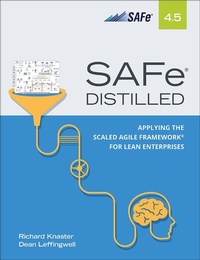
SAFe 4.5 Distilled
Applying the Scaled Agile Framework for Lean Software and Systems Engineering
2nd Edition
Published on 20. July 2018
352 pages
978-0-13-517127-1 (ISBN)
Description

SAFe (R): The World's Leading Framework for Enterprise Agility
"Philips is continuously driving to develop high-quality software in a predictable, fast, and Agile way. SAFe addresses this primary goal, and offers these further benefits: reduced time-to-market, improved quality, stronger alignment across geographically distributed multi-disciplinary teams, and collaboration across teams to deliver meaningful value to customers with reduced cycle time."
-Sundaresan Jagadeesan, SW CoE Program Director, Philips
To succeed in today's adapt-or-die marketplace, businesses must be able to rapidly change the way they create and deliver value to their customers. Hundreds of the world's most successful companies-including Intel, Capital One, AstraZeneca, Cisco, and Philips-have turned to the Scaled Agile Framework (R) (SAFe (R)) to achieve agility at scale and maintain a competitive edge.
SAFe (R) 4.5 Distilled: Applying the Scaled Agile Framework (R) for Lean Enterprises explains how adopting SAFe can quickly improve time to market and increase productivity, quality, and employee engagement. In this book, you will
Understand the business case for SAFe: its benefits, the problems it solves, and how to apply it
Get an overview of SAFe across all parts of the business: team, program, value stream, and portfolio
Learn why SAFe works: the power of SAFe's Lean-Agile mindset, values, and principles
Discover how systems thinking, Agile development, and Lean product development form the underlying basis for SAFe
Learn how to become a Lean-Agile leader and effectively drive an enterprise-wide transformation
Register your book for convenient access to downloads, updates, and/or corrections as they become available. See inside book for details.
"Philips is continuously driving to develop high-quality software in a predictable, fast, and Agile way. SAFe addresses this primary goal, and offers these further benefits: reduced time-to-market, improved quality, stronger alignment across geographically distributed multi-disciplinary teams, and collaboration across teams to deliver meaningful value to customers with reduced cycle time."
-Sundaresan Jagadeesan, SW CoE Program Director, Philips
To succeed in today's adapt-or-die marketplace, businesses must be able to rapidly change the way they create and deliver value to their customers. Hundreds of the world's most successful companies-including Intel, Capital One, AstraZeneca, Cisco, and Philips-have turned to the Scaled Agile Framework (R) (SAFe (R)) to achieve agility at scale and maintain a competitive edge.
SAFe (R) 4.5 Distilled: Applying the Scaled Agile Framework (R) for Lean Enterprises explains how adopting SAFe can quickly improve time to market and increase productivity, quality, and employee engagement. In this book, you will
Understand the business case for SAFe: its benefits, the problems it solves, and how to apply it
Get an overview of SAFe across all parts of the business: team, program, value stream, and portfolio
Learn why SAFe works: the power of SAFe's Lean-Agile mindset, values, and principles
Discover how systems thinking, Agile development, and Lean product development form the underlying basis for SAFe
Learn how to become a Lean-Agile leader and effectively drive an enterprise-wide transformation
Register your book for convenient access to downloads, updates, and/or corrections as they become available. See inside book for details.
More details
Edition
2nd edition
Language
English
Place of publication
Boston
United States
Publishing group
Pearson Education (US)
Target group
Professional and scholarly
File size
17,25 MB
ISBN-13
978-0-13-517127-1 (9780135171271)
Copyright in bibliographic data and cover images is held by Nielsen Book Services Limited or by the publishers or by their respective licensors: all rights reserved.
Schweitzer Classification
Other editions
Additional editions
Richard Knaster | Dean Leffingwiell
SAFe 5.0 Distilled; Achieving Business Agility with the Scaled Agile Framework
Book
11/2020
Addison Wesley
€37.50
Shipment within 15-20 days
Richard Knaster | Dean Leffingwell
SAFe 4.5 Distilled
Applying the Scaled Agile Framework for Lean Enterprises
Book
12/2018
2nd Edition
Addison Wesley
€42.08
Article exhausted; check for reprint
Persons
Richard Knaster, SAFe Fellow and Principal Consultant at Scaled Agile, Inc., has more than 25 years' experience in software development in roles ranging from developer to executive and has been involved in Agile for more than a decade. Prior to joining Scaled Agile, Inc., Richard worked at IBM, where his career spanned from product line management (PPM domain) and professional services to chief methodologist, Agile and Lean. Richard is a certified IBM Thought Leader and an Open Group Distinguished IT Specialist. He is also a certified SPC, PSM, Agile Certified Practitioner, PMP, and a contributor to the Disciplined Agile Delivery framework and PMI Portfolio/Program Management standards. He is a contributor to SAFe (R) 4.5 Reference Guide (Addison-Wesley, 2018).
Dean Leffingwell, creator of SAFe (R), is widely recognized as the one of the world's foremost authorities on Lean-Agile best practices. He is an author, serial entrepreneur, and software systems development methodologist. His two best-selling books, Agile Software Requirements: Lean Requirements Practices for Teams, Programs, and the Enterprise (Addison-Wesley, 2011), and Scaling Software Agility: Best Practices for Large Enterprises (Addison-Wesley, 2007), form much of the basis of modern thinking on Lean-Agile practices and principles.
Dean Leffingwell, creator of SAFe (R), is widely recognized as the one of the world's foremost authorities on Lean-Agile best practices. He is an author, serial entrepreneur, and software systems development methodologist. His two best-selling books, Agile Software Requirements: Lean Requirements Practices for Teams, Programs, and the Enterprise (Addison-Wesley, 2011), and Scaling Software Agility: Best Practices for Large Enterprises (Addison-Wesley, 2007), form much of the basis of modern thinking on Lean-Agile practices and principles.
Content
Chapter 1: Business Need for SAFe
Chapter 2: SAFe Overview
Chapter 3: Lean-Agile Mindset
Chapter 4: SAFe Principles
Chapter 5: Lean-Agile Leaders
Chapter 6: The Agile Release Train
Chapter 7: Planning a Program Increment
Chapter 8: Iterating
Chapter 9: Executing the Program Increment
Chapter 10: Inspect and Adapt
Chapter 11: Large Solution SAFe Overview
Chapter 12: Defining Large and Complex Solutions
Chapter 13: Solution Train Execution
Chapter 14: Lean Portfolio Management
Chapter 15: Strategy and Investment Funding
Chapter 16: Agile Portfolio Operations
Chapter 17: Lean Governance
Chapter 18: The Guiding Coalition
Chapter 19: Designing the Implementation
Chapter 20: Implementing Agile Release Trains
Chapter 21: Launching More ARTs and Value Streams; Extending to the Portfolio
Chapter 22: Sustaining and Improving
Chapter 2: SAFe Overview
Chapter 3: Lean-Agile Mindset
Chapter 4: SAFe Principles
Chapter 5: Lean-Agile Leaders
Chapter 6: The Agile Release Train
Chapter 7: Planning a Program Increment
Chapter 8: Iterating
Chapter 9: Executing the Program Increment
Chapter 10: Inspect and Adapt
Chapter 11: Large Solution SAFe Overview
Chapter 12: Defining Large and Complex Solutions
Chapter 13: Solution Train Execution
Chapter 14: Lean Portfolio Management
Chapter 15: Strategy and Investment Funding
Chapter 16: Agile Portfolio Operations
Chapter 17: Lean Governance
Chapter 18: The Guiding Coalition
Chapter 19: Designing the Implementation
Chapter 20: Implementing Agile Release Trains
Chapter 21: Launching More ARTs and Value Streams; Extending to the Portfolio
Chapter 22: Sustaining and Improving
