

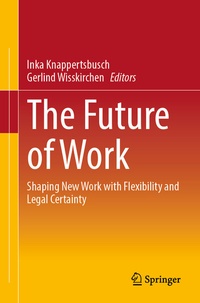
The Future of Work
Description

This book takes readers on a journey into the future of work. Following the influence of the COVID-19 pandemic, working conditions have become more flexible than ever before. The freedoms granted within this framework continue to be demanded by many employees. There are also numerous companies that have had predominantly positive experiences with this change and would like to continue with it. Against this backdrop, it is to be expected that the shift away from a traditional working environment - due to the four influencing factors of demographic change, skills shortages, digitalisation and artificial intelligence - will accelerate in the future. This book provides an overview of the various design options for New Work and highlights their respective advantages and disadvantages. It also analyses new trends and forecasts relating to the future of work. In addition, the relevant legal framework is presented in a concise and easy-to-understand manner. This book provides you with the tools you need to actively shape the future of work in your company in a legally compliant manner.
The editors
Dr. Inka Knappertsbusch is a lawyer specializing in employment law and employee data protection at the international commercial law firm CMS Germany. She advises companies primarily on restructuring and works agreements, in particular on issues related to IT and new work. Her work also focuses on data protection and artificial intelligence in employment relationships. She is the co-editor of the book "Arbeitswelt und KI 2030".
Dr. Gerlind Wisskirchen is a partner and lawyer at the international commercial law firm CMS Germany and advises multinational corporations in particular on restructuring, national and international employment law and compliance issues. She is also an expert on the digitalisation of the world of work, with experience as a keynote speaker, author and lecturer and is the editor of the report "Artificial Intelligence and Robotics and Their Impact on the Workplace" for the Global Employment Institute.
The translation was done with the help of artificial intelligence. A subsequent human revision was done primarily in terms of content.
More details
Other editions
Additional editions
Persons
Dr. Inka Knappertsbusch is a lawyer specializing in employment law and employee data protection at the international commercial law firm CMS Germany. She advises companies primarily on restructuring and works agreements, in particular on issues related to IT and new work. Her work also focuses on data protection and artificial intelligence in employment relationships. She is the co-editor of the book "Arbeitswelt und KI 2030".
Dr. Gerlind Wisskirchen is a partner and lawyer at the international commercial law firm CMS Germany and advises multinational corporations in particular on restructuring, national and international employment law and compliance issues. She is also an expert on the digitalisation of the world of work, with experience as a keynote speaker, author and lecturer and is the editor of the report "Artificial Intelligence and Robotics and Their Impact on the Workplace" for the Global Employment Institute.
