

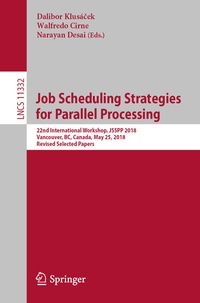
Job Scheduling Strategies for Parallel Processing
22nd International Workshop, JSSPP 2018, Vancouver, BC, Canada, May 25, 2018, Revised Selected Papers
Published on 12. January 2019
IX, 147 pages
978-3-030-10632-4 (ISBN)
Description

This book constitutes the thoroughly refereed post-conference proceedings of the 22nd International Workshop on Job Scheduling Strategies for Parallel Processing, JSSPP 2018, held in Vancouver, Canada, in May 2018.
The 7 revised full papers presented were carefully reviewed and selected from12 submissions. The papers cover topics in the fields of design and evaluation of new scheduling approaches. They focus on several interesting problems in resource management and scheduling.More details
Series
Language
English
Place of publication
Cham
Switzerland
Publishing group
Springer International Publishing
Product notice
Reflowable
Illustrations
IX, 147 p. 80 illus., 35 illus. in color.
File size
13,50 MB
ISBN-13
978-3-030-10632-4 (9783030106324)
DOI
10.1007/978-3-030-10632-4
Schweitzer Classification
Other editions
Additional editions
Dalibor Klusácek | Walfredo Cirne | Narayan Desai
Job Scheduling Strategies for Parallel Processing
22nd International Workshop, JSSPP 2018, Vancouver, BC, Canada, May 25, 2018, Revised Selected Papers
Book
01/2019
Springer
€53.49
Shipment within 7-9 days
Persons
Content
- Intro
- Preface
- Organization
- Contents
- Analysis of Job Metadata for Enhanced Wall Time Prediction
- 1 Introduction
- 2 Related Work
- 2.1 Predicting Job Walltimes
- 2.2 Machine Learning
- 3 Methods
- 3.1 Job Metadata
- 3.2 Metrics
- 4 Results
- 5 Conclusion and Future Work
- References
- Evaluating the Impact of Soft Walltimes on Job Scheduling Performance
- 1 Introduction
- 1.1 Walltime Estimates
- 1.2 Soft Walltimes in PBS Professional
- 1.3 Paper Contribution and Structure
- 2 Related Works
- 3 Runtime Prediction Techniques
- 4 Experimental Evaluation
- 4.1 Workload Log Characteristics
- 4.2 Simulation Methodology
- 4.3 Overall Results
- 4.4 Detailed Performance Analysis Using Heatmaps
- 4.5 Discussion
- 5 Conclusion and Future Work
- References
- Reducing the Human-in-the-Loop Component of the Scheduling of Large HTC Workloads
- 1 Introduction
- 2 Scheduling Large HTC Workloads at CC-IN2P3
- 2.1 Organization and Management of the Computing Infrastructure
- 2.2 Resource Allocation Procedure
- 2.3 Characterization of the Workload
- 3 Reducing the Human-in-the-Loop Component
- 3.1 From Physical to Logical Resource Partitioning
- 3.2 Simplification of the Access Rule and Quota Mechanisms
- 3.3 Extending the Fair-Share History Window
- 4 Conclusion and Future Work
- References
- Using Pilot Systems to Execute Many Task Workloads on Supercomputers
- 1 Introduction
- 2 Related Work
- 3 RADICAL-Pilot
- 3.1 Overall Architecture
- 3.2 Programming Model
- 3.3 State and Execution Models
- 3.4 Agent Architecture
- 4 Enabling RP on Cray Systems
- 4.1 Application Level Placement Scheduler (ALPS)
- 4.2 Cluster Compatibility Mode (CCM)
- 4.3 Open Run-Time Environment (OpenRTE/ORTE)
- 5 Experiments
- 5.1 Microbenchmark Experiments
- 5.2 Agent Integrated Performance
- 5.3 Resource Utilization and Overheads at Scale
- 5.4 Discussion
- 6 Conclusion
- References
- Adaptive Simultaneous Multi-tenancy for GPUs
- 1 Introduction
- 2 Background and Motivation
- 2.1 GPU Execution Model
- 2.2 Resource Requirements
- 2.3 Issue Slot Utilization
- 2.4 Non-overlapping Execution
- 3 Adaptive Simultaneous Multi-tenancy
- 3.1 Overview
- 3.2 Host-Side Service
- 3.3 Application Side
- 3.4 Kernel Code Transformation
- 3.5 Profiling and Pruning the Parameter Space
- 3.6 Sharing Policy
- 3.7 Example Scenario
- 3.8 Limitations
- 4 Evaluation
- 4.1 Platform
- 4.2 Benchmark Kernels
- 4.3 Single Kernel Performance
- 4.4 Multi-kernel Performance
- 5 Related Work
- 5.1 Persistent Threads
- 5.2 Software-Based Multi-tasking on GPUs
- 5.3 Hardware-Based Multi-tasking on GPUs
- 6 Conclusion
- References
- Stochastic Programming Approach for Resource Selection Under Demand Uncertainty
- 1 Introduction
- 2 Problem Description
- 3 Two-Stage Stochastic Programming Model
- 4 Solution Approaches
- 4.1 Sample Average Approximation
- 4.2 L-Shaped Decomposition Algorithm
- 4.3 A Genetic Algorithms Based Approach
- 5 Experimental Setup
- 6 Experimental Results
- 6.1 Stochastic Programming Based Solutions
- 6.2 Value of Stochastic Solution
- 6.3 Comparison with a GA-Based Approach
- 7 Related Work
- 8 Conclusions and Future Work
- References
- Approaching Actor-Level Resource Control for Akka
- 1 Introduction
- 2 Related Work
- 3 Design and Implementation
- 3.1 Shared Components
- 3.2 The Two Implementations
- 4 Evaluation
- 4.1 Experimental Setup
- 4.2 Overheads
- 4.3 Idle Time for Pre-estimated Execution Time Implementation
- 4.4 Quality of Control
- 5 Conclusions and Future Work
- References
- Author Index
