

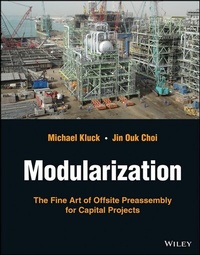
Modularization
Description

A practical, hands-on guide to offsite preassembly, beginning with the project as just a concept gleam in the CEO's eye and winding all the way through implementation at the construction site.
Modularization is a philosophy change! And along with that change, comes the need to understand the implementation requirements and project mindset adjustments that impact and influence all aspects of the modular project. To accomplish this, the book provides a complete (from beginning to end) identification and evaluation of the differences that make a modular project unique, starting with the very basics in terms of definitions and setting the groundwork of expectations by identifying benefits and challenges. Then, because the journey is as important as the destination, the reader is guided through the various project phases in a manner that reflects how they would be addressed in the workplace. From the very earliest identification of concepts, through early assessment and selection of the optimal choice to be finally carried into detailed design, the reader is acquainted with each phase of the development process, including explanations and relevant suggestions for many of the questions and issues that typically come up.
A perfect reference for professional and technical leaders when developing the early, critical planning phases of modular projects, this guide offers useful examples and details on the fundamentals required to get a modular project started correctly and keep it on track. And, for those whom this is not their first foray into modular project management, this guide includes suggestions, examples, and/or lessons learned to make the subsequent module projects easier to implement.
Recognized industry experts Michael Kluck and Dr. Jin Ouk Choi have authored this guide to modularization that is ideal for owners, contractors, project management, engineers, project controls, and procurement--in fact, anyone interested in improving current construction project management practices. In addition, its thought-provoking examples and project case studies provide the perfect platform for its instructional use in teaching modular concepts.
Written from the perspective of both the Client/Owner and the EPC Contractor, this guide provides useful information needed for initial project management setup and technical details useful to working functional groups within the project. As such, it is truly a universal guide that can provide personnel at all levels within the project with the information needed to make project implementation more seamless. This book is written in terms of the large-scale industrial modularization project, but the steps and process are equally applicable to small-scale projects and projects outside the industrial construction realm.
Some of the topics covered in this guide include:
* The basics (to set a basis for major topic presentations)
* Module configurations ("good, bad, and ugly")
* A deep dive into modularization business case
* Module team and project interactions
* Module execution planning and timing
* Success factors, pitfalls and avoidance
* A walk through the "module project"
* A modular project case exercise - tying it all together
* Standardization - the next step
* What the future holds
More details
Other editions
Additional editions
Persons
MICHAEL KLUCK (Houston, TX) is a Senior Project Manager and modularization subject matter expert for KBR (Kellogg Brown & Root). With over 40 years in the industry, his equal time on both sides (Owner/Client and EPC contractor) of the modular project management fence has provided the basis for the unique perspective reflected in this guide.
JIN OUK CHOI, PH.D. (Las Vegas, NV) is an Associate Professor in the Department of Civil Engineering and Environmental and Construction at the University of Nevada, Las Vegas (UNLV). His extensive technical and academic work on the Modularization and Standardization research efforts dovetails nicely, providing both historic and state of the art information as well as linking the practical applications and efforts with documented technical research
Content
Preface ix
Acknowledgements xi
Introduction xiii
Chapter 1 What Is Modularization? 1
Chapter 2 Advantages and Challenges of Modularization 17
Chapter 3 Industry Status on Modularization 31
Chapter 4 What Is a Module? 45
Chapter 5 The Business Case for Modularization 63
Chapter 6 The Module Team and Execution Plan Differences 95
Chapter 7 Key Critical Success Factors for Modular Project Success 109
Chapter 8 The Fabrication Yard 119
Chapter 9 Module Considerations by Project Group 129
Chapter 10 A Practical Module Development Process 151
Chapter 11 Modularization Application Case Study Exercise 177
Chapter 12 Standardization 187
Chapter 13 Innovative Technologies for Modularization 197
Chapter 14 Moving Forward 207
Chapter 15 Key Literature and Resources on Modularization 213
Abbreviations 221
Contributors 223
Index 225
INTRODUCTION
Why is there an entire book devoted to the "art" of modularization? Simply stated, because the decision to modularize impacts every aspect of a project's planning and execution. Even from the very beginning of a project, in the Opportunity Framing (pre-FEL-1 or FEL-0) phase, some basic but important decisions must be made to avoid inadvertently limiting the modular opportunities.
So, the book has been written as a guide of sorts, walking through what is necessary to perform a modular project successfully, starting with some very basic "stuff." The path and sequencing of the book make perfect sense to us . to others, perhaps not so much. And while there may be a temptation to skip over these early parts to find answers needed in the later chapters, it is recommended that you ground yourself with the basics provided by these first few chapters. This will help set you up for the detailed module planning effort--just like a quick review of the rules of any game you plan to play is recommended prior to launching into it.
This book combines research findings from the analyses of real case modular projects with industry examples to help tie any theories presented to real-life scenarios. Thus, we expect that not all chapters will be of equal value to you. We also expect you may not even agree with some of the ideas and concepts stated. But we do hope that you can see past our methods on the approach and over-simplified examples to the reasoning and understand the conclusions from them.
So, consider this as a guide for your modular road trip. And, like a road trip, it's the journey, not just the destination. To be effective, such a guide needs to point one in the right direction/provide a preparation plan/suggest basic supplies/identify support along the way/and offer an emergency kit for when things don't go as planned. We hope the specific guidance in the format provided is helpful in implementing successful modular project planning, even if presented in a bit different format than you might have anticipated.
In order to help you better understand how the book has been written, the remainder of this introduction delves into a brief description of what each chapter is about, beginning with the basics of what modularization is.
Chapter 1: What Is Modularization?
Chapter 1 sets the basics in terms of what is needed from a ground-level or basic understanding of the concepts and terms. While this may seem too elementary, it is critical because everyone has their own definition of what a module is (or what it is not) and, as a result, a pre-conceived notion of what is involved in its development. It addresses the current state of industrial construction and why it continues to see productivity decline to the point where projects are becoming unsustainable with the traditional stick-built methodology. In addition, other sectors, such as manufacturing and shipbuilding, are examined in terms of how they have addressed their productivity issues and succeeded in a major turnaround in cost and schedule and how modularization offers a similar potential advance in both. Then, based on the foundation laid that "modularization is this industry's alternative," details are explored around the variability of the optimal modular answer and how a one size does not fit all. Finally, the chapter further grounds expectations by discussing "what modularization is not."
Chapter 2: Advantages and Challenges of Modularization
Chapter 2 follows the basics described in Chapter 1 with further details on the modularization concept, including a high-level look at why the module fabrication yard is such an ideal place for module assembly. More details are provided in terms of the advantages of selecting this project approach and some of the disadvantages (or challenges) of this project execution method.
Chapter 3: Industry Status on Modularization
Chapter 3 describes the industry status on modularization through a compilation of 25 actual case projects in terms of observed advantages, cost and schedule savings compared to the stick-built approach, difficulties, impediments, business case drivers for modularization, types of module units, module numbers, size, and weight, and characteristics of the job site and the modular fabrication shop, along with the subsequent editorial comments regarding some of the results themselves. This chapter validates the advantages and disadvantages which were initially identified in Chapter 2 via this set of actual project case histories and sets the stage for the following chapters, which address how to properly set up and execute a modular project in more detail.
Chapter 4: What Is a Module?
Previous chapters defined modularization and module terms, mentioned the advantages and challenges, and spoke about WHY the industry needs to really embrace this alternative to stick-built execution, but they did not provide details on the modules themselves. Chapter 4 explains the length and breadth (and height, no pun intended) of module variability. Modules are identified and described in terms of their more common types with the goal of providing a basis for understanding the magnitude and variability of options available when the term "modularization" is mentioned. Further, this chapter dives into the "module considerations" necessary to develop a successful module project concentrating on those that are slightly different and unique to the module philosophy, such as:
- Plot Plan development
- Differences between the stick-built and module layout
- Optimal module size
- Typical module contents and those that might require special considerations
- Guidance on division of responsibility in terms of material procurement.
Chapter 5: The Business Case for Modularization
Chapter 5 begins the discussion of the modularization business case, as a logical extension of the information provided by the previous four chapters that identified the basis of understanding what a module is, why modularization is important, why implementation will be a challenge, and the potential options in terms of module configuration. In addition, it explains what makes a project a good candidate for modularization, the factors to consider, the importance of timing in modularization considerations, the modular project execution planning steps by project phases, and describes how to conduct a business case analysis using the tool provided. It also provides guidance on how to approach the project module option in terms of developing the project-specific details necessary to identify the optimal module case for your specific project in terms of size, number, cost, schedule, etc. The three key contents addressed in this chapter are as follows:
- Important Business Case Considerations are identified and explained.
- The 13-step Business Case Model is explained in detail.
- A usable Business Case Financial Analysis Model is provided.
Chapter 6: The Module Team and Execution Plan Differences
This chapter presents how to manage the project philosophy shift to the modular approach via the Module Team, identifying key team members and their qualifications. The dynamics of the team are explained and contrasted against the typical stick-built project team. Examples are provided on team organization as well as how the team should be incorporated into the overall project management. Also, a deep dive is taken into explaining how the execution of the modular project differs from the stick-built project. These major execution plan differences are identified in terms of what they are, when they should first be incorporated into the project execution, and their priority for implementation within each project phase. This detailed listing is visually summarized in an activity table showing the various execution plan differences by project phase and the priority of execution within each project phase.
Chapter 7: Key Critical Success Factors for Modular Project Success
Chapter 7 complements Chapter 6 because, when considered together, the two chapters provide the foundational basis for why the modular job is so different and why understanding these differences and success factors are so important to the success of a modular job. Chapter 7 explains the concept of critical success factors (CSFs), how they were developed, and their importance to the success or failure of a modular project. The 21 CSFs are equated to a listing of common mistakes identified on modular projects that failed or were only marginally successful. Later, the chapter examines the CSFs in terms of difficulty of accomplishment, and identifies an ideal time for initial implementation and who has primary responsibility. Furthermore, it demonstrates the relationship between the CSFs and project performance. Finally, a somewhat whimsical exercise involving the Module "Perfect Storm" is provided, a hypothetical scenario of a module job where almost everything aligns in terms of the worst possible outcomes, and where we comment on the subsequent conclusions reached.
Chapter 8: The Fabrication Yard
Chapter 8 continues the explanation, initiated in Chapter 2, of the benefits a fabrication yard can provide in terms of the overall modular project...
