

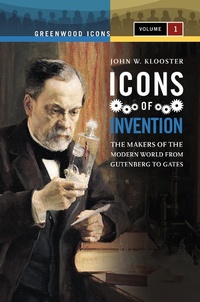
Icons of Invention
The Makers of the Modern World from Gutenberg to Gates [2 Volumes]
Published on 14. July 2009
728 pages
978-0-313-34744-3 (ISBN)
Description

These two volumes provide in-depth coverage of 24 of history's most important inventors and their inventions.
Who invented the sewing machine, the telephone, the internal combustion engine? Who pioneered vaccination? Who gave the world television, nylon, the nuclear reactor? The answers to some of these questions are straightforward, the answers to others much less so. All of them are explored in the fascinating Icons of Invention: The Makers of the Modern World from Gutenberg to Gates.
This in-depth resource tells the stories of 24 of the most influential and well-known inventions of the modern age-and of the individuals most responsible for their development. Presented in chronological order, the entries provide background on the lives and work of inventors such as Thomas Edison, Alexander Fleming, and Tim Berners-Lee. At the same time, the set profiles their competitors and details the sometimes-controversial, often-mistake-plagued routes almost all of them took to their most famous creations.
Who invented the sewing machine, the telephone, the internal combustion engine? Who pioneered vaccination? Who gave the world television, nylon, the nuclear reactor? The answers to some of these questions are straightforward, the answers to others much less so. All of them are explored in the fascinating Icons of Invention: The Makers of the Modern World from Gutenberg to Gates.
This in-depth resource tells the stories of 24 of the most influential and well-known inventions of the modern age-and of the individuals most responsible for their development. Presented in chronological order, the entries provide background on the lives and work of inventors such as Thomas Edison, Alexander Fleming, and Tim Berners-Lee. At the same time, the set profiles their competitors and details the sometimes-controversial, often-mistake-plagued routes almost all of them took to their most famous creations.
More details
Series
Language
English
Place of publication
New York
United States
Publishing group
Bloomsbury Publishing Plc
Target group
Interest Age: From 7 to 17 years
File size
51,48 MB
ISBN-13
978-0-313-34744-3 (9780313347443)
Copyright in bibliographic data and cover images is held by Nielsen Book Services Limited or by the publishers or by their respective licensors: all rights reserved.
Schweitzer Classification
Other editions
Additional editions
![Cover: Icons of Invention [2 volumes] - Greenwood Press](https://content.schweitzer-online.de/static/catalog_manager/live/media_files/representation/A1652850/528264_l_1.jpg)
John W. Klooster
Icons of Invention [2 volumes]
The Makers of the Modern World from Gutenberg to Gates
Book
07/2009
Greenwood Press
€230.27
Article exhausted; check different version
Person
John W. Klooster is a retired attorney-at-law who specialized in intellectual property law.
Content
- Cover
- Contents
- List of Photos
- Series Foreword
- Acknowledgments
- Introduction
- Volume 1
- Printing and Johannes Gutenberg
- The Steam Engine and James Watt
- Mass Transportation: Fitch, Fulton, Stevens, and Trevithick
- Food Preservation and Nicolas François Appert
- The Reaper and Cyrus McCormick
- Telegraphy: Morse and Marconi
- The Sewing Machine: Hunt, Howe, and Singer
- The Telephone and Alexander Graham Bell
- Internal Combustion Engine: Otto and Diesel
- Electric Power: Edison,Westinghouse, Tesla, and Stanley
- Vaccination and Louis Pasteur
- Volume 2
- Affordable Automobiles and Henry Ford
- The Airplane and the Wright Brothers
- Radio: Fessenden, de Forest, and Armstrong
- Penicillin and Alexander Fleming
- Television and Philo Farnsworth
- Jet Engines: Hans von Ohain and Frank Whittle
- Nylon and Wallace Carothers
- Nuclear Reactor and Enrico Fermi
- Transistors: John Bardeen, William Shockley, and Walter Brattain
- Integrated Circuits, Microprocessors, and Computers: Jack Kilby and Steve Wozniak
- Satellite Communications and John R. Pierce
- Software and Bill Gates
- The Internet and the World Wide Web: Kleinrock, Baran, Kahn, Cerf, and Berners-Lee
- Epilogue
- Bibliography
- Index
- A
- B
- C
- D
- E
- F
- G
- H
- I
- J
- K
- L
- M
- N
- O
- P
- R
- S
- T
- U
- V
- W
- X
- Y
- Z
