

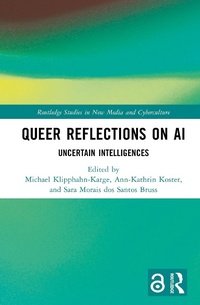
Queer Reflections on AI
Uncertain Intelligences
1st Edition
Published on 17. July 2023
204 pages
978-1-000-92358-2 (ISBN)
Description

This volume offers a socio-technical exploration of Artificial Intelligence (AI) and the way it reflects and reproduces certain normative representations of gender and sexuality, to ultimately guide more diverse and radical discussions of life with digital technologies.
Moving beyond the examination of empirical examples and technical solutions, the book approaches the relationship between queerness and AI from a theoretical perspective that posits queer theory as central to understanding AI differently. The chapters pose questions about the politics and ethics of machine embodiments and data imaginaries on the one hand, and about technical possibilities for a production of social identities characterised by shifting diversity and multiplicity on the other, as they are mediated by and through digital technologies.
Transgressing disciplinary boundaries to engage a diversity of conceptual tools, critical approaches, and theoretical traditions, this book will be an important resource for students and researchers of gender and sexuality, new media and digital cultures, cultural theory, art and visual culture, and AI.
The Open Access version of this book, available at http://www.taylorfrancis.com, has been made available under a Creative Commons Attribution (CC-BY) 4.0 license.
Moving beyond the examination of empirical examples and technical solutions, the book approaches the relationship between queerness and AI from a theoretical perspective that posits queer theory as central to understanding AI differently. The chapters pose questions about the politics and ethics of machine embodiments and data imaginaries on the one hand, and about technical possibilities for a production of social identities characterised by shifting diversity and multiplicity on the other, as they are mediated by and through digital technologies.
Transgressing disciplinary boundaries to engage a diversity of conceptual tools, critical approaches, and theoretical traditions, this book will be an important resource for students and researchers of gender and sexuality, new media and digital cultures, cultural theory, art and visual culture, and AI.
The Open Access version of this book, available at http://www.taylorfrancis.com, has been made available under a Creative Commons Attribution (CC-BY) 4.0 license.
More details
Series
Edition
1. Auflage
Language
English
Place of publication
London
United Kingdom
Publishing group
Taylor & Francis Ltd
Target group
College/higher education
Product notice
Reflowable
Illustrations
1 Tables, black and white; 9 Halftones, black and white; 9 Illustrations, black and white
File size
1,90 MB
ISBN-13
978-1-000-92358-2 (9781000923582)
Copyright in bibliographic data and cover images is held by Nielsen Book Services Limited or by the publishers or by their respective licensors: all rights reserved.
Schweitzer Classification
Other editions
Additional editions
Michael Klipphahn-Karge | Ann-Kathrin Koster | Sara Morais dos Santos Bruss
Queer Reflections on AI
Uncertain Intelligences
Book
11/2024
1st Edition
Routledge
€63.00
Shipment within 10-20 days
Michael Klipphahn-Karge | Ann-Kathrin Koster | Sara Morais dos Santos Bruss
Queer Reflections on AI
Uncertain Intelligences
Book
07/2023
1st Edition
Routledge
€215.77
Shipment within 10-20 days
Persons
Michael Klipphahn-Karge is an art historian at Technische Universitaet Dresden and Editor of the peer-reviewed online journal w/k Between Science and Art.
Ann-Kathrin Koster is a Research Associate at the Weizenbaum-Institute, Berlin.
Sara Morais dos Santos Bruss is a media theorist and curator at the Haus der Kulturen der Welt in Berlin.
Ann-Kathrin Koster is a Research Associate at the Weizenbaum-Institute, Berlin.
Sara Morais dos Santos Bruss is a media theorist and curator at the Haus der Kulturen der Welt in Berlin.
Content
Preface
Introduction: Queer(y)ing AI
Part I Genealogies
1. Queering intelligence: A theory of intelligence as performance and a critique of individual and artificial intelligence
2. Neural "freedoms": Population, choice, and machine learning
3. I spy with my little AI: How queer bodies are made dirty for digital technologies to claim cleanness
Part II Materialities
4. We're all cyborgs now? Cripping the smart cyborg
5. Uncanny bodies: Queer subjects, artificial surrogates, and ambiguous robotics
6. Patching & hoarding. Recodings of digital reproduction technologies
Part III Speculations
7. Wild Science/Fiction: Conscious AI as queer excess in VanderMeer's Annihilation.
8. Innovation and iteration: Queer machines and the mension between manifesto and manifestor
9. AI as medium and message: The (im)possibility of a queer response
Conclusion
10. Inconclusion: Absent presences
Introduction: Queer(y)ing AI
Part I Genealogies
1. Queering intelligence: A theory of intelligence as performance and a critique of individual and artificial intelligence
2. Neural "freedoms": Population, choice, and machine learning
3. I spy with my little AI: How queer bodies are made dirty for digital technologies to claim cleanness
Part II Materialities
4. We're all cyborgs now? Cripping the smart cyborg
5. Uncanny bodies: Queer subjects, artificial surrogates, and ambiguous robotics
6. Patching & hoarding. Recodings of digital reproduction technologies
Part III Speculations
7. Wild Science/Fiction: Conscious AI as queer excess in VanderMeer's Annihilation.
8. Innovation and iteration: Queer machines and the mension between manifesto and manifestor
9. AI as medium and message: The (im)possibility of a queer response
Conclusion
10. Inconclusion: Absent presences
