

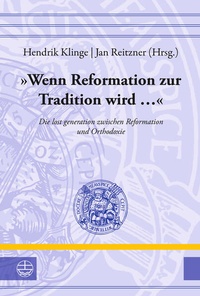
»Wenn Reformation zur Tradition wird ...«
Die lost generation zwischen Reformation und Orthodoxie
1st Edition
Published on 20. March 2026
308 pages
978-3-374-08016-8 (ISBN)
Description

Wann wird die Reformation selbst zur Tradition? Oder: Wie wird aus der Theologie Luthers »die« lutherische Theologie? Diese Fragen drängen sich in der Zeit zwischen den Jubiläumsjahren 2017 und 2030 mit aller Wucht auf. Die diesem Band zugrundeliegende Tagung anlässlich des 500. Geburtstags von Martin Chemnitz versucht die Pluralität und Dynamik jener Prozesse genauso zu betonen, wie aus systematischen Gründen das reformatorische Erbe in seiner Gänze zur Geltung zu bringen. In einer ersten Sektion steht die Person Martin Chemnitz im Mittelpunkt der verschiedenen Studien, sodann das Verhältnis von Reformation und Tradition bei seinen Zeitgenossen. Anschließend werden Lied und Predigt als exemplarische Praktiken dieser Zeit thematisiert. Den Abschluss bilden übergreifende theologiegeschichtliche Perspektiven. Es ist die mit dem Band verbundene Hoffnung, dass die »lost generation« nicht zur vergessenen Generation wird, sondern das Bewusstsein dafür geschärft wird, wie aus dem Aufbruch der Reformation selbst eine Tradition entstanden ist.
Mit Beiträgen von Beims, Klaus-Dieter, Graßmann, Tobias, Jammerthal, Tobias, Klinge, Hendrik, Michel, Stefan, Milde, Jonas, Pfuch, Tilman, Reitzner, Jan, Röser-Israel, Lars, Schmidt, Steffie, Voigt-Goy, Christopher und Christian Volkmar Witt.
[»When Reformation Becomes Tradition ...«. The Lost Generation between Reformation and Orthodoxy]
When does the Reformation itself become tradition? Or: How does Luther's theology become »Lutheran« theology? These questions arise with great urgency in the period between the anniversary years 2017 and 2030. The conference on which this volume is based, held on the occasion of the 500th birthday of Martin Chemnitz, attempts to emphasise the plurality and dynamism of those processes, as well as to highlight the Reformation heritage in its entirety for systematic reasons. First, Martin Chemnitz is analysed as an example; second, the relationship between the Reformation and tradition among his contemporaries is examined; third, hymns and sermons are studied as exemplary practices of the time; and finally, the book concludes with overarching perspectives on the history of theology. The hope associated with this volume is that the »lost generation« will not become a forgotten generation, but that awareness will be raised of how a tradition emerged from the dawn of the Reformation itself.
Mit Beiträgen von Beims, Klaus-Dieter, Graßmann, Tobias, Jammerthal, Tobias, Klinge, Hendrik, Michel, Stefan, Milde, Jonas, Pfuch, Tilman, Reitzner, Jan, Röser-Israel, Lars, Schmidt, Steffie, Voigt-Goy, Christopher und Christian Volkmar Witt.
[»When Reformation Becomes Tradition ...«. The Lost Generation between Reformation and Orthodoxy]
When does the Reformation itself become tradition? Or: How does Luther's theology become »Lutheran« theology? These questions arise with great urgency in the period between the anniversary years 2017 and 2030. The conference on which this volume is based, held on the occasion of the 500th birthday of Martin Chemnitz, attempts to emphasise the plurality and dynamism of those processes, as well as to highlight the Reformation heritage in its entirety for systematic reasons. First, Martin Chemnitz is analysed as an example; second, the relationship between the Reformation and tradition among his contemporaries is examined; third, hymns and sermons are studied as exemplary practices of the time; and finally, the book concludes with overarching perspectives on the history of theology. The hope associated with this volume is that the »lost generation« will not become a forgotten generation, but that awareness will be raised of how a tradition emerged from the dawn of the Reformation itself.
More details
Other editions
Additional editions
Hendrik Klinge | Jan Reitzner
»Wenn Reformation zur Tradition wird ...«
Die lost generation zwischen Reformation und Orthodoxie
Book
03/2026
1st Edition
Evangelische Verlagsanstalt
€78.00
Available immediately
