

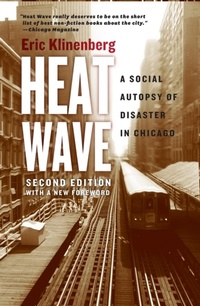
Heat Wave
A Social Autopsy of Disaster in Chicago
2nd Edition
Published on 22. December 2022
344 pages
978-0-226-27621-2 (ISBN)
Description

The "compelling" story behind the 1995 Chicago weather disaster that killed hundreds-and what it revealed about our broken society (
Boston Globe).
On July 13, 1995, Chicagoans awoke to a blistering day in which the temperature would reach 106 degrees. The heat index-how the temperature actually feels on the body-would hit 126. When the heat wave broke a week later, city streets had buckled; records for electrical use were shattered; and power grids had failed, leaving residents without electricity for up to two days. By July 20, over seven hundred people had perished-twenty times the number of those struck down by Hurricane Andrew in 1992.
Heat waves kill more Americans than all other natural disasters combined. Until now, no one could explain either the overwhelming number or the heartbreaking manner of the deaths resulting from the 1995 Chicago heat wave. Meteorologists and medical scientists have been unable to account for the scale of the trauma, and political officials have puzzled over the sources of the city's vulnerability. In Heat Wave, Eric Klinenberg takes us inside the anatomy of the metropolis to conduct what he calls a "social autopsy," examining the social, political, and institutional organs of the city that made this urban disaster so much worse than it ought to have been.
He investigates why some neighborhoods experienced greater mortality than others, how city government responded, and how journalists, scientists, and public officials reported and explained these events. Through years of fieldwork, interviews, and research, he uncovers the surprising and unsettling forms of social breakdown that contributed to this human catastrophe as hundreds died alone behind locked doors and sealed windows, out of contact with friends, family, community groups, and public agencies. As this incisive and gripping account demonstrates, the widening cracks in the social foundations of American cities made visible by the 1995 heat wave remain in play in America's cities today-and we ignore them at our peril.
Includes photos and a new preface on meeting the challenges of climate change in urban centers
" Heat Wave is not so much a book about weather, as it is about the calamitous consequences of forgetting our fellow citizens.... A provocative, fascinating book, one that applies to much more than weather disasters." - Chicago Sun-Times
"It's hard to put down Heat Wave without believing you've just read a tale of slow murder by public policy." - Salon
"A classic. I can't recommend it enough." -Chris Hayes
On July 13, 1995, Chicagoans awoke to a blistering day in which the temperature would reach 106 degrees. The heat index-how the temperature actually feels on the body-would hit 126. When the heat wave broke a week later, city streets had buckled; records for electrical use were shattered; and power grids had failed, leaving residents without electricity for up to two days. By July 20, over seven hundred people had perished-twenty times the number of those struck down by Hurricane Andrew in 1992.
Heat waves kill more Americans than all other natural disasters combined. Until now, no one could explain either the overwhelming number or the heartbreaking manner of the deaths resulting from the 1995 Chicago heat wave. Meteorologists and medical scientists have been unable to account for the scale of the trauma, and political officials have puzzled over the sources of the city's vulnerability. In Heat Wave, Eric Klinenberg takes us inside the anatomy of the metropolis to conduct what he calls a "social autopsy," examining the social, political, and institutional organs of the city that made this urban disaster so much worse than it ought to have been.
He investigates why some neighborhoods experienced greater mortality than others, how city government responded, and how journalists, scientists, and public officials reported and explained these events. Through years of fieldwork, interviews, and research, he uncovers the surprising and unsettling forms of social breakdown that contributed to this human catastrophe as hundreds died alone behind locked doors and sealed windows, out of contact with friends, family, community groups, and public agencies. As this incisive and gripping account demonstrates, the widening cracks in the social foundations of American cities made visible by the 1995 heat wave remain in play in America's cities today-and we ignore them at our peril.
Includes photos and a new preface on meeting the challenges of climate change in urban centers
" Heat Wave is not so much a book about weather, as it is about the calamitous consequences of forgetting our fellow citizens.... A provocative, fascinating book, one that applies to much more than weather disasters." - Chicago Sun-Times
"It's hard to put down Heat Wave without believing you've just read a tale of slow murder by public policy." - Salon
"A classic. I can't recommend it enough." -Chris Hayes
All prices
More details
Other editions
Additional editions
Book
05/2015
2nd Edition
University of Chicago Press
€22.50
Shipment within 10-20 days
Person
Eric Klinenberg is professor of sociology and director of the Institute for Public Knowledge at New York University. The recipient of an Individual Projects Fellowship from the Open Society Institute in 2000, he is the coeditor of
The Making and Unmaking of Whiteness and a regular contributor to
Le Monde Diplomatique.

