

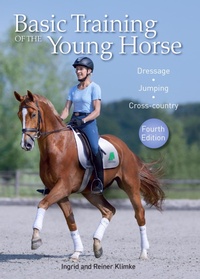
Basic Training of the Young Horse
Dressage, Jumping, Cross-country
Published on 21. October 2019
232 pages
978-1-908809-91-9 (ISBN)
Description

Over thirty years after the first publication of Reiner Klimke's classic work comes this new fourth edition, with completely new photos and updated by his daughter, Ingrid. Based on sound practical and theoretical advice, this instructional handbook gives advice on establishing a specific training plan for recreational riders as well as competition riders to enable them to train their young horses successfully. Every aspect of the education of a young horse is covered, including: basic education and handling from foalhood; lungeing and free-schooling; backing and training under saddle; developing impulsion from suppleness; assessing and improving basic gaits; cavalletti work; jumping training; cross-country training and, finally, preparing for the first competition.
More details
Language
English
Place of publication
London
United Kingdom
Publishing group
The Crowood Press Ltd
Illustrations
Diagrams; Halftones, color; Illustrations
File size
101,30 MB
ISBN-13
978-1-908809-91-9 (9781908809919)
Copyright in bibliographic data and cover images is held by Nielsen Book Services Limited or by the publishers or by their respective licensors: all rights reserved.
Schweitzer Classification
Other editions
Additional editions
Book
10/2019
J.A.Allen & Co Ltd
€47.27
Shipment within 3-4 weeks
Persons
The name Klimke is synonymous with good riding. The late Dr Reiner Klimke was the most successful dressage rider in the world. His daughter Ingrid Klimke follows in the footsteps of her famous father. An Olympic and European gold medallist, she is one of very few riders to have achieved major successes at the highest level in both dressage and three-day eventing. The name Klimke is synonymous with good riding. The late Dr Reiner Klimke was the most successful dressage rider in the world - not only was he an Olympic gold medallist, World Dressage Champion and European Dressage Chanpion, but also European Horse Trials Champion. All his victories and medals were won on horses he had trained himself.
Content
- Intro
- Title
- Contents
- Remembering Dr Reiner Klimke
- Basic Education - Of the Young Horse
- The aim of basic training
- The handling and education of young horses
- Education begins as a foal
- How old should a horse be to start ridden work?
- The transition from field to stable
- Observing the horse
- Getting the horse used to saddle and bridle
- Leading in hand
- Lungeing - And Free Schooling
- Groundwork
- The first stage of lungeing
- Lunge equipment
- Using the aids
- Lungeing before the initial mounting and riding
- We make progress
- Free-schooling in the indoor arena
- Training - Under Saddle
- First and second year
- Riding for the first time
- The development of basic training
- Planning a ridden session
- Suppling exercises in the first year
- Collecting exercises in the second year
- Practical experience
- Controlling the working environment
- Developing Impulsion - From Suppleness
- Learning the aids
- How the aids work
- Obedience to the forward-driving aids
- Establishing a contact (use of the poll)
- Obedience to the aids for lateral movement
- Riding on curved lines
- Riding on curved lines
- Full and half-halts
- Rein-back
- The Basic Gaits - Assessment and Improvement
- The basics
- Riding straight - the natural crookedness of the horse
- Improving the basic gaits
- Trot
- Canter
- Walk
- The effect of conformation on basic training
- The effect of temperament on basic training
- Cavalletti Work - With and Without the Rider
- Cavalletti work with the young horse
- How it began
- Theory
- Practical equipment
- On the lunge
- Cavalletti work under the rider on straight lines
- Different cavalletti layouts
- Cavalletti work under the rider on curved lines
- Jumping Training
- Jumping without a rider
- Free-jumping in the first year of training
- The goals
- Methods
- Tips for the best way of developing training
- Jumping with a rider
- Requirements
- The first jump on the long side
- Gymnastic jumping with cavalletti - gridwork
- Example 3
- Jumping single obstacles
- Jumping grids and combinations
- Jumping a simple course
- Problems and tips for solving them
- Cross-Country Training
- Getting used to the great outdoors
- Rules
- Equipment
- The first hack
- Suppling exercises when you hack
- Riding up and down hills
- The first natural obstacle
- Jumping with a lead horse
- Getting used to water
- Jumping steps
- Jumping down two steps
- Jumping on and off banks
- Jumping in and out of water
- Stairs and drop jumps
- Jumping in and out of water
- Ditches
- Other obstacles
- Hedges
- Narrow fences
- Corners
- Combinations
- Narrow brush fences
- Preparing - For the First Competition
- Tips for the first competition
- Preparing for all eventualities
- Keeping calm before the start
- Coping with competition atmosphere
- Training plan from basic training to the first competition
- First month (September)
- Second month (October)
- Third month (November)
- Fourth month (December)
- Fifth month (January)
- Sixth month (February)
- Seventh month (March)
- Eighth month (April)
- Ninth month (May)
- Tenth month (June) to end of competition season
- Good luck!
- Appendix - Saving the Best Till Last
- The horses
- Index
- Copyright
