

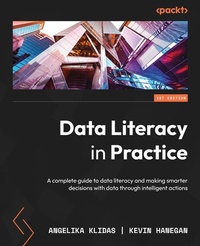
Data Literacy in Practice
Description

All prices
More details
Other editions
Additional editions
Persons
Angelika is a highly skilled denizen of the Data world. As operations manager for several organizations, strategic advisor and Data Literacy evangelist, she is able to analyze BI & Analytics environments expertly, map the ambitions of organizations and deliver cutting-edge advice to help organizations mature their data use. Inspiring organizations and people to grow in Business Intelligence & Analytics maturity is her passion. In addition to teaching at the University of Applied Sciences in Amsterdam, where she spreads her knowledge and passion to her Data & Analytics studentsHanegan Kevin :
Kevin has helped individuals and organizations maximize the value they receive from their data for over 20 years. He is a is a frequent speaker and thought leader on topics including data literacy, data-informed decision making, decision intelligence, and essential skills for today's workforce. He is currently the Chief Learning Officer at Qlik, a data and analytics company, as well as the chair of the advisory board for The Data Literacy Project. Kevin is also an accomplished author of multiple books, including Turning Data into Wisdom, which helps individuals learn strategies to make data-informed decisions. He applies his passion both in the corporate setting and also in academia where he is an adjust professor at Boise State University.
Content
- Unfolding Your Data Journey
- Understanding the Four-Pillar Model
- Implementing Organizational Data Literacy
- Managing Your Data Environment
- Aligning with Organizational Goals
- Designing Dashboards and Reports
- Questioning the Data
- Handling Data Responsibly
- Turning Insights into Decisions
- Defining a Data Literacy Competency Framework
- Assessing Your Data Literacy Maturity
- Managing Data and Analytics Projects
- Appendix A - Templates
- Appendix B - References
Preface
Data is more than a commodity in our digital world. It is the ebb and flow of our modern existence. Individuals, teams, and enterprises that work confidently with data unlock a new realm of possibilities. The resultant agility, growth, and inevitable success have one origin: data literacy.
Data Literacy in Practice is a comprehensive guide that will build your understanding of data literacy basics, and accelerate your journey to independently uncovering insights with best practices, practical models, and real-world examples.
Discover the four-pillar model that underpins all data and analytics. Explore concepts such as measuring data quality, setting up a pragmatic data management environment, choosing the right graphs for your readers, and questioning your insights.
This guide is written by two data literacy pioneers, each with a thorough footprint within the data and analytics commercial world, including their lectures at top universities in the US and the Netherlands.
By the end of the book, you'll be equipped with a combination of skills and mindsets, along with tools and frameworks, that allow you to find insights and meaning within your data to enable effective and efficient data-informed decision-making.
Who this book is for
This book is for data analysts, data professionals, and data teams starting or wanting to accelerate their data literacy journey. Discover the skills and mindset you need to work independently with data, along with the tools and frameworks to build a solid knowledge base, and start making your data work for you today.
What this book covers
Chapter 1, The Beginning - The Flow of Data, covers the process of going from data to insights and action and shows how it is a multi-step process. Understanding this process is critical for anyone who is leveraging data to make decisions. This chapter will introduce the flow of data through this process, as well as common pitfalls that can get in the way at each step.
Chapter 2, Unfolding Your Data Journey, shows how, to be able to properly turn data into actionable insights, individuals need to be able to leverage multiple steps in analytics maturity: descriptive, diagnostic, predictive, prescriptive, and semantic. This chapter will introduce those steps with practical examples of what insights you can get from each step in the process.
Chapter 3, Understanding the Four-Pillar Model, looks at the four elementary pillars of data and analytics that we need to address in our businesses. Everybody knows and understands what data or a dashboard is. From that point of view, we see more demand and acceptance for data and analytics projects and the need for data literacy knowledge.
Chapter 4, Implementing Organizational Data Literacy, focuses on best practices related to organizational strategy and culture to support data literacy and data-informed decision-making. For individuals and organizations to be able to elicit insights and value from their data, there needs to be widespread adoption of data-informed decision-making. Despite many organizations having tools, technologies, and technical abilities, they are often unable to become data-informed due to their lack of a data literacy culture.
Chapter 5, Managing Your Data Environment, looks at how low-code/no-code solutions are maturing in an interesting way, giving all the benefits to their users in building rapid data lakes, data warehouses, and data pipelines. If we compare this technology against the more traditional solutions, we notice that we are able to get a better "race pace" in developing a data and analytics fundament. Due to the enormous growth (1.7 Mb of data is created every second for every person on earth) and complexity of data and data environments, a good and solid data strategy and taking care of a shared data vision was never as important as it is now. But in the last 2 years, there has been a shift occurring, and the necessity of a managed data environment has become more important.
Chapter 6, Aligning with Organizational Goals, explains how Key Performance Indicators (KPIs) are extremely vital in helping organizations understand how well they are performing in relation to their strategic goals and objectives. However, understanding what a KPI truly is versus what is just a measurement or a metric is important, along with understanding the right types of KPIs to track, including leading and lagging indicators.
Chapter 7, Designing Dashboards and Reports, talks about how visualizations provide a vital function in helping to describe situations. Visualizations can be used for both finding insights and also for communicating those insights to others. Choosing the right visualization depends on both the data you are using and what you are trying to show. This chapter will focus on choosing the right chart type, as well as designing charts to make it easier for people to interpret relevant parts.
Chapter 8, Questioning the Data, covers learning to ask questions, analyze outliers (supporting story by Dr. Snow - Death in the Pit), exclude bias, and so on so that you will be able to ask the right questions and develop your curiosity. You will understand the difference between correlation and causation. By addressing those topics, you will be able to understand what signals and noise are, and how to analyze the outliers by addressing hypothetical questions. You will be able to recognize the good, the bad, and the ugly insights.
Chapter 9, Handling Data Responsibly, explains how ethics is a science in which people try to qualify certain actions as right or wrong. However, there are no unequivocal answers to ethical questions because they are often very personal. Today, data and analytics are everywhere, touching every waking moment of our lives. Data and analytics, therefore, play an enormous role in our daily lives - for example, Amazon knows what we buy and suggests other articles that we may be interested in; applications show us how we will look when we are older, and Netflix and Spotify know what we watch or listen to and give us suggestions of what else to watch or listen to.
Chapter 10, Turning Insights into Decisions, explores how many individuals and organizations come up with insights from their data. However, the process of turning insights into decisions and acting on them is much more difficult. This chapter focuses on what is required to support this step in the process, including introducing a six-step framework, which is both systemic and systematic. The chapter also includes how you can manage the change related to your decisions and how you can communicate effectively to all stakeholders via storytelling with data.
Chapter 11, Defining a Data Literacy Competency Framework, explains how the first step to increasing your own data literacy via education is to learn what exactly are the competencies that support data literacy. This chapter describes a data literacy competency framework, which includes the right hard skills, soft skills, and mindsets for data literacy. It also discusses how competencies have various levels, and you can progress up the levels as you become more experienced with data literacy. This chapter also focuses on best practices for getting started learning these competencies.
Chapter 12, Assessing Your Data Literacy Maturity, introduces how you can assess your own data literacy skills and then explains how to interpret the results of the assessment to personalize your educational journey. Before you begin your educational journey for data literacy, you should start by assessing your current level, and then using that assessment to understand what competencies to focus on next.
Chapter 13, Managing Data and Analytics Projects, explains the ways you can approach a data and analytics project and how you can manage it as a project leader and keep track of the business case and the value that it can bring. It all starts with the development of a data and analytics business case, in which you define the project scope, goals, and risks but also the beneficial value that it can bring to your organization. Data and analytics projects are often across organizations, departments, and processes of business units. They mostly contain a mix of strategic goals or have high political content and hidden stakeholders and have specific data and analytics risks that you should take care of.
Chapter 14, Appendix A - Templates, provides the materials to help you get started on your data literacy journey. All materials are also available on www.kevinhanegan.com.
Chapter 15, Appendix B - References, provides a summary of the references, books, and articles that we've read over the years. All of them inspired us and helped us to teach and...
