

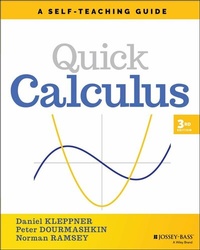
Quick Calculus
Description

In Quick Calculus: A Self-Teaching Guide, 3rd Edition, a team of expert MIT educators delivers a hands-on and practical handbook to essential calculus concepts and terms. The author explores calculus techniques and applications, showing readers how to immediately implement the concepts discussed within to help solve real-world problems.
In the book, readers will find:
* An accessible introduction to the basics of differential and integral calculus
* An interactive self-teaching guide that offers frequent questions and practice problems with solutions.
* A format that enables them to monitor their progress and gauge their knowledge
This latest edition provides new sections, rewritten introductions, and worked examples that demonstrate how to apply calculus concepts to problems in physics, health sciences, engineering, statistics, and other core sciences.
Quick Calculus: A Self-Teaching Guide, 3rd Edition is an invaluable resource for students and lifelong learners hoping to strengthen their foundations in calculus.
More details
Other editions
Additional editions
Persons
American Association of Physics Teachers.
peter DOURMASHKIN is Senior Lecturer at MIT.
The late Norman RAMSEY was the Higgins Professor of Physics at Harvard University and the recipient of the 1989 Nobel Prize in Physics.
Content
Chapter One Starting Out 1
1.1 A Few Preliminaries 1
1.2 Functions 2
1.3 Graphs 5
1.4 Linear and Quadratic Functions 11
1.5 Angles and Their Measurements 19
1.6 Trigonometry 28
1.7 Exponentials and Logarithms 42
Summary of Chapter 1 51
Chapter Two Differential Calculus 57
2.1 The Limit of a Function 57
2.2 Velocity 71
2.3 Derivatives 83
2.4 Graphs of Functions and Their Derivatives 87
2.5 Differentiation 97
2.6 Some Rules for Differentiation 103
2.7 Differentiating Trigonometric Functions 114
2.8 Differentiating Logarithms and Exponentials 121
2.9 Higher-Order Derivatives 130
2.10 Maxima and Minima 134
2.11 Differentials 143
2.12 A Short Review and Some Problems 147
Conclusion to Chapter 2 164
Summary of Chapter 2 165
Chapter Three Integral Calculus 169
3.1 Antiderivative, Integration, and the Indefinite Integral 170
3.2 Some Techniques of Integration 174
3.3 Area Under a Curve and the Definite Integral 182
3.4 Some Applications of Integration 201
3.5 Multiple Integrals 211
Conclusion to Chapter 3 219
Summary of Chapter 3 219
Chapter Four Advanced Topics: Taylor Series, Numerical Integration, and Differential Equations 223
4.1 Taylor Series 223
4.2 Numerical Integration 232
4.3 Differential Equations 235
4.4 Additional Problems for Chapter 4 244
Summary of Chapter 4 248
Conclusion (frame 449) 250
Appendix A Derivations 251
A.1 Trigonometric Functions of Sums of Angles 251
A.2 Some Theorems on Limits 252
A.3 Exponential Function 254
A.4 Proof That dy/dx = 1/dxdy 255
A.5 Differentiating X¯n 256
A.6 Differentiating Trigonometric Functions 258
A.7 Differentiating the Product of Two Functions 258
A.8 Chain Rule for Differentiating 259
A.9 Differentiating Ln X 259
A.10 Differentials When Both Variables Depend on a Third Variable 260
A.11 Proof That if Two Functions Have the Same Derivative They Differ Only by a Constant 261
A.12 Limits Involving Trigonometric Functions 261
Appendix B Additional Topics in Differential Calculus 263
B.1 Implicit Differentiation 263
B.2 Differentiating the Inverse Trigonometric Functions 264
B.3 Partial Derivatives 267
B.4 Radial Acceleration in Circular Motion 269
B.5 Resources for Further Study 270
Frame Problems Answers 273
Answers to Selected Problems from the Text 273
Review Problems 277
Chapter 1 277
Chapter 2 278
Chapter 3 282
Tables 287
Table 1: Derivatives 287
Table 2: Integrals 288
Indexes 291
Index 291
Index of Symbols 295
CHAPTER ONE
Starting Out
In spite of its formidable name, calculus is not a particularly difficult subject. The fundamental concepts of calculus are straightforward. Your appreciation of their value will grow as you develop the skills to use them.
After working through Quick Calculus you will be able to handle many problems and be prepared to acquire more elaborate techniques if you need them. The important word here is working, though we hope that you find that the work is enjoyable.
Quick Calculus comprises four chapters that consist of sections and subsections. We refer to the subsections as frames. Each chapter concludes with a summary. Following these chapters there are two appendixes on supplementary material and a collection of review problems with solutions.
The frames are numbered sequentially throughout the text. Working Quick Calculus involves studying the frames and doing the problems. You can check your answers immediately: they will be located at the bottom of one of the following pages or, if the solutions are longer, in a separate frame. Also a summary of frame problems answers start on page 273.
Your path through Quick Calculus will depend on your answers. The reward for a correct answer is to go on to new material. If you have difficulty, the solution will usually be explained and you may be directed to another problem.
Go on to frame 1.
1.1 A Few Preliminaries
1
Chapter 1 will review topics that are foundational for the discussions to come. These are:
- the definition of a mathematical function;
- graphs of functions;
- the properties of the most widely used functions: linear and quadratic functions, trigonometric functions, exponentials, and logarithms.
A note about calculators: a few problems in Quick Calculus need a simple calculator. The calculator in a typical smartphone is more than adequate. If you do not happen to have access to a calculator, simply skip the problem: you can master the text without it.
Go on to frame 2.
2
Here is what's ahead: this first chapter is a review, which will be useful later on; Chapter 2 is on differential calculus; and Chapter 3 introduces integral calculus. Chapter 4 presents some more advanced topics. At the end of each chapter there is a summary to help you review the material in that chapter. There are two appendixes-one gives proofs of a number of relations used in the book, and the other describes some supplementary topics. In addition, there is a list of extra problems with answers in the Review Problems on page 277, and a section of tables you may find useful.
First we review the definition of a function. If you are already familiar with this and with the idea of dependent and independent variables, skip to frame 14. (In fact, in this chapter there is ample opportunity for skipping if you already know the material. On the other hand, some of the material may be new to you, and a little time spent on review can be a good thing.)
A word of caution about the next few frames. Because we start with some definitions, the first section must be somewhat more formal than most other parts of the book.
Go on to frame 3.
1.2 Functions
3
The definition of a function makes use of the idea of a set. If you know what a set is, go to 4. If not, read on.
A set is a collection of objects-not necessarily material objects-described in such a way that we have no doubt as to whether a particular object does or does not belong to it. A set may be described by listing its elements. Example: 23, 7, 5, 10 is a set of numbers. Another example: Reykjavik, Ottawa, and Rome is a set of capitals.
We can also describe a set by a rule, such as all the even positive integers (this set contains an infinite number of objects).
A particularly useful set is the set of all real numbers. This includes all numbers such as 5, -4, 0, ½, , -3.482, . The set of real numbers does not include quantities involving the square root of negative numbers. Such quantities are called complex numbers; in this book we will be concerned only with real numbers.
The mathematical use of the word "set" is similar to the use of the same word in ordinary conversation, as "a set of chess pieces."
Go to 4.
4
In the blank below, list the elements of the set that consists of all the odd integers between -10 and +10.
Elements: ____________________
Go to 5 for the correct answer.
5
Here are the elements of the set of all odd integers between -10 and +10:
Go to 6.
6
Now we are ready to talk about functions. Here is the definition.
A function is a rule that assigns to each element in a set A one and only one element in a set B.
The rule can be specified by a mathematical formula such as , or by tables of associated numbers, for instance, the temperature at each hour of the day. If is one of the elements in set A, then the element in set B that the function associates with is denoted by the symbol . This symbol is the value of evaluated at the element . It is usually read as " of ."
The set is called the domain of the function. The set of all possible values of as varies over the domain is called the range of the function. The range of need not be all of .
In general, A and B need not be restricted to sets of real numbers. However, as mentioned in frame 3, in this book we will be concerned only with real numbers.
Go to 7.
7
For example, for the function , with the domain being all real numbers, the range is __________________________________.
Go to 8.
8
Otherwise, skip to 10.
The range is all nonnegative real numbers. For an explanation, go to 9.
9
Recall that the product of two negative numbers is positive. Thus for any real value of positive or negative, is positive. When is 0, is also 0. Therefore, the range of is all nonnegative numbers.
Go to 10.
10
Our chief interest will be in rules for evaluating functions defined by formulas. If the domain is not specified, it will be understood that the domain is the set of all real numbers for which the formula produces a real number, and for which it makes sense. For instance,
- Range = ___________________.
- Range = ___________________.
For the answers go to 11.
11
The function is real for nonnegative, so the answer to (a) is all nonnegative real numbers. The function is defined for all values of except zero, so the range in (b) is all real numbers except zero.
Go to 12.
12
When a function is defined by a formula such as , is called the independent variable and is called the dependent variable. One advantage of this notation is that the value of the dependent variable, say for , can be indicated by .
Often, a single letter is used to represent the dependent variable, as in
Here is the independent variable, and is the dependent variable.
Go to 13.
13
In mathematics the symbol frequently represents an independent variable, often represents the function, and usually denotes the dependent variable. However, any other symbols may be used for the function, the independent variable, and the dependent variable. For example, we might have , which is read as " equals of ." Here is the independent variable, is the dependent variable, and is the function.
Now that we know what a function means, let's describe a function with a graph instead of a formula.
Go to 14.
1.3 Graphs
14
Otherwise, go to 15.
If you know how to plot graphs of functions, skip to frame 19.
15
We start by constructing coordinate axes. In the most common cases we construct a pair of mutually perpendicular intersecting lines, one horizontal, the other vertical. The horizontal line is often called the -axis and the vertical line the -axis. The point of intersection is the origin, and the axes together are called the coordinate axes.
Next we select a convenient unit of length and, starting from the origin, mark off a number scale on the -axis, positive to the right and negative to the left. In the same way, we mark off a scale along the -axis with positive numbers...
